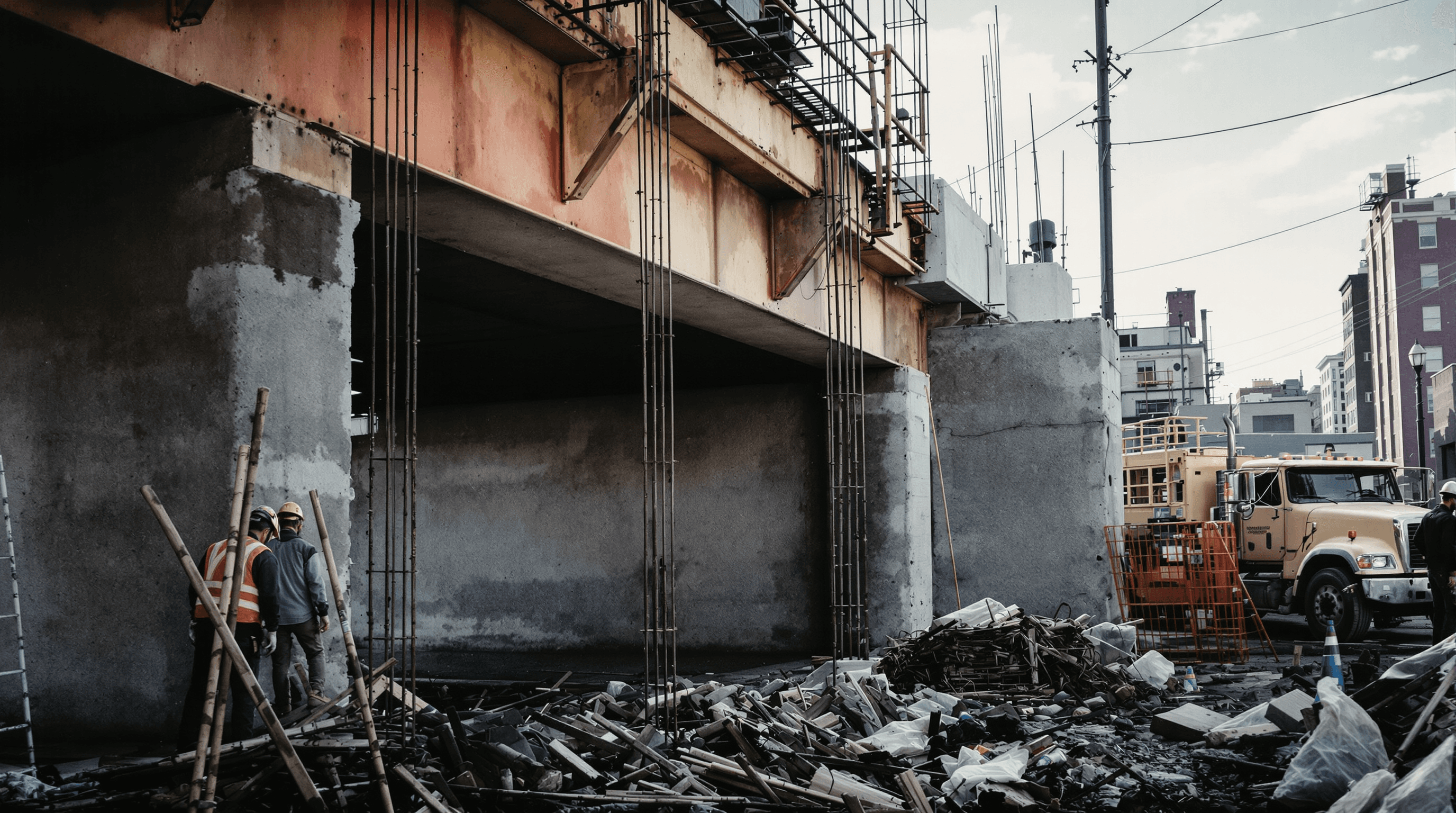
Miguel heard the scaffold buckle beneath his boots on a February morning at the Manhattan residential tower going up on East 72nd Street. The sound — a sharp crack followed by groaning metal — came three seconds before he fell 15 feet onto the concrete below.
*This account is a fictionalized composite based on patterns from actual New York construction accident cases. The worker's name has been changed to protect privacy.*
Miguel had arrived at 6:30 AM, same as every day for the past eight months. The 38-year-old father of two from Queens had been installing exterior brick on the building's facade. February wind off the East River made the scaffold sway more than usual, but the crew foreman said they were behind schedule. Keep working.
The planks felt loose when Miguel stepped onto the scaffold that morning. He'd mentioned it to his supervisor the week before — the wooden boards shifted when workers moved across them. "We'll look at it," was all he got back. They never did.
The accident happened at 9:15 AM. Miguel was carrying a 40-pound load of bricks when the scaffold platform gave way. The planks weren't properly secured to the scaffold frame — a violation of both OSHA regulations and New York Industrial Code Rule 23. He fell backward, landing on his spine.
Emergency surgery at NewYork-Presbyterian. Three months of physical therapy. Medical bills over $280,000. Miguel couldn't work for seven months. His family burned through their savings by April.
The general contractor's insurance company called within a week. They offered $85,000 to settle. Miguel almost signed. He needed money. But his wife insisted he talk to a lawyer first.
The case took 18 months. The defense tried to blame Miguel for overloading the scaffold, then claimed he was intoxicated (he wasn't). They argued the scaffold met minimum safety standards (it didn't). Discovery revealed the GC had been cited by OSHA two months earlier for scaffold violations at another job site.
Final settlement: $1.2 million. Miguel's attorney collected one-third, leaving him with $800,000 after expenses. Not enough to replace a lifetime of lost earnings, but enough for his kids' college funds.
The case turned on New York Labor Law 240 — the Scaffold Law. Under this statute, property owners and general contractors are absolutely liable when workers are injured in falls from height, regardless of who was at fault. Miguel didn't need to prove negligence. The scaffold failed. He was injured. The law applied.
Construction Worker Rights in New York: What Every Worker Must Know
Construction worker rights in New York are among the strongest in the nation. But most workers don't know what protections they have until after they're injured. New York's Labor Law 240 and 241 provide legal protections that exist nowhere else in the United States — laws that hold property owners and contractors absolutely liable for certain types of construction accidents.
The state's construction safety laws date back to 1885, when New York became the first state to recognize that construction work requires special legal protections. These laws exist because construction remains one of the most dangerous industries in America. OSHA reports that one in five workplace deaths occurs in construction, with falls accounting for nearly 40% of construction fatalities.
New York Labor Law 240, known as the Scaffold Law, eliminates the need to prove fault in height-related accidents. If you're injured falling from a scaffold, ladder, or other elevation, the property owner and general contractor are liable — even if the accident was partially your fault. Under 29 CFR 1926.501, OSHA requires fall protection when workers are exposed to falls of six feet or more, but New York's protections go much further.
Labor Law 241(6) requires construction sites to comply with specific safety regulations found in the New York Industrial Code. When these detailed safety rules are violated and cause injury, workers can sue beyond their workers' compensation benefits.
PPE is the last line of defense, not the first. When an employer's entire safety plan is 'wear a hardhat and safety equipment,' they've got it backwards. The hierarchy of controls says eliminate the hazard first, engineer it out second, administratively control it third, and only then rely on PPE. A hardhat doesn't fix a missing guardrail.
But legal protections only work when workers know their rights before accidents happen. Most construction workers learn about Labor Law 240 from their hospital bed, not their job site. That needs to change.
Your Rights Before an Accident: Safety and Prevention
Construction workers have specific rights to safe working conditions that most never exercise. You don't have to wait for an accident to demand proper safety equipment and training. Federal and state laws create enforceable rights that protect workers who speak up about hazardous conditions.
The Occupational Safety and Health Act gives workers the right to request OSHA inspections when they believe workplace conditions violate federal safety standards. Under 29 CFR 1926.95, hard hats are required on construction sites. Fall protection equipment must meet specific standards under 29 CFR 1926.502. These aren't suggestions — they're legal requirements your employer must follow.
New York's Industrial Code Rule 23 goes beyond federal OSHA standards in many areas. The state requires specific safety measures for concrete work, excavation, and steel erection that are stricter than federal minimums. When contractors cut corners on safety equipment or training, they're violating state law.
Workers who report safety violations or refuse dangerous work are protected from retaliation under both federal and state law. Your employer cannot fire, demote, or reduce your pay for exercising safety rights. But you need to know how these protections work before you need them.
Right to Refuse Unsafe Work
Section 11(c) of the Occupational Safety and Health Act protects workers who refuse to perform tasks that pose immediate danger of death or serious injury. This isn't a general right to refuse any work you consider dangerous — the threat must be immediate. And the employer must refuse to correct it.
In construction, this right most commonly applies to working on unstable scaffolds, entering unprotected trenches, or using defective fall protection equipment. The key is documenting your safety concerns. Give your employer the opportunity to fix the problem before refusing work.
New York Labor Law Section 27-a provides additional retaliation protection for workers who file safety complaints or cooperate with safety investigations. Employers who violate these protections face civil penalties and must reinstate workers with back pay.
Safety Training and Equipment Rights
Construction workers have the right to safety training before starting work involving fall hazards, excavation, or electrical systems. OSHA's construction standards under 29 CFR 1926 require specific training for different types of work, not just general safety orientation.
For [fall protection violations](/blog/fall-protection-violations-construction), employers must provide both training and proper equipment. Personal fall arrest systems must be inspected before each use and replaced when damaged. Harnesses, lanyards, and anchor points must meet specific strength requirements under 29 CFR 1926.502.
Tool and equipment safety isn't optional. Power tools must be properly grounded or double-insulated. Electrical equipment requires ground-fault circuit interrupters (GFCIs) on construction sites. Guards on saws and grinders cannot be removed or disabled, even temporarily.
Height-Related Accident Rights Under Labor Law 240
[New York Labor Law 240](/blog/new-york-labor-law-240-scaffold-law) provides the strongest protection for construction workers injured in falls anywhere in the United States. This law makes property owners and general contractors absolutely liable for injuries from falls during construction, renovation, or demolition work.
The Scaffold Law applies to more than just scaffold accidents. Workers injured falling from ladders, roofs, building structures, or any elevated surface are covered. The law also protects workers struck by falling objects during construction work. You don't need to prove the property owner or contractor was negligent — only that you were injured in a covered activity.
Recent Court of Appeals decisions have expanded Labor Law 240 coverage. In 2023, the court ruled that workers injured on ladders that tip sideways are covered, not just those who fall straight down. Workers injured when scaffold planks collapse are protected even if they don't fall to the ground.
The law eliminates comparative negligence as a defense. Even if you weren't wearing a hard hat, ignored safety procedures, or were partially responsible for your accident, the property owner and general contractor remain fully liable. Insurance companies cannot reduce your damages based on your own conduct.
> The biggest factor in construction accident settlements isn't the type of accident — it's the severity of the injury and the clarity of liability. A scaffold fall with a sprained ankle might settle for $150,000. The same fall with a spinal cord injury could be $5 million or more. Liability clarity through Labor Law 240 drives numbers up because the defense can't argue comparative negligence. > — NY Construction Advocate Legal Team, Settlement factor analysis across case types
Labor Law 240 cases routinely result in seven-figure settlements when injuries are severe. Spinal cord injuries from scaffold collapses settle for $2-8 million. Traumatic brain injuries from falls typically settle for $1-4 million. Even "minor" fractures that require surgery often settle for $300,000-800,000.
*Settlement amounts vary based on injury severity, jurisdiction, and case facts. Figures reflect reported NY construction verdicts. Source: NY State court records. Your case may differ significantly.*
General Safety Violation Rights Under Labor Law 241(6)
Labor Law 241(6) requires construction sites to comply with specific safety regulations in New York's Industrial Code. Unlike Labor Law 240, you must prove a specific safety rule was violated and that violation caused your injury. But when you can prove both elements, you can sue beyond workers' compensation.
Industrial Code Rule 23 contains hundreds of detailed safety requirements for construction work. Rule 23-1.7 requires proper guardrails on elevated surfaces. Rule 23-5.1 sets standards for scaffold construction and inspection. Rule 23-8.2 governs excavation safety and trenching.
These regulations are "concrete and specific" — not general safety requirements. A violation of Rule 23-1.7(b) requiring 42-inch high guardrails with intermediate rails gives you a valid 241(6) claim. A general complaint about "inadequate safety measures" does not.
Common Industrial Code violations that support 241(6) claims include improperly secured scaffold planks, missing trench shoring, inadequate electrical grounding, and defective ladder placement. Each violation must be proven through expert testimony. And you need documentation of the specific rule that was broken.
Courts have consistently ruled that 241(6) violations must be the proximate cause of injury — not just present at the accident site. If you're injured when a scaffold collapses due to missing guardrails, but the guardrail violation didn't cause the collapse, you don't have a valid 241(6) claim.
Beyond Workers' Compensation: When You Can Sue
Workers' compensation provides medical coverage and partial wage replacement for all work injuries. But it doesn't cover pain and suffering or full lost earnings. New York construction workers can often sue property owners, general contractors, and equipment manufacturers beyond their workers' comp benefits.
[Third-party liability claims](/blog/third-party-liability-construction-accidents) allow you to recover full damages when someone other than your direct employer caused your injury. If you work for a subcontractor but are injured due to unsafe conditions created by the general contractor, you can sue the GC while collecting workers' comp from your employer.
Property owners who hire contractors remain liable under Labor Law 240 and 241(6) even when they don't directly control the work. Courts have rejected attempts by property owners to avoid liability by claiming they delegated all safety responsibilities to contractors.
Equipment manufacturers can be sued when defective tools, machinery, or safety equipment cause injury. Scaffold manufacturers face liability when their products collapse due to design defects. Tool manufacturers are liable when safety guards fail or electrical systems cause injury due to manufacturing defects.
> The fight in most construction accident cases isn't about whether someone was hurt — it's about who pays. The GC blames the sub. The sub blames the owner. The owner blames the architect. Meanwhile, the worker's bills pile up. That's why these cases need aggressive early investigation: depositions, OSHA records, DOB filings, subcontract chains. > — NY Construction Advocate Legal Team, Multi-party liability dynamics in construction accident cases
You can pursue workers' compensation and third-party lawsuits simultaneously. Workers' comp provides immediate medical coverage and wage benefits while your lawsuit proceeds. If you recover damages in a lawsuit, the workers' comp insurer has a right to reimbursement, but you keep the remainder.
Wage and Hour Rights for Construction Workers
Construction workers have specific wage and hour protections that go beyond standard employment law. New York's prevailing wage requirements, overtime rules, and anti-retaliation protections create enforceable rights that many workers don't know exist.
The Fair Labor Standards Act requires overtime pay at time-and-a-half for hours over 40 per week. But construction industry exemptions can be complex. Day-rate workers often believe they're not entitled to overtime, but courts look at whether the day rate was intended to cover straight time or include overtime premium.
New York Labor Law Article 6-A requires wage statements showing hours worked, rate of pay, and deductions. Construction workers who don't receive proper wage statements can recover damages even without proving wage theft. Under 29 CFR 1926.95, contractors must maintain records of worker hours and wages for federal projects.
Prevailing Wage Protections
New York Labor Law Article 8 requires contractors on public works projects to pay prevailing wages — typically union scale wages even on non-union jobs. This covers construction, renovation, and maintenance work on government buildings, schools, and publicly funded projects.
[Prevailing wage violations](/blog/prevailing-wage-violations-new-york) can result in significant back pay awards. Workers can recover the difference between what they were paid and the prevailing wage rate, plus liquidated damages equal to 25% of unpaid wages. The New York Department of Labor enforces these requirements through audits and complaint investigations.
Public works projects include any construction funded in whole or part by government money, including projects with government grants or tax incentives. Private developers who receive public subsidies may be subject to prevailing wage requirements.
Overtime and Misclassification Issues
Construction companies often misclassify employees as independent contractors to avoid paying overtime, workers' compensation, and employment taxes. New York uses a strict six-factor test to determine whether someone's an employee or contractor. It focuses on the level of control and independence.
True independent contractors set their own hours, use their own tools, work for multiple companies, and have the right to refuse specific assignments. Most construction workers who are labeled "contractors" are actually employees entitled to overtime pay and other protections.
Day-rate pay doesn't eliminate overtime rights. If your day rate doesn't include an overtime premium for long hours, you're entitled to additional pay when you work more than 40 hours per week.
Immigration Status and Your Rights
Immigration status has no bearing on your rights under New York's construction safety laws. Labor Law 240 and 241(6) protect all workers injured on construction sites, regardless of citizenship or work authorization. Workers' compensation covers undocumented workers in New York.
Federal courts have consistently ruled that immigration status can't be used to defeat personal injury claims. Employers cannot threaten to report workers to immigration authorities for filing safety complaints or injury claims. Such threats violate federal retaliation laws under Section 11(c) of the OSH Act.
Undocumented workers can file anonymous safety complaints with OSHA without revealing their identity. The agency is prohibited from sharing worker information with immigration authorities except in limited circumstances involving national security.
Union vs. Non-Union Worker Protections
Union construction workers have additional safety protections through collective bargaining agreements. But New York's Labor Law 240 and 241(6) apply equally to all workers. Union contracts often provide stronger safety training requirements, equipment standards, and grievance procedures for safety disputes.
Union safety representatives have the right to inspect job sites and file grievances over unsafe conditions. These representatives cannot be fired or disciplined for safety advocacy activities. Non-union workers can request OSHA inspections but don't have the same job site access rights.
Collective bargaining agreements may provide additional wage and benefit protections beyond state minimums, including higher overtime rates, employer-paid health insurance, and pension contributions. But these benefits don't replace your rights under state and federal safety laws.
Non-union workers retain the right to organize and form unions under the National Labor Relations Act. Employers cannot threaten, discipline, or fire workers for union organizing activities, even during active safety disputes.
What to Do Immediately After a Construction Accident
Your actions in the first hours after a construction accident can significantly impact both your medical recovery and legal rights. New York law provides specific protections for injured workers, but you must follow certain procedures to preserve your claims.
Seek immediate medical attention even if your injuries seem minor. Adrenaline can mask serious injuries, and delayed treatment creates opportunities for insurance companies to argue your injuries weren't caused by the accident. Emergency room records provide crucial documentation of injury severity and cause.
Report your accident to your supervisor immediately, preferably in writing. New York Workers' Compensation Law requires notice "as soon as practicable" after injury. Late reporting can jeopardize your workers' comp benefits, though exceptions exist for serious injuries that prevent immediate reporting.
Document the accident scene if possible. Take photos of the equipment, scaffolding, or conditions that caused your injury. Get names and contact information for witnesses. This evidence often disappears quickly as contractors clean up and continue work.
> Construction sites change fast. The scaffold that collapsed on Monday is gone by Wednesday. The trench that caved in gets filled. Evidence disappears because the site has to keep moving. That's why we tell workers: take photos with your phone before you leave the site if you can. A 30-second video of the conditions is worth months of depositions. > — NY Construction Advocate Legal Team, Evidence preservation urgency in construction cases
Contact a [construction accident attorney](/blog/construction-accident-lawyer-new-york) before signing any documents from your employer's insurance company. Initial settlement offers are typically far below the true value of your claim, especially in Labor Law 240 cases. You have three years to file a personal injury lawsuit in New York, but evidence preservation is critical.
Seasonal Construction Rights and Spring Safety
Spring construction activity brings specific safety challenges that workers should understand. Equipment that's been stored over winter requires inspection before use. New crews need proper safety training. Wet soil conditions create additional excavation hazards under OSHA trenching standards.
OSHA typically increases construction inspections during spring months as activity ramps up. Workers cannot be retaliated against for cooperating with OSHA inspectors or providing information about safety violations. Under 29 CFR 1926.651, trenches in wet soil require additional shoring and more frequent inspection.
New project starts in spring trigger training requirements for fall protection, excavation safety, and hazardous material handling. Workers have the right to receive this training before starting hazardous work, not during or after.
Frequently Asked Questions
**Q: Can I sue if I'm injured in a construction accident in New York?** Yes, if your injury was caused by a fall from height or violation of specific safety regulations. New York Labor Laws 240 and 241(6)
