The Law Most Construction Workers Have Never Heard Of
If you work in construction in New York and you were hurt in a fall or by a falling object, you may have a legal claim that operates differently from any other injury lawsuit in the United States. Under New York Labor Law Section 240(1), property owners and general contractors can be held strictly liable for gravity-related construction accidents — regardless of whether they were careless, regardless of whether you were partly at fault, and regardless of what your employer told you to do.
This statute has been on the books since 1885. Courts have interpreted it broadly for 140 years. And yet most injured construction workers never hear about it until they find a lawyer. That gap costs people millions of dollars in recoveries they were entitled to — scaffold falls typically settle for $750,000-$2.8 million, while cases involving spinal injuries from height-related accidents often result in awards ranging from $1.2 million to $4.5 million.
This guide explains what the statute actually requires, how courts have applied it, and what you need to know if you were hurt on a construction site in New York.
What the Statute Actually Says
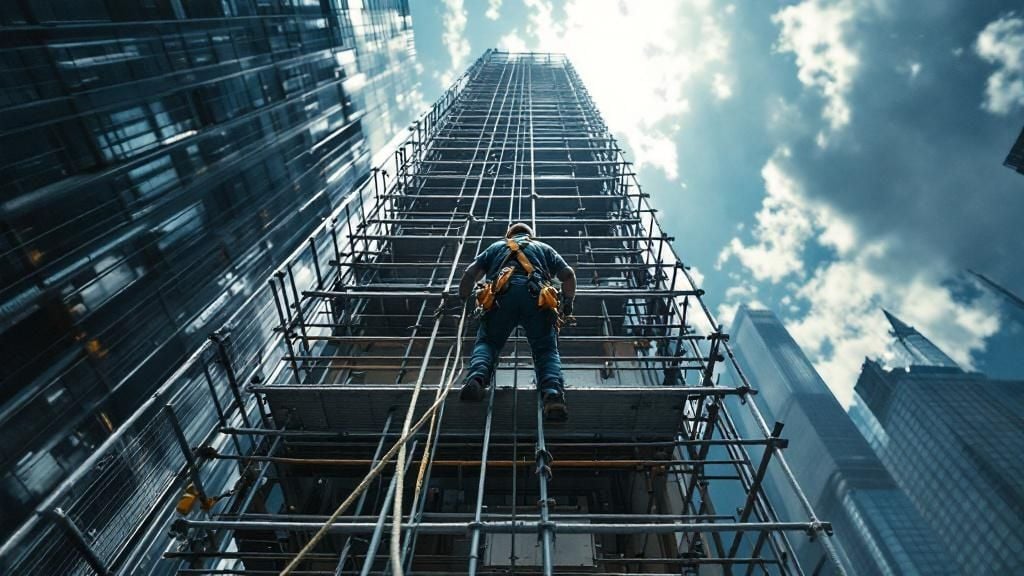
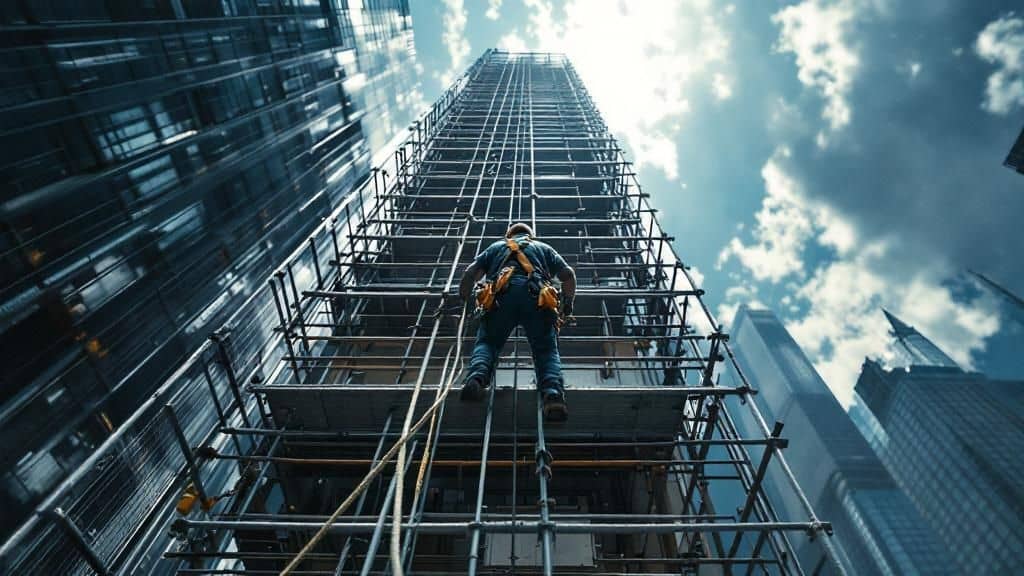
New York Labor Law § 240(1) states: "All contractors and owners and their agents... in the erection, demolition, repairing, altering, painting, cleaning or pointing of a building or structure shall furnish or erect, or cause to be furnished or erected for the performance of such labor, scaffolding, hoists, stays, ladders, slings, hangers, blocks, pulleys, braces, irons, ropes, and other devices which shall be so constructed, placed and operated as to give proper protection to a person so employed."
Three words carry the entire legal weight of that sentence: "proper protection." When a scaffold collapses, when a ladder slides out, when an unsecured load falls from above — courts ask whether the device provided "proper protection." If the answer is no, and if that failure caused the injury, liability follows automatically under this absolute liability standard.
The statute covers a wide range of work: erection, demolition, repair, alteration, painting, cleaning, and pointing. Courts have held that "alteration" extends to interior renovation. "Repair" covers routine maintenance to building structures. The scope is intentionally broad — and it's needed, given that fall protection violations under 29 CFR 1926.501 have topped OSHA's citation list for 14 consecutive years.
Strict Liability: What It Actually Means
"Strict liability" is a legal term that surprises most people when they hear what it means in practice. In an ordinary negligence case, a plaintiff must prove the defendant was careless — that they failed to act as a reasonable person would have. Under Labor Law 240, that burden disappears.
To prevail under 240(1), a worker must show:
What the worker does NOT need to prove: that the owner knew about the hazard. That the contractor was warned. That the scaffold was obviously dangerous. That anyone acted unreasonably. None of that matters under strict liability.
And crucially: comparative fault — the idea that the injured worker was partly to blame — doesn't reduce a 240(1) recovery. New York's standard comparative fault rule, which would reduce damages proportionally to the plaintiff's degree of fault, doesn't apply to 240(1) claims. The Court of Appeals has been explicit about this for decades. Either the protection was adequate or it wasn't.
How Courts Define the Gravity Requirement
Labor Law 240 is sometimes called the "Scaffold Law," but that label understates its scope. The statute protects workers against any accident where gravity is the operative force causing harm — whether that's a fractured spine resulting in $430,000 in medical bills or traumatic brain injury leading to permanent disability.
In Runner v. New York Stock Exchange, Inc. (13 N.Y.3d 599, 2009), the Court of Appeals articulated the controlling test: the relevant inquiry is "whether the harm flows directly from the application of the force of gravity to the object." In Runner, a worker was injured when an 800-pound reel of wire, being moved via a makeshift ramp, rolled down and struck him. The worker wasn't working at height. The reel didn't fall from above. But gravity caused the harm — and the court held 240 applied.
The statute doesn't require a dramatic fall from height. In Wilinski v. 334 East 92nd Housing Development Fund Corp. (18 N.Y.3d 1, 2011), a worker was struck by iron standpipes that fell while lying on the same floor where he was working. The Court of Appeals held this could support a 240 claim. The critical question wasn't the height differential but whether gravity was the direct operative force.
By contrast, the court in Misseritti v. Mark IV Construction Co. (86 N.Y.2d 487, 1995) held that not every construction accident involves a gravity-related risk. A worker who was injured when a wall collapsed onto him while he was working at ground level couldn't recover under 240 — the wall fell horizontally, not vertically. The gravity-risk requirement has real teeth.
The Two Defenses Defendants Actually Use
Property owners and contractors have two viable defenses to a 240 claim. Both are narrow. Both require specific facts.
The "sole proximate cause" defense, articulated in Blake v. Neighborhood Housing Services of New York City (1 N.Y.3d 280, 2003), holds that if the worker's own conduct was the sole cause of the accident — not just a contributing cause — the defendant can escape liability. The key word is "sole." If the owner provided a safe ladder and the worker chose to use a chair instead, and the chair tipped over, a court might find the worker's own decision was the only cause of the injury. But if the ladder itself was defective, or if no safe ladder was available, the defense fails even if the worker made poor choices.
The "recalcitrant worker" defense requires two elements: (1) the worker received a specific, direct instruction regarding proper safety equipment, and (2) the worker deliberately disregarded that instruction. General safety training, boilerplate warnings, or a foreman's vague directive to "be careful" don't satisfy this defense. The instruction must be specific and the refusal must be deliberate. The Court of Appeals in Cahill v. Triborough Bridge & Tunnel Authority (4 N.Y.3d 35, 2004) made clear that this defense isn't available whenever a worker deviates from best practices — it requires proof of a specific instruction and a specific refusal.
Who You Can Actually Sue
Labor Law 240 liability falls on owners, general contractors, and their statutory agents. Understanding each category matters for building your case.
Property owners include individuals, corporations, LLCs, trusts, and government entities that own the building or premises where you were injured. The one statutory exception is owners of one- and two-family dwellings who neither directed nor controlled the work. A family hiring a contractor to add a deck to their home may escape liability. A real estate LLC that owns an apartment building under renovation won't.
General contractors are liable regardless of whether they subcontracted the work to your employer. The statute imposes non-delegable duties — a GC can't escape liability by pointing to a subcontractor. Even if the GC never touched the scaffold, they remain responsible if they had authority to supervise the work.
"Statutory agents" are entities who weren't parties to the primary construction contract but who exercised supervision and control over the work or had the authority to do so. In Russin v. Louis N. Picciano & Son (54 N.Y.2d 311, 1981), the Court of Appeals held that the test for statutory agency is whether the entity functioned as an alter ego of the owner or general contractor in controlling safety. An owner's representative with authority to stop unsafe work, or a construction manager with full site control, may qualify as a statutory agent.
Your direct employer, in most cases, is protected from direct suit by the Workers' Compensation Law exclusivity provision. But your employer isn't the target of most 240 claims — the owner and general contractor are.
Statistics: The Scale of the Problem in New York
According to the Bureau of Labor Statistics' Census of Fatal Occupational Injuries (2022), the construction industry recorded 1,069 fatalities — more than in any other industry sector. Falls accounted for 421 deaths in 2023, representing 38.7% of all construction fatalities. Among all construction fatalities, the four leading causes — falls, struck-by-object, caught-in/between, and electrocution — account for 60.4% of deaths, a category OSHA calls the "Fatal Four."
OSHA's 2024 violation data shows the persistent danger: fall protection violations under 29 CFR 1926.501 generated 6,763 citations with total fines of $49.3 million — an average of $7,290 per citation. Scaffolding violations under 29 CFR 1926.451 resulted in 1,937 citations totaling $6.99 million in fines.
In New York City specifically, the NYC Department of Buildings tracks construction accidents across all five boroughs. The 2024 enforcement data shows where and how workers get hurt:
Hurt on a Construction Site?
Tell us what happened. A licensed New York attorney will review your case and call you — free, no obligation.
(Source: NYC Department of Buildings, 2024 Enforcement Report)
New York City employs approximately 373,800 construction workers (BLS). When a city that size sees 482 injuries and 7 fatalities in a single year — with falls as the dominant cause — the strict liability framework of Labor Law 240 isn't a technicality. It's the primary legal remedy available to workers and families in these cases.
Damages Available Under Labor Law 240
Because 240(1) doesn't reduce recovery for comparative fault, the full range of damages is available:
Past medical expenses, including all treatment from the date of accident forward — often exceeding $285,000 for complex fall injuries requiring multiple surgeries. Future medical expenses, calculated based on life expectancy and projected care needs. And lost wages from the accident date through the date of verdict or settlement. Future lost earnings, often presented through an economist's analysis of projected career earnings discounted to present value — typically $650,000-$1.8 million for workers in their 30s and 40s who can't return to construction work. Pain and suffering damages, which can be substantial in cases involving permanent injury — frequently $500,000-$2.2 million for spinal cord injuries or traumatic brain injuries.
Loss of consortium for the injured worker's spouse. Property damage in appropriate cases.
Workers' compensation benefits received don't offset a full recovery in most situations — there's a statutory lien, meaning the comp carrier recovers from the verdict, but the worker's total recovery is the sum of both streams.
Frequently Asked Questions
Q: Does Labor Law 240 apply if the accident happened on a renovation project in an occupied apartment building?
Yes. The statute applies to "altering" a building or structure, and courts have consistently held that interior renovation work — even in occupied buildings — qualifies. The fact that tenants are present, that the work is cosmetic rather than structural, or that the project is small doesn't remove the coverage. What matters is whether the activity involved construction-type work creating elevation hazards. A worker repainting stairwells in a 30-unit residential building, working on a ladder over a staircase, is covered by Labor Law 240 just as much as an ironworker on a high-rise steel frame. Courts interpreting the statute reach this conclusion because the statute instructs that it be construed liberally to accomplish its purpose. The 1885 legislature enacted this statute precisely because workers at height — in any context — had limited ability to demand safe equipment from owners and contractors who held all the economic use.
Q: What if I was partly at fault? Does that reduce my recovery?
No. This is one of the most significant features of Labor Law 240(1), and one that often surprises people who have experience with ordinary personal injury cases. New York generally applies comparative fault — your recovery is reduced proportionally to your degree of responsibility. Labor Law 240 is a statutory exception to that rule. If the required safety device was absent or defective and that deficiency was a proximate cause of your accident, you recover in full. The only exception is the "sole proximate cause" defense discussed above — but that requires your conduct to be the only cause, with no contribution from any safety violation. If there was a defective scaffold AND you did something unsafe, comparative fault still doesn't apply. Courts have consistently held that the legislature's decision to impose absolute liability was intentional and must be honored.
Q: I work for a subcontractor. Can I sue the property owner?
Yes. Labor Law 240 applies regardless of your contractual relationship. The statute protects any "person employed" in the covered activities — courts have held this includes not just direct employees of the owner or GC, but any worker whose tasks are part of the construction project. An electrician employed by an electrical subcontractor, a roofer employed by a roofing sub, a laborer employed by a staffing agency — all are covered. Your employment relationship is with your direct employer, who is typically shielded by workers' compensation exclusivity. The 240 claim runs against the owner and general contractor, who aren't your employer. The statute creates a legal pathway specifically because the Legislature recognized that workers doing dangerous work often have no direct relationship with the parties who own the property or control the site.
Q: What if my employer provided the scaffold and the property owner never touched it?
The property owner's lack of direct involvement isn't a defense. Labor Law 240 imposes a non-delegable duty on owners — meaning they can't transfer that responsibility to contractors or subcontractors. Even if the general contractor provided the scaffold, even if your employer set it up, even if the property owner never visited the site, they remain responsible for ensuring that adequate safety equipment was in place. The statute's drafters understood that property owners are the ultimate party with the economic power to require safe construction practices. Allowing them to avoid liability by delegating safety to contractors would undermine the entire statutory scheme. Courts have enforced this non-delegable duty rule consistently since the statute was enacted.
Q: Does it matter that I signed a safety waiver when I started the job?
No. Workers can't waive the protections of Labor Law 240. The statute creates a public policy protection that operates regardless of what a worker signs. Employment agreements, safety acknowledgment forms, or site access waivers can't limit or eliminate a worker's right to bring a Labor Law 240 claim. Courts have rejected arguments that workers assumed the risk of their injuries or contractually waived their statutory rights. The non-waivable nature of these protections reflects the Legislature's recognition that construction workers — facing economic pressure to accept any available work — can't meaningfully bargain away safety protections. Employers and contractors who present such waivers aren't reducing their liability — they're creating documents that courts will simply disregard.
Q: What if there were no witnesses to my fall?
The absence of witnesses doesn't prevent a successful 240 claim. Plaintiffs routinely recover under Labor Law 240 based on their own testimony, supported by physical evidence from the scene, medical records, and expert testimony about how the accident must have occurred given the physical evidence. Expert witnesses — engineers, safety professionals, and vocational rehabilitation specialists — can reconstruct accident scenarios based on the condition of equipment, the injuries sustained, and site conditions. It's also worth noting that accident scenes change quickly on construction sites — equipment gets replaced, witnesses get transferred to other projects, and physical evidence disappears. Acting quickly — retaining a lawyer immediately, taking photographs, and preserving evidence before the site changes — is critical. Your lawyer can send a litigation hold letter to all potentially responsible parties demanding preservation of evidence within days of the accident.
Call (888) 702-1581 for a free case review. There is no fee unless we recover.
Related: Construction Accident Statute of Limitations in New York: Every Deadline You Need to Know
Related: NYC Construction Safety Enforcement Is Changing in 2026: What Workers Need to Know
Related: What Is Labor Law 240? A Complete Guide for New York Construction Workers
Related Reading
Prior results do not guarantee a similar outcome. This article is attorney advertising. The information on this site is for general informational purposes only and does not constitute legal advice.
Frequently Asked Questions
Does Labor Law 240 apply if the accident happened on a renovation project in an occupied apartment building?▼
What if I was partly at fault? Does that reduce my recovery?▼
I work for a subcontractor. Can I sue the property owner?▼
What if my employer provided the scaffold and the property owner never touched it?▼
Does it matter that I signed a safety waiver when I started the job?▼
What if there were no witnesses to my fall?▼
Get a Free Case Review
Find out if you have a claim under New York Labor Law. A licensed NY attorney will review your case and call you back.