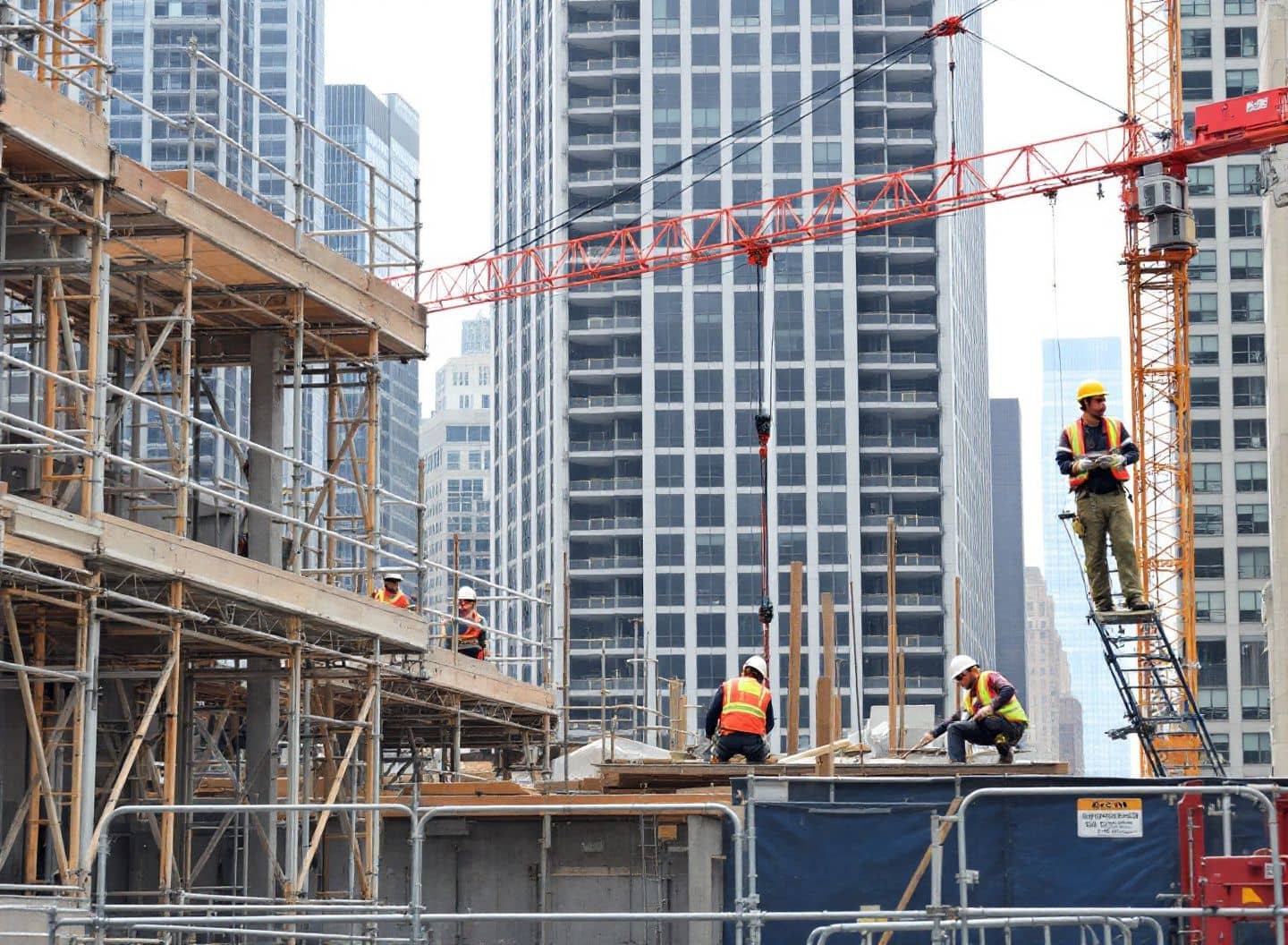
When concrete formwork gives way on a New York construction site, the consequences can be catastrophic. Workers may fall through collapsing decking, get buried under tons of wet concrete, or be struck by flying shoring components. These aren't freak accidents. They're the predictable result of cutting corners on a process that has well-defined safety requirements under both federal OSHA standards and New York State law. If you've been hurt in a formwork or concrete-related accident, understanding the legal framework that governs your site is the first step toward protecting your rights.
What Makes Concrete Formwork So Dangerous
Formwork is the temporary structure that holds wet concrete in place while it cures. It's built from wood panels, metal frames, shores, reshores, and a web of bracing components. The whole system has to bear enormous loads. A single cubic yard of concrete weighs roughly 4,000 pounds, and a poured slab can contain hundreds of cubic yards. If any part of the formwork is undersized, improperly braced, or removed too early, the entire assembly can fail suddenly and without warning.
The mechanism of injury follows a recognizable pattern. A shore gives way or a panel buckles. The load shifts, other components fail in rapid sequence, and the structure collapses. Workers on top of the deck fall with it, or workers below are buried under falling concrete and debris. In multi-story construction, a failure on one floor can trigger progressive collapse to lower levels. Workers don't usually have time to react. That's why prevention, not reaction, is what the regulations are designed to enforce.
Concrete workers, carpenters who build formwork, ironworkers who place rebar, and laborers who pour and finish concrete all face these risks. So do workers on adjacent trades who may be operating below an active pour. Understanding which rules apply, and who bears responsibility for enforcing them, matters enormously when someone gets hurt.
OSHA 1926.703: The Federal Standard for Concrete Construction
The federal Occupational Safety and Health Administration has a dedicated standard for concrete and masonry construction: 29 CFR 1926.703. This regulation covers formwork design, shoring and reshoring requirements, and the procedures that must be followed before, during, and after a concrete pour.
Under 29 CFR 1926.703, formwork must be designed, fabricated, erected, supported, braced, and maintained so that it can safely support all vertical and lateral loads that might be applied during concrete placement. The standard requires that shoring equipment be inspected before erection and that it be capable of supporting the loads without distortion. It also specifies that no construction loads can be placed on a concrete structure unless the employer determines, based on information from a structural engineer or other qualified source, that the structure can support those loads.
Reshoring rules are equally specific. When shores are removed before concrete has reached its design strength, reshoring must be installed immediately to carry the loads until the concrete is strong enough. Failing to reshore correctly is one of the most common causes of progressive collapse in multi-story concrete construction. OSHA also requires that all formwork be removed in a controlled manner, following a sequence that prevents sudden uneven loading.
Employers who violate 29 CFR 1926.703 may face OSHA citations, but those citations aren't automatically useful in a civil injury claim. What they do show is that a recognized safety standard was in place, that the employer knew about it, and that the employer didn't follow it. That's relevant context when a worker is building a negligence or Labor Law case.
New York Labor Law Section 241(6) and the Concrete Worker
New York's Labor Law Section 241(6) is one of the most worker-protective statutes in the country. It requires that construction, demolition, and excavation work be performed in a manner that provides reasonable and adequate protection for workers. Critically, it imposes a non-delegable duty on owners and general contractors. That means an owner can't escape liability simply by arguing that a subcontractor was responsible for safety. If a specific Industrial Code regulation was violated and a worker was injured as a result, Labor Law Section 241(6) provides a direct path to liability, regardless of the owner's actual knowledge of the violation.
For Labor Law Section 241(6) to apply to your concrete injury claim, you need to point to a specific, applicable regulation that was violated. That's where Part 23 of the New York Industrial Code comes in.
12 NYCRR Part 23 and the Industrial Code Rules That Apply to Formwork
The New York Industrial Code, and in particular 12 NYCRR 23-1.7, sets out concrete safety rules that flesh out the general obligations of Labor Law Section 241(6). The regulations in 12 NYCRR 23-1.7 govern protection of workers from falls, falling objects, and other hazards in construction, demolition, and excavation operations. These rules aren't aspirational. They're specific, mandatory requirements that courts have consistently recognized as the kind of concrete regulatory predicates needed to support a Labor Law Section 241(6) claim.
Additional provisions in Part 23 address shoring, bracing, and the sequence of formwork removal, mirroring many of the concerns addressed in the federal OSHA standard. When these Industrial Code sections are read alongside Labor Law Section 241(6), they create a body of law that places real obligations on every owner and general contractor on a New York site, not just the subcontractor closest to the work.
New York Labor Law § 241(1) requires qualifying fireproof flooring or filling to be completed as building work progresses. This provision reflects the legislature's understanding that incomplete or inadequate floor surfaces create ongoing fall and collapse hazards as workers move through a structure. For concrete workers, this means that the floor system itself, not just the formwork below it, must meet applicable standards at each stage of construction.
Fall Protection on Concrete Sites: Where 29 CFR 1926.501 Fits In
Hurt on a Construction Site?
Tell us what happened. A licensed New York attorney will review your case and call you — free, no obligation.
Concrete formwork failures often cause falls, but falls also happen independently on concrete sites. Workers slip from elevated decks, fall through open floor penetrations, or lose their footing on sloped formwork surfaces. The federal fall protection standard, 29 CFR 1926.501, requires fall protection for workers at heights of six feet or more above a lower level in construction. It's the most frequently cited OSHA standard in construction nationally, with 6,307 citations issued in fiscal year 2024 alone. That citation volume tells you something: employers know about the rule and still skip it.
On a concrete site, 29 CFR 1926.501 applies at the leading edge of a freshly poured slab, at floor penetrations left open for rebar or conduit, and at the edges of elevated formwork platforms. Workers are often moving quickly during a pour, focused on getting concrete placed before it sets. That's exactly when a missing guardrail or an unprotected floor opening becomes lethal. The standard requires guardrail systems, personal fall arrest systems, or safety net systems depending on the specific condition. Choosing to provide none of these is a violation that supports both OSHA enforcement and a civil injury claim.
Who Can Be Held Liable After a Formwork Collapse
In New York, liability in a construction accident case rarely falls on just one party. The non-delegable duty language in Labor Law Section 241(6) means that property owners and general contractors can be held liable even if they didn't personally build the faulty formwork. A subcontractor who designed or erected the formwork may face separate liability based on negligence. A formwork equipment supplier could be liable if the equipment itself was defective. The engineer of record who reviewed the shoring drawings may have professional liability exposure if the design was inadequate.
Workers' compensation will generally cover medical costs and a portion of lost wages regardless of fault. But it doesn't cover everything, and it doesn't account for pain, suffering, or permanent disability in the same way a third-party civil claim does. Because most construction workers are employed by subcontractors rather than the owner or general contractor, they're often able to pursue both a workers' compensation claim against their employer and a Labor Law or negligence claim against the owner, general contractor, or another party on site. The availability of that third-party claim is one of the most important features of New York construction injury law.
Preserving Evidence After a Concrete or Formwork Injury
Formwork is temporary by nature. After a collapse, the site is often cleared quickly so construction can resume or so investigators can work. That means evidence disappears fast. If you've been injured, or if a coworker has been hurt and you're in a position to help, these steps matter.
The value of a concrete accident claim varies with the severity of the injury, the extent of permanent disability, the number of responsible parties, and the strength of the evidence showing regulatory violations. There's no universal formula, but well-documented cases with clear regulatory violations generally support stronger claims than those where evidence was lost or never gathered.
Why These Cases Require Careful Legal Analysis
Concrete and formwork injury cases sit at the intersection of engineering, federal safety standards, and New York's unique statutory framework. Proving that a violation of 29 CFR 1926.703 or 12 NYCRR 23-1.7 caused a specific injury often requires expert testimony about load calculations, shoring capacity, and proper sequencing. The non-delegable duty framework under Labor Law Section 241(6) shifts some of that burden, but the underlying facts still need to be developed carefully.
Injured concrete workers in New York deserve to understand what protections exist for them and what obligations their employers and site owners had. The law is there. The question is whether anyone enforced it, and if not, who should be held responsible for the consequences.
Attorney Advertising. Prior results do not guarantee a similar outcome. This article is for general informational purposes only and does not constitute legal advice. NY Construction Advocate connects injured workers with experienced New York construction accident attorneys.
Primary sources
Frequently Asked Questions
What is OSHA 1926.703 and does it apply to my New York construction site?▼
How does Labor Law Section 241(6) help injured concrete workers?▼
Can I sue the property owner if I was hurt by a formwork collapse on their site?▼
What if I was already receiving workers' compensation? Can I still file a separate lawsuit?▼
What safety regulations protect workers from falls during concrete pours?▼
What evidence should I try to preserve after a formwork accident?▼
Does New York Labor Law address fireproof flooring during construction?▼
Get a Free Case Review
Find out if you have a claim under New York Labor Law. A licensed NY attorney will review your case and call you back.