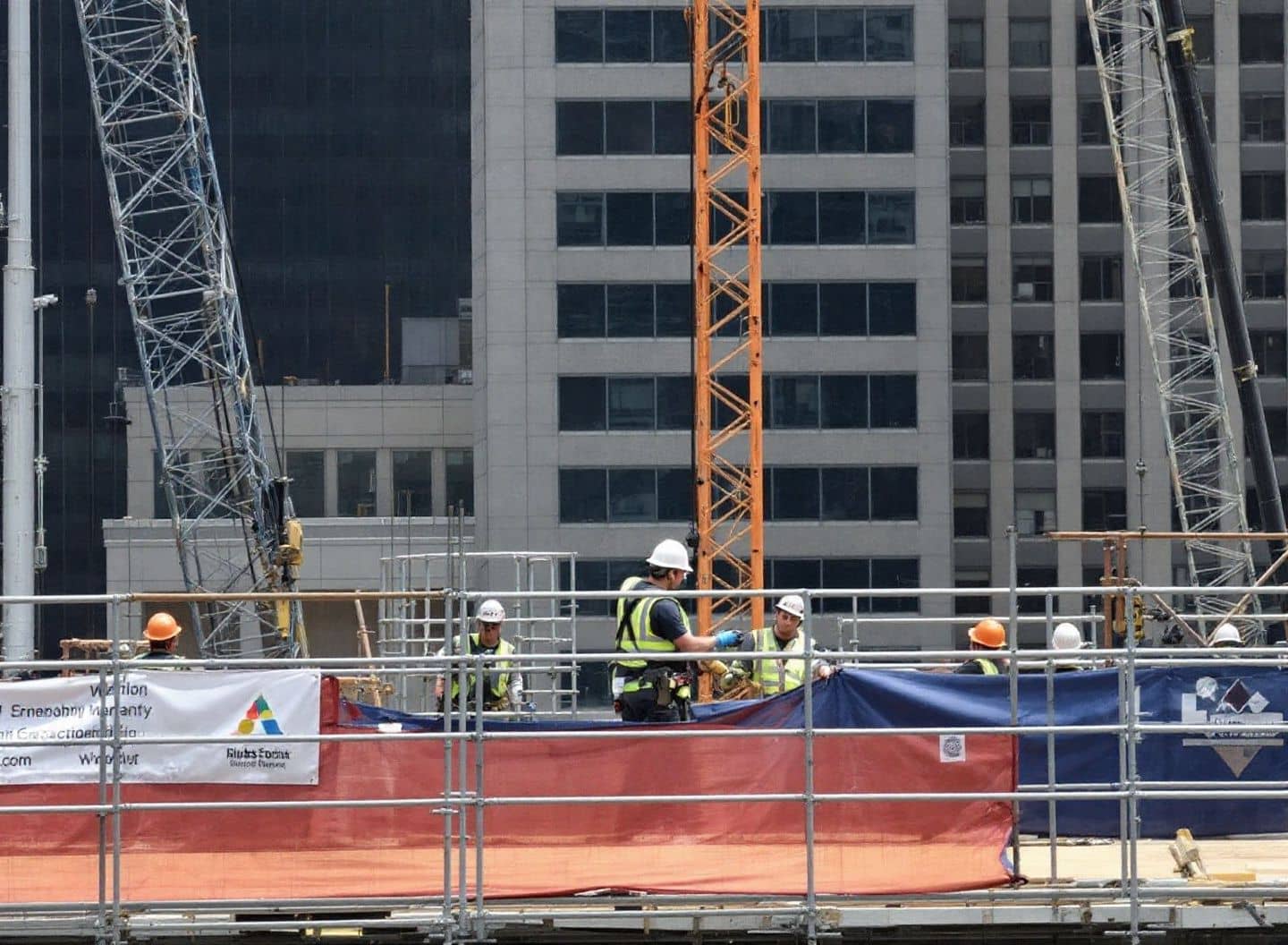
If you've ever worked on a high-rise construction project in New York City, you know the buck hoist is as essential as concrete and steel. It carries workers and materials dozens of stories into the air, sometimes several times an hour. Most days it does its job without incident. But when a buck hoist or material hoist fails, the consequences can be devastating, ranging from crush injuries and broken bones to catastrophic falls and fatalities. Understanding why these machines fail, who bears legal responsibility under New York law, and what an injured worker can do are questions that matter enormously to the thousands of tradespeople who depend on hoists every single day.
What Is a Buck Hoist and Why Is It Different From Other Lifting Equipment?
A buck hoist, sometimes called a personnel hoist or construction elevator, is a temporary external elevator attached to a building's exterior during construction. It's distinct from a crane or a material lift in one important way: workers ride it. That dual purpose, carrying both people and heavy construction materials, makes the engineering demands and the safety stakes unusually high. Material hoists, by contrast, are designed strictly for loads, not passengers, but they share many of the same mechanical systems and failure modes.
Both types of hoists run on rack-and-pinion drive systems or cable drum systems. They rely on guide rails bolted to the building's structure, electric motors, braking assemblies, limit switches, and safety devices called overspeed governors. Each component is a potential failure point. On a busy New York job site, these machines run almost continuously during working hours, and the wear accumulates fast. When maintenance is deferred or inspection records aren't kept, workers pay the price.
How Buck Hoist and Material Hoist Failures Actually Injure Workers
The mechanism of injury depends on which component fails and when. Here are the most common failure scenarios that show up in construction accident claims:
It's worth noting the trade-specific risk here. Ironworkers, operating engineers, laborers, and carpenters all use buck hoists constantly. They're often carrying tools, wearing heavy personal protective equipment, and focused on the work ahead, not on whether the hoist was last inspected on schedule. The worker has no realistic way to independently verify that the machine they're stepping into is safe. That's exactly why the law places the obligation on contractors and owners, not workers.
New York Labor Law § 241(6) and Its Role in Hoist Injury Claims
New York's Labor Law § 241(6) is one of the most important tools available to construction workers injured in mechanical accidents. The statute requires that all areas in which construction, excavation, or demolition work is performed be so constructed, shored, equipped, guarded, arranged, operated, and conducted as to provide reasonable and adequate protection and safety to persons employed therein. Critically, the liability under Labor Law § 241(6) is imposed on property owners and general contractors regardless of whether they directly controlled the work or the equipment involved. That non-delegable duty is what makes the statute so powerful for injured workers.
Labor Law § 241(6) isn't self-executing in isolation. To succeed on a claim, an injured worker must point to a specific, applicable Industrial Code provision that was violated. The Industrial Code serves as the rulebook that gives content to the statute's broad mandate. For hoist injuries, the relevant provisions are found in 12 NYCRR 23-9, the section of New York's Industrial Code dedicated to machinery and mechanical equipment used on construction, demolition, and excavation sites.
12 NYCRR 23-9: The Industrial Code Rules That Govern Hoists
The regulations found in 12 NYCRR 23-9 exist for a clear reason: to establish specific safety practices for the operation of machinery and mechanical equipment on New York construction sites. These regulations implement Labor Law § 241(6) by translating the statute's general safety mandate into concrete, enforceable requirements. When a hoist-related injury occurs and a worker brings a claim under Labor Law § 241(6), demonstrating a violation of 12 NYCRR 23-9 is often the key step in establishing liability.
The regulations under 12 NYCRR 23-9 address inspection requirements, operational limits, maintenance obligations, and the duties of operators. They set standards for how machinery must be guarded, how defects must be reported, and how equipment must be taken out of service when it's found to be unsafe. A contractor who allows a hoist with a known defective brake to remain in service isn't just cutting corners, that contractor is violating a specific regulatory standard that New York courts can use to establish liability in a civil action.
It's also worth understanding that violations of 12 NYCRR 23-9 are not automatically dispositive. New York courts require that the violation be a proximate cause of the injury. But when an investigation reveals that a hoist failure was preceded by unreported mechanical defects, missed inspections, or ignored manufacturer service requirements, the causal chain can often be established with the help of engineering experts and maintenance records.
Hurt on a Construction Site?
Tell us what happened. A licensed New York attorney will review your case and call you — free, no obligation.
Federal OSHA Standards: Where 29 CFR 1926.300 Fits In
New York's Industrial Code doesn't operate in a vacuum. Federal OSHA standards also apply to construction sites, and 29 CFR 1926.300 governs the general requirements for tools and equipment used in construction, including the requirement that all machinery and equipment be maintained in safe operating condition and that guards be in place on all moving parts. While an OSHA violation under 29 CFR 1926.300 isn't directly actionable in a New York civil lawsuit the way an Industrial Code violation is, it matters in at least two significant ways.
First, OSHA inspection reports and citations can become important evidence in a civil case. They help establish what was wrong with the equipment and who knew about it. Second, 29 CFR 1926.300 sets the baseline standard of care that a reasonable contractor is expected to meet. When an expert witness testifies that a contractor's maintenance practices fell below the standards required by 29 CFR 1926.300, it helps persuade a jury that the contractor's conduct was unreasonable.
Other Labor Law Theories That May Apply
Labor Law § 241(6) isn't always the only theory available. Depending on the facts, Labor Law § 240(1), New York's so-called Scaffold Law, may also apply when the injury results from a gravity-related risk, such as a worker falling through an open hoist shaft or being struck by a falling object released from a material hoist. The Scaffold Law imposes strict liability on owners and general contractors for elevation-related accidents, and it's one of the strongest worker-protection statutes in the country.
Labor Law § 200, which codifies the common law duty to maintain a safe workplace, can also come into play when a general contractor or owner had actual notice of a dangerous hoist condition and failed to correct it. These claims often run alongside each other. An injured worker and their attorney will typically evaluate all three statutory theories and pursue whichever ones the facts support.
Fireproof Flooring and the Broader Context of Labor Law 241
One often-overlooked provision within the Labor Law 241 framework is the requirement that builders complete fireproof flooring as work progresses. While this might seem unrelated to hoist failures at first glance, it reflects the same underlying principle that shapes the entire statute: the obligation to create a safe work environment as construction advances, not after the fact. The same mindset that allows fireproof flooring to be deferred indefinitely is the mindset that allows hoist inspections to slip. Contractors who cut corners on one safety requirement often cut corners on others.
What Injured Workers Should Do After a Hoist Accident
The steps a worker takes immediately after a hoist injury can significantly affect their ability to bring a claim. Here's what matters most from a legal and practical standpoint:
The Value of a Buck Hoist Injury Claim in New York
It would be wrong to suggest there's a formula for what a hoist injury claim is worth, because there isn't one. The value of any construction accident claim varies with the severity of the injury, the impact on the worker's ability to return to their trade, the extent of pain and suffering, and the strength of the liability evidence. A worker who suffers a temporary injury and returns to full duty will have a very different claim than a worker who suffers a permanent spinal cord injury or loses a limb. What doesn't vary is the legal right to pursue full compensation under the applicable statutes, and that right is worth taking seriously.
New York's Labor Law framework, particularly the non-delegable liability provisions in Labor Law § 241(6) and § 240(1), exists precisely because the construction industry has historically resisted internalizing the true cost of worker injuries. The law forces accountability onto the parties who are best positioned to prevent accidents: property owners who choose their contractors and general contractors who control the site.
Attorney Advertising. Prior results do not guarantee a similar outcome. This article is for general informational purposes only and does not constitute legal advice. NY Construction Advocate connects injured workers with experienced New York construction accident attorneys.
Primary sources
Frequently Asked Questions
What makes a buck hoist different from a regular construction elevator or crane?▼
How does Labor Law § 241(6) protect workers injured in hoist accidents?▼
What does 12 NYCRR 23-9 require, and how does it apply to hoist safety?▼
Can a worker sue their employer after a buck hoist injury, or is workers' compensation the only option?▼
What role does OSHA's 29 CFR 1926.300 play in a New York hoist injury lawsuit?▼
How soon after a hoist accident must a worker take legal action in New York?▼
What kinds of injuries are most common in buck hoist and material hoist accidents?▼
Get a Free Case Review
Find out if you have a claim under New York Labor Law. A licensed NY attorney will review your case and call you back.