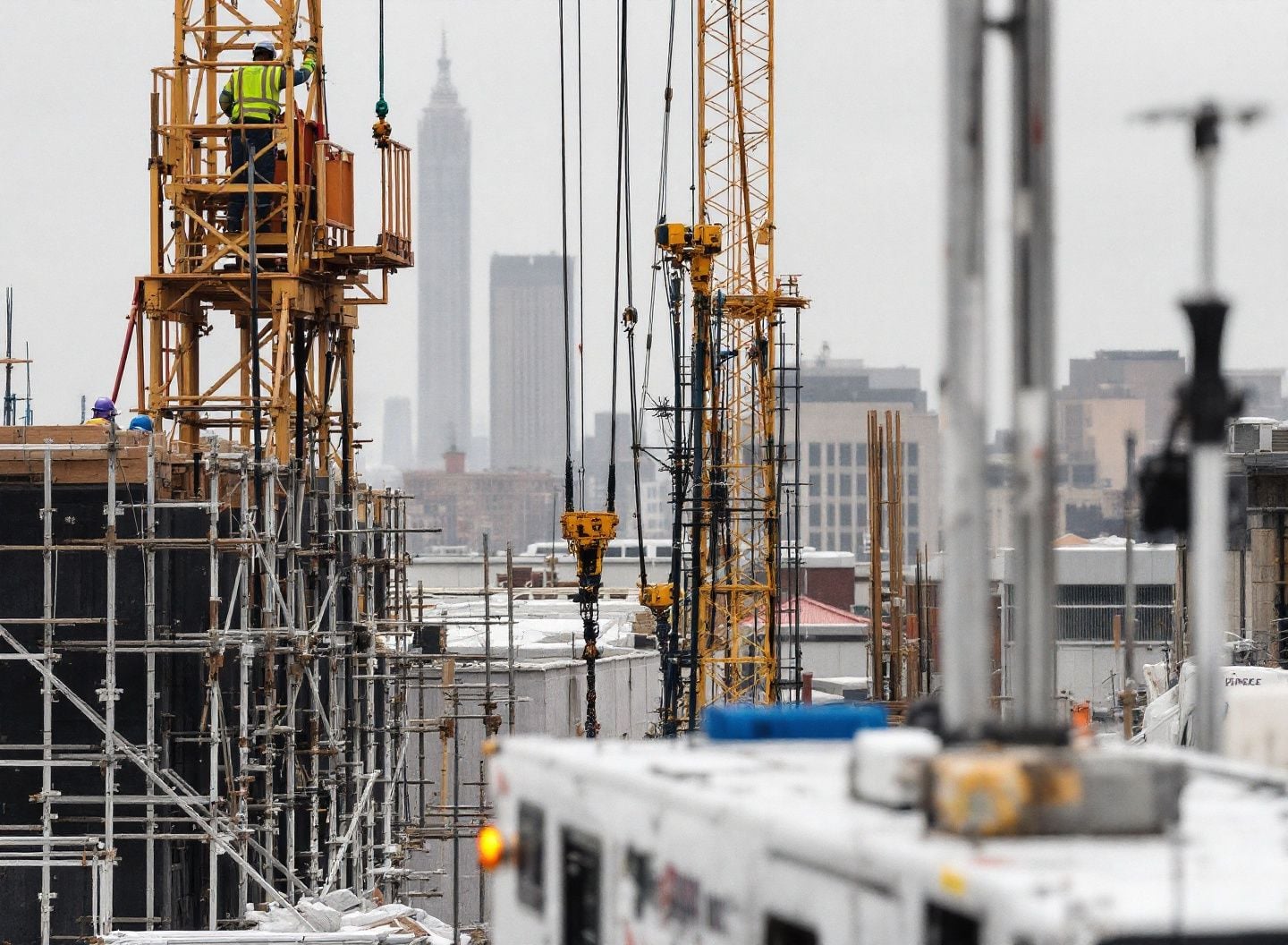
New York City's skyline is built crane by crane, and that density creates a hazard most workers don't think about until it's too late: overhead power lines. An aerial lift or crane boom that drifts too close to an energized conductor can turn a routine pick-and-carry operation into a mass-casualty event in under a second. The physics are brutal. The legal framework is clear. And yet, minimum clearance violations remain a leading cause of serious injury and death on New York construction sites.
This article breaks down exactly how these accidents happen, which federal and state rules are supposed to prevent them, and what legal protections injured New York workers can exercise when those rules are ignored.
The Dual Hazard: Why a Single Incident Can Kill More Than One Worker
Most construction hazards kill one way. Crane contact with an energized power line kills two ways simultaneously, which is why safety professionals treat it as a category of its own.
First, there's electrocution. When a crane boom, wire rope, load line, or suspended load bridges the gap between an energized conductor and ground, the crane's entire steel structure becomes part of the circuit. Any worker touching the crane, the rigging, or the suspended load at that moment receives a potentially lethal shock. Workers on the ground who are guiding a load with a tag line are especially vulnerable because they're holding a conductor (the rope or chain) that connects directly to the energized equipment. Current doesn't have to pass through someone's heart to be fatal; arc flash and ventricular fibrillation can both result from contact.
Second, there's the crush hazard. When a crane boom contacts a power line, the electrical force or the operator's emergency reaction can cause sudden, uncontrolled movement of the boom or the load. A suspended load that begins swinging erratically, or a boom that recoils or collapses, can strike workers who had no warning the contact was occurring. Ironworkers, riggers, and signal persons working within the crane's swing radius are in a particularly dangerous position because they're close to the action by design.
These two mechanisms don't occur in sequence. They happen at the same time. A rigger on the ground guiding a concrete form might be electrocuted through the tag line while a second worker in the swing radius is struck by the lurching load. That's why industry veterans treat power line proximity as an absolute exclusion issue, not a managed-risk issue.
OSHA's Minimum Clearance Requirements Under 29 CFR 1926.1400
Federal OSHA's crane and derrick standard, 29 CFR 1926.1400, sets out the crane safety framework that governs most New York construction sites. Within that framework, the power line provisions are among the most specific and the most frequently violated.
The regulations require that before any crane operates near an overhead power line, the employer must determine whether the line is energized. If it is, and if the crane or its load could come within the applicable minimum clearance distance, the employer has a series of mandatory steps to complete. Those steps include notifying the utility, establishing whether the line can be de-energized or relocated, and, if neither is possible, implementing specific encroachment-prevention measures before work begins.
The default minimum clearance under OSHA's standard is 10 feet for lines up to 50 kV. For higher voltages, that distance increases. New York City's grid includes high-voltage transmission lines that can run at much higher voltages, particularly in areas where feeder lines cross above active construction zones. A clearance violation at those voltages isn't a paperwork offense. It's an event that can kill everyone within the crane's reach.
The standard also requires a dedicated spotter when a crane operates near power lines, specific equipment controls, and pre-task planning that accounts for the maximum working radius of the boom and any suspended load. Employers who skip any one of these requirements aren't just bending the rules. They're exposing their workers to an uncontrolled electrocution risk with no warning system in place.
How New York State Rules Add Another Layer of Employer Duty
Federal OSHA sets the floor. New York State's Industrial Code adds requirements on top of it, and those requirements matter enormously when an injured worker pursues a Labor Law claim.
The relevant state-level crane safety rules appear in 12 NYCRR 23-8, which governs mobile cranes, tower cranes, and derricks used in construction, demolition, and excavation work. 12 NYCRR 23-8 addresses everything from pre-operational inspections and load capacity requirements to operator certification and the duties of signal persons. Violations of 12 NYCRR 23-8 are significant in personal injury litigation because they can form the predicate for a Labor Law Section 241(6) claim, which holds owners and general contractors strictly liable for failing to comply with specific, concrete safety rules.
What that means practically: if an employer or site owner violated a provision of 12 NYCRR 23-8 and a worker was injured as a result, the worker doesn't have to prove the defendant was negligent in a general sense. The violation itself is the evidence. That's a meaningful procedural advantage in a case where the employer may try to argue the accident was unforeseeable.
Labor Law § 240 and the Gravity-Related Injury Connection
New York's Labor Law § 240 (sometimes called the Scaffold Law) requires contractors, owners, and their agents to furnish or erect scaffolding, hoists, stays, ladders, and other protective devices during building, excavation, and repair work. The statute's purpose is to protect workers from the consequences of elevation-related hazards, including falling objects and equipment.
When a crane contacts a power line and the resulting shock or mechanical failure causes the load to drop or the boom to fall, that falling-object or falling-equipment scenario can fall squarely within Labor Law § 240's scope. Courts have found that a load that drops unexpectedly from a rigging failure, or a boom that collapses and strikes a worker below, triggers the statute's protections. Labor Law § 240 imposes absolute liability on covered parties, meaning the worker doesn't need to show the owner or contractor was careless. The failure to prevent the gravity-related harm is enough.
Hurt on a Construction Site?
Tell us what happened. A licensed New York attorney will review your case and call you — free, no obligation.
Not every crane-power line case will have a clean Labor Law § 240 claim, and the facts matter enormously. But in cases where the power line contact causes a structural failure, a load drop, or a boom collapse that injures or kills someone, the statute is a serious part of any legal analysis.
Which Trades Face the Highest Risk
Ironworkers, riggers, and operating engineers are the most obvious people at risk, but they're not the only ones. Signal persons who guide loads by radio or hand signal are frequently positioned near the load's destination, which can put them directly under a swing path that passes near an overhead conductor. Laborers assigned to ground-level cleanup or material staging in the vicinity of an active crane pick may not even be watching the boom when contact occurs.
On tight urban sites like those common in Brooklyn, Queens, or midtown Manhattan, the crane may be working in a footprint where power lines pass directly above or alongside the site. In those environments, every single pick requires a pre-task analysis that accounts for the energized lines. When that analysis doesn't happen, or when an operator misjudges the boom's reach at maximum radius, the consequences are catastrophic and largely preventable.
Workers handling tag lines deserve special attention. A tag line is a rope used to control load swing. When the load is energized because the crane has contacted a power line, current travels through that rope to the worker's hands. Tag line injuries from crane-power line contact are particularly difficult to predict because the worker handling the line may be standing 30 or 40 feet away from the crane itself and completely unaware that contact has occurred.
What Employers Are Actually Required to Do Before a Lift Near Power Lines
The pre-lift planning requirements under 29 CFR 1926.1400 and 12 NYCRR 23-8 together create a checklist that responsible employers follow before any pick that might bring the crane within striking distance of an energized line. The key steps include:
When any of these steps is skipped, the employer has created a foreseeable hazard without a corresponding safeguard. That's not just an OSHA violation. It's the kind of systemic failure that courts take seriously in personal injury and wrongful death cases.
The Legal Rights of Injured Workers and Their Families
A worker injured in a crane-power line accident in New York may have claims under multiple legal theories simultaneously. Workers' compensation covers medical bills and a portion of lost wages regardless of fault, but it doesn't cover the full range of damages available in a civil lawsuit. Because crane-power line accidents almost always involve third-party liability (the general contractor, the site owner, the crane company, or the utility), an injured worker typically has the right to pursue both workers' comp and a separate civil claim.
The value of those claims varies with the severity of the injury. Electrocution injuries can cause permanent nerve damage, cardiac conditions, and cognitive impairment that follow a worker for decades. Crush injuries from a falling load can involve orthopedic damage, traumatic brain injury, or worse. The law recognizes these long-term consequences, and civil damages in Labor Law cases can include lost earning capacity, pain and suffering, and medical expenses well beyond what workers' comp provides.
For families who have lost someone in a crane-power line fatality, New York's wrongful death statutes allow recovery for economic losses the family depended on, as well as other recognized categories of harm. Labor Law § 240 applies when a worker is injured or killed in a qualifying accident, and the statute's absolute liability provision means the legal analysis starts from a position of strength when the facts fit.
None of this is simple, and crane accident cases involve complex fact patterns that require expert analysis of the crane's specifications, the power line's voltage and location, the site's pre-task planning records, and the employer's compliance with both OSHA and state regulations. Getting that analysis right from the beginning matters.
Attorney Advertising. Prior results do not guarantee a similar outcome. This article is for general informational purposes only and does not constitute legal advice. NY Construction Advocate connects injured workers with experienced New York construction accident attorneys.
Frequently Asked Questions
What is the minimum distance a crane must maintain from an energized power line under federal OSHA rules?▼
Does Labor Law § 240 cover a worker who is struck by a crane load that drops after the crane contacts a power line?▼
If I'm a tag line worker who was electrocuted when a crane touched a power line, can I sue the general contractor even if my employer was the crane company?▼
What should a worker do immediately after a crane-power line contact incident on a New York construction site?▼
Can a family file a wrongful death claim if a worker is killed when a crane contacts a power line in New York?▼
Does workers' compensation prevent an injured crane accident worker from also suing the general contractor or site owner?▼
Get a Free Case Review
Find out if you have a claim under New York Labor Law. A licensed NY attorney will review your case and call you back.