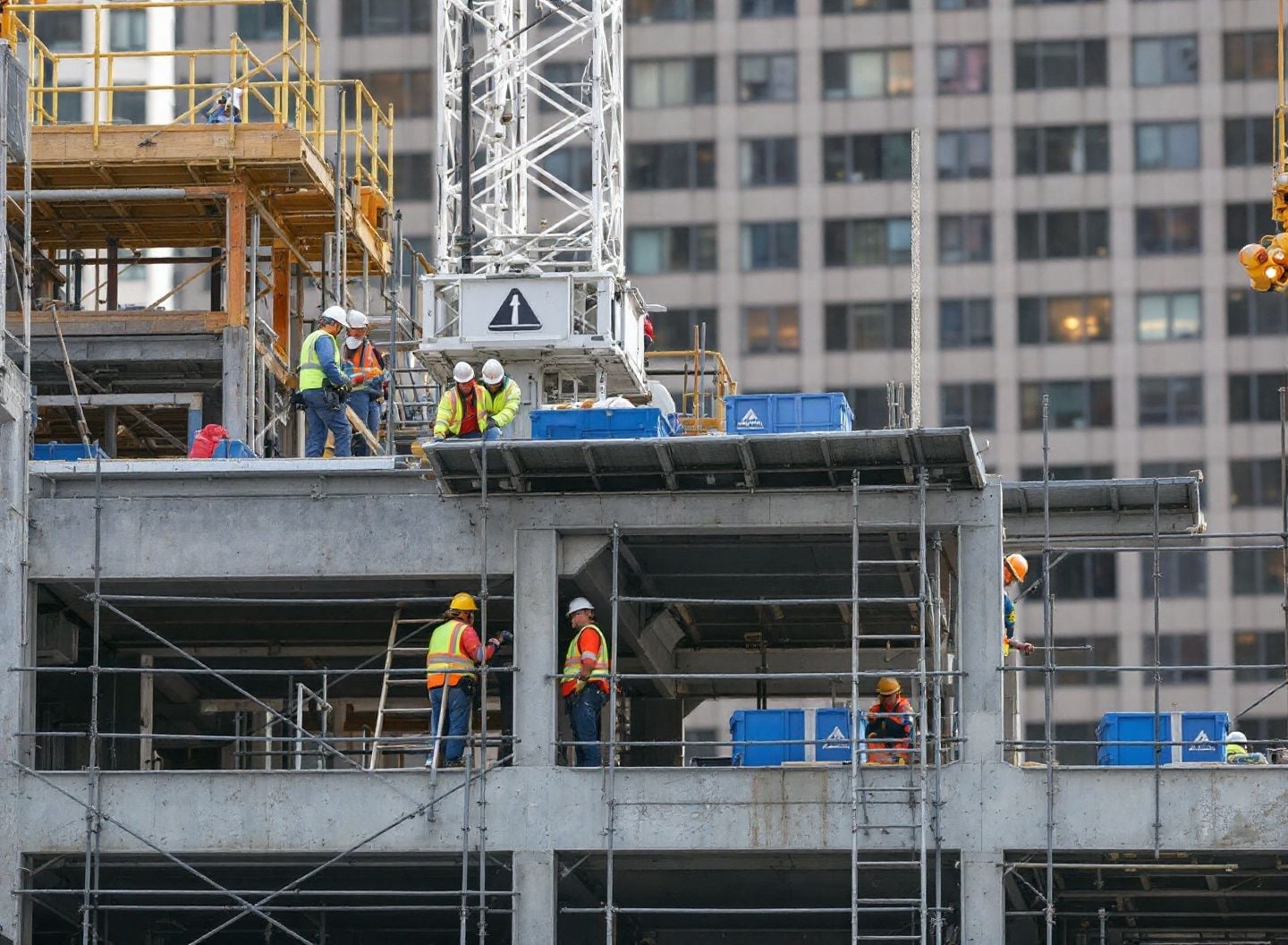
Construction cranes move enormous weight through the air above workers, pedestrians, and occupied buildings every day in New York City. When a crane functions properly, those lifts are controlled and predictable. When something goes wrong, the consequences are almost never minor. Dropped loads and two-blocking events are two of the most dangerous failure modes a crane can experience, and they happen faster than any worker can react. If you've been injured in a crane accident, or if you lost a family member to one, understanding what caused the accident and which laws apply can make a decisive difference in how your case is handled.
What Two-Blocking Actually Means — and Why It's So Dangerous
Two-blocking occurs when the lower load block (the hook block carrying the load) is hoisted so high that it makes contact with the upper block or boom tip. At that point, the wire rope has nowhere left to travel. If the crane operator continues to hoist, the wire rope or its terminations are placed under catastrophic tension that far exceeds the design load of the rigging. The result is typically a sudden, explosive failure: the rope parts, the hook block drops, or a component of the rigging assembly fractures and sends hardware flying at high velocity.
Modern cranes are required under 29 CFR 1926.1400 to be equipped with anti-two-block (ATB) devices that cut power to the hoist the moment the blocks approach dangerous proximity. But ATB systems can be bypassed, poorly maintained, or simply absent on older equipment brought onto a New York site without adequate inspection. When that protection is missing, the only thing standing between a two-blocking event and a catastrophe is operator awareness — and that's a thin margin when workers are fatigued, signals are unclear, or visibility is limited.
The injuries that result from two-blocking are severe. When a load block drops from elevation, anyone in the fall zone below faces lethal risk from direct impact. Workers on steel, scaffold, or elevated platforms who are struck by a parting wire rope or a dislodged block can suffer traumatic brain injury, spinal cord damage, crush injuries, or death. Even those not directly struck can be injured when a suddenly released load swings, lands on scaffolding, or strikes adjacent structures, triggering secondary collapses.
Rigging Failure and Dropped Loads: The Mechanics of a Load-Line Accident
Two-blocking is one cause of a dropped load, but it isn't the only one. Rigging failure during a lift can occur when any component of the load path gives way: a wire rope that has suffered hidden internal corrosion, a hook with a worn or missing safety latch, a shackle that was improperly sized for the load, or a below-the-hook lifting device with a defective weld. These failures don't always announce themselves. Wire rope can look acceptable on the surface while broken wires accumulate inside the strands, weakening the assembly load cycle by load cycle until it fails without warning.
Federal crane standards under 29 CFR 1926.1400 impose detailed inspection requirements for exactly this reason. Wire rope must be removed from service when the number of broken wires in a given length exceeds specified thresholds, when kinking, bird-caging, or corrosion is present, or when the rope has been shock-loaded. Hooks must be inspected before each shift and removed from service if deformation, cracks, or latch defects are found. Shackles must be rated for the loads they carry and properly secured. When these inspection and replacement obligations are ignored, worn or damaged components remain in service, and the risk of an in-flight failure grows with every lift.
New York construction sites are especially demanding environments for rigging equipment. Salt air near the waterfront accelerates corrosion. Heavy urban lifts often push equipment to the edge of its rated capacity. Tight job-site schedules create pressure to skip pre-shift inspections. That combination creates conditions where a rigging failure, though entirely preventable, becomes more likely.
How New York Labor Law § 240 Applies to Crane Accidents
Labor Law § 240 is frequently called the Scaffold Law, but its reach extends well beyond scaffolding. The statute requires that owners, general contractors, and their agents furnish or erect scaffolding, hoists, ladders, and other protective devices that are constructed, placed, and operated to give proper protection to workers engaged in building work. Courts have consistently applied Labor Law § 240 to crane-related injuries because a crane is a hoist within the meaning of the statute, and a dropped load is precisely the kind of elevation-related hazard the law was designed to address.
What makes Labor Law § 240 particularly significant for crane accident victims is the concept of absolute liability. When the statute applies, owners and contractors cannot escape responsibility by pointing to the crane operator's error, a subcontractor's negligence, or a worker's own conduct (with narrow exceptions). The duty to provide adequate hoisting equipment that is properly operated is non-delegable. That means even an owner who had no day-to-day involvement in the crane operation can be held responsible for injuries caused by a defective or improperly operated crane. For someone injured by a dropped load or a two-blocking event, that statutory framework can be critically important.
Not every crane accident qualifies under Labor Law § 240. Courts examine whether the injury resulted from an elevation-related risk and whether the failure of a safety device was a proximate cause. A worker struck by a falling load while working at ground level typically has a strong § 240 claim. The analysis can become more complex when the injured worker was the crane operator rather than someone in the fall zone, or when the accident involves a load that shifted laterally rather than dropped vertically. Consulting with a construction accident attorney who understands the nuances of § 240 case law is essential.
The Role of 12 NYCRR 23-8 in Crane Accident Claims
Hurt on a Construction Site?
Tell us what happened. A licensed New York attorney will review your case and call you — free, no obligation.
New York's Industrial Code, specifically 12 NYCRR 23-8, establishes detailed safety requirements for mobile cranes, tower cranes, and derricks used on construction, demolition, and excavation sites. These regulations implement Labor Law Section 241(6), which requires that construction work be performed in a manner that provides reasonable and adequate protection and safety to workers. Unlike the absolute liability standard of Labor Law § 240, a Section 241(6) claim based on a violation of 12 NYCRR 23-8 requires showing that the code violation was a proximate cause of the injury, but comparative fault on the part of the injured worker can reduce (though not eliminate) recovery.
The provisions within 12 NYCRR 23-8 cover a wide range of crane operations. They address load capacity requirements, the qualifications of crane operators, inspection obligations, the establishment of swing radius exclusion zones, signalperson requirements, and the handling of suspended loads. When a two-blocking event occurs because an ATB device was non-functional, or when a load drops because rigging wasn't inspected before the shift, those failures can constitute specific violations of 12 NYCRR 23-8. Identifying which specific subsection was violated, and demonstrating how that violation caused the injury, is often central to building a successful Section 241(6) claim.
OSHA Standards and Their Relationship to Your Civil Case
The federal Occupational Safety and Health Administration crane standard, 29 CFR 1926.1400, is one of the most detailed regulatory frameworks in construction safety. It covers everything from pre-erection inspections and assembly procedures for tower cranes to annual load testing, operator certification, and anti-two-block device requirements. Violations of 29 CFR 1926.1400 don't automatically create a private right of action the way a violation of New York's Labor Law does, but they're far from irrelevant in a civil case.
OSHA inspection records, citations, and the standard's own requirements are regularly used in construction accident litigation to establish what a reasonable crane owner or contractor should have done. If a contractor deployed a crane without a functioning ATB device in violation of 29 CFR 1926.1400, that fact tends to show that the contractor knew or should have known about a foreseeable danger and failed to address it. It can also support a negligence claim against parties who may not be covered by the absolute liability provisions of Labor Law § 240.
An important practical point: OSHA conducts fatality investigations and may issue citations after a serious crane accident. Those records can be obtained and used as evidence. If there was an OSHA investigation following the accident in which you were injured, your attorney should obtain those records early in the case.
Who Is Responsible When a Crane Load Drops?
Crane accidents rarely have a single responsible party. The chain of potential liability is long and often involves multiple entities whose decisions or failures contributed to the accident. The crane owner may have put defective equipment into service. The contractor who hired the crane may have failed to verify that the equipment met code requirements. The general contractor overseeing the site may have failed to enforce proper exclusion zones or inspection protocols. The crane operator's employer may have deployed an under-trained or inadequately supervised operator. In some cases, the manufacturer of a defective ATB device or rigging component may bear product liability responsibility.
New York's Labor Law structure is designed to make sure that injured workers have recourse even when the precise cause of the equipment failure is difficult to pin down immediately. The non-delegable duty imposed by Labor Law § 240 means that the owner and general contractor cannot insulate themselves simply because the crane was operated by a subcontractor's crew. That said, identifying all potentially responsible parties and preserving evidence from the crane itself, including inspection logs, maintenance records, and electronic data from crane computers, requires prompt action after an accident.
What Injured Workers and Their Families Should Do After a Crane Accident
If you've been injured in a crane accident or if you're a family member seeking answers after a fatality, the steps you take in the days and weeks following the accident can significantly affect your ability to pursue a claim. Seek medical treatment immediately, and make sure your treating providers document your injuries completely. Report the accident to your employer in writing. If OSHA is investigating, cooperate fully but understand that you have rights, including the right to have legal representation when speaking with investigators.
The crane and its components should be treated as evidence. Ideally, a qualified forensic engineer will be retained to inspect the equipment before it's repaired or returned to service. Photographs and video from the scene, eyewitness accounts, and any shift inspection logs or pre-lift plans should be preserved. New York's statutes of limitations for construction accident claims vary depending on the type of claim and who the defendants are, so getting legal advice promptly protects your options. The value of a crane accident claim varies with the severity of the injury, the extent of medical treatment required, and the long-term impact on the worker's ability to earn a living.
Crane accidents in New York aren't inevitable. They're the product of decisions: decisions to skip inspections, to bypass safety devices, to push schedules at the expense of worker safety. When those decisions injure workers, the law provides meaningful recourse. Understanding that recourse is the first step toward protecting your rights.
Attorney Advertising. Prior results do not guarantee a similar outcome. This article is for general informational purposes only and does not constitute legal advice. NY Construction Advocate connects injured workers with experienced New York construction accident attorneys.
Frequently Asked Questions
What is two-blocking, and how does it cause a dropped load on a construction crane?▼
Does Labor Law § 240 cover injuries caused by a crane dropping a load?▼
How does 12 NYCRR 23-8 protect construction workers from crane accidents in New York?▼
Can a worker injured by a dropped crane load sue even if the crane was operated by a subcontractor?▼
What evidence is most important to preserve after a crane dropped-load accident in New York?▼
What types of injuries do workers typically suffer in two-blocking or dropped-load crane accidents?▼
Does an OSHA violation under 29 CFR 1926.1400 automatically mean a contractor is liable in a New York civil lawsuit?▼
Get a Free Case Review
Find out if you have a claim under New York Labor Law. A licensed NY attorney will review your case and call you back.