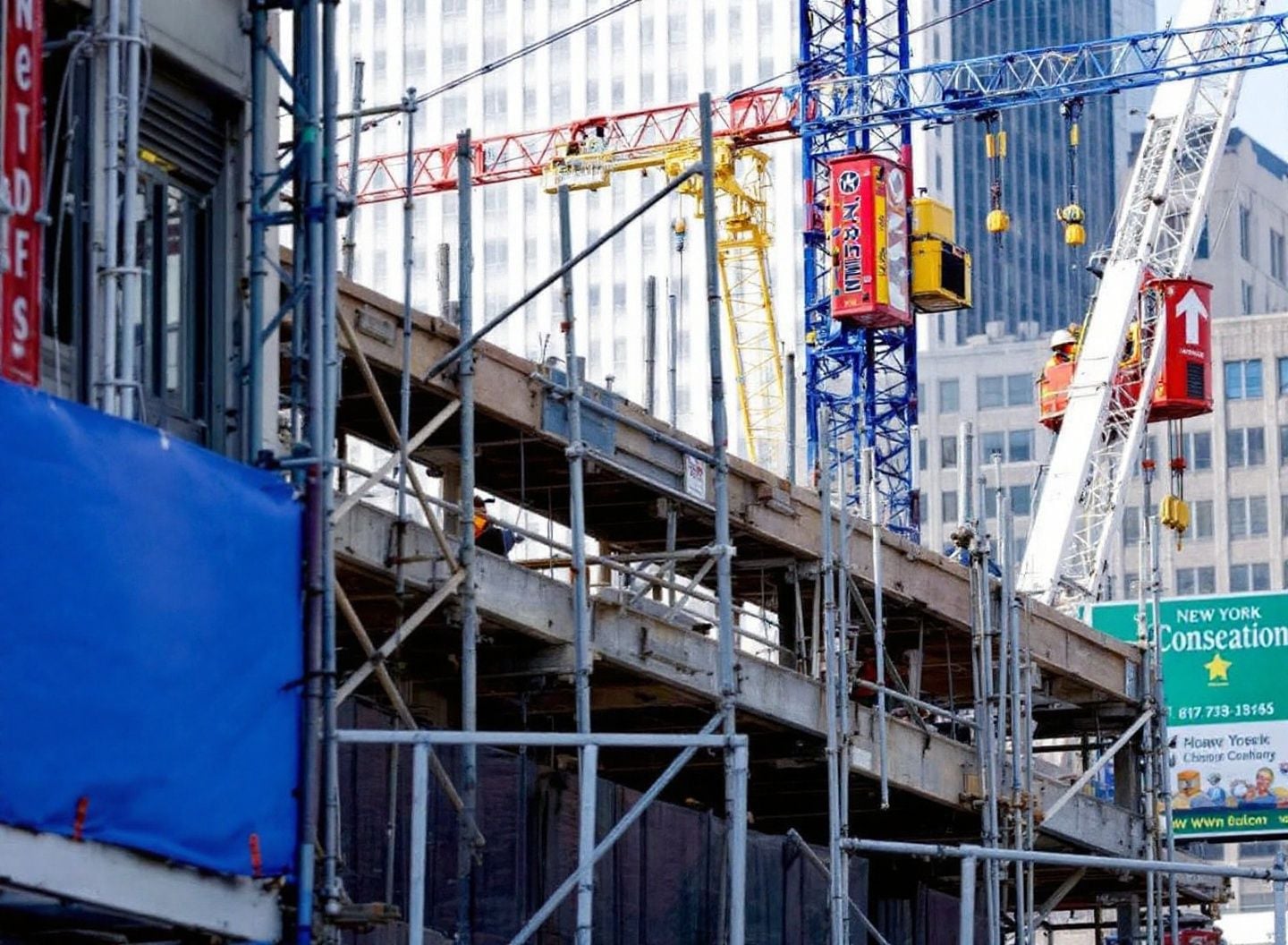
Picture a worker walking through a ground-floor corridor of a building under renovation in Manhattan. Three stories above, a crew is stripping out concrete formwork. A section of rebar, no longer secured, slides off the edge. It doesn't take much height or much weight to cause a catastrophic injury. Falling objects are one of the leading killers in the construction industry, and New York has put together one of the most worker-protective legal frameworks in the country to address exactly that hazard. Understanding how those protections work, and what happens when they fail, is essential for anyone who works on a New York job site.
Why Falling Objects Are So Dangerous on Construction Sites
The physics are unforgiving. An object dropped from even two stories converts gravitational potential energy into kinetic force rapidly. A single brick falling thirty feet strikes with enough force to penetrate a standard hard hat at certain angles. Tools, lumber, concrete chunks, scaffolding components, steel pipe sections, and loose hardware all routinely appear on elevated work surfaces. None of them have to be large to cause serious harm.
The mechanism of injury in most falling-object cases is straightforward: an unsecured item on an elevated surface gets dislodged by vibration, foot traffic, wind, or simple negligence, and a worker below has no warning and no time to move. The head and neck absorb most of the impact. Traumatic brain injuries, skull fractures, cervical spine damage, and crush injuries to the shoulders are the most common outcomes. Falls from height get more public attention, but being struck by a falling object is just as likely to end a worker's career, or their life.
Trade-specific risk matters here. Ironworkers, carpenters, roofers, and laborers working below elevated decks face constant exposure. Plumbers and electricians who work in ceiling cavities are often directly below other trades working overhead. Masonry workers on scaffolding are both a source of falling debris for those below and recipients of falling objects from higher tiers. No single trade owns this risk.
Labor Law § 240: The Scaffold Law's Falling-Object Branch
Most people know Labor Law § 240 as the Scaffold Law, and they associate it with falls from heights. That's accurate, but it's only half the picture. The statute expressly covers injuries caused by falling objects as well, not just falling workers. The statute imposes absolute liability on property owners and general contractors when they fail to furnish or erect scaffolding, hoists, stays, ladders, slings, hangers, blocks, pulleys, braces, irons, ropes, or other devices adequate to give proper protection to workers.
Courts interpreting Labor Law § 240 have consistently held that a falling-object claim requires two things: the object must have been being hoisted or secured, or it must have required securing for the purposes of the undertaking, and the failure to secure it must have been a proximate cause of the injury. This is not a negligence standard. It's strict liability. The owner and contractor can't point to the worker's own conduct as a complete defense. If the required protective device was absent or inadequate, liability attaches.
That's a meaningful distinction in practice. In a conventional negligence case, comparative fault can reduce or eliminate a worker's recovery. Under Labor Law § 240, if the statute applies and the protective device was missing or failed, the injured worker's own actions generally don't defeat the claim. The severity of injuries in falling-object cases, which often include traumatic brain injury or permanent disability, means that the value of a claim varies with the severity of the injury, the worker's age, earning capacity, and the permanence of the harm.
12 NYCRR 23-1.7: Overhead Protection Requirements in Plain Language
New York's Industrial Code takes the broad principles of Labor Law § 240 and translates them into specific, enforceable requirements. The key regulation is 12 NYCRR 23-1.7, which is titled 'Protection from general hazards' and covers, among other things, the specific hazard of overhead falling objects.
Under 12 NYCRR 23-1.7, when workers are required to work or pass beneath elevated work areas where there is a risk of falling objects, overhead protection must be provided. That protection can take several forms: solid planking, grating with openings small enough to prevent passage of debris, debris netting rated for the anticipated load, or other approved overhead protective structures. The regulation specifies that this protection must be capable of supporting the weight of any materials that might fall onto it, which means the structural adequacy of the protection is itself a code requirement, not just a suggestion.
Toe-boards are addressed separately but are equally important. A toe-board is a vertical barrier, typically four inches high or more, installed at the open edge of a scaffold platform, elevated deck, or similar surface. Its purpose is simple: to stop tools, materials, and loose debris from rolling or sliding off the edge before gravity takes over. When toe-boards are absent or inadequate, material that would have stayed on the platform becomes a projectile for anyone below.
The regulation under 12 NYCRR 23-1.7 gives contractors and site owners specific benchmarks. Vague claims that 'general safety precautions' were in place don't satisfy the code. The requirement is for actual, physical protective systems sized and rated for the actual conditions on the site. When an investigation reveals that no overhead protection was installed in a zone where workers regularly passed beneath active demolition or construction work, that's not a close call under the code.
Hurt on a Construction Site?
Tell us what happened. A licensed New York attorney will review your case and call you — free, no obligation.
Federal Standards: Where 29 CFR 1926.501 Fits In
Federal OSHA also regulates this hazard. 29 CFR 1926.501 is OSHA's primary fall protection standard for construction, and it covers both fall-from-height and falling-object scenarios. The regulation requires that contractors assess each work area for fall and falling-object hazards and implement controls. In fiscal year 2024, OSHA issued 6,307 citations under 29 CFR 1926.501 nationwide, making it consistently one of the most-cited standards in federal enforcement.
It's worth understanding how federal and state standards interact on a New York job site. OSHA sets a national floor. New York's own Industrial Code, including 12 NYCRR 23-1.7, can and often does impose stricter or more specific requirements. A violation of 29 CFR 1926.501 can be relevant evidence in a civil claim under New York law, but a worker's legal rights in New York largely rise or fall on the state statutes and regulations, not on the federal standard. Both matter, but for the purpose of a New York civil lawsuit, Labor Law § 240 and the Industrial Code carry more direct legal weight.
What Contractors and Owners Are Actually Required to Do
The obligations aren't abstract. When a general contractor is running a multi-story building project, they have affirmative duties to assess overhead hazard zones before work begins, install debris netting or overhead planking over pedestrian and worker travel paths below elevated work, install toe-boards on every open scaffold edge where materials could fall, and inspect those systems regularly. If a subcontractor's crew is working overhead while another sub's crew works below, it's not acceptable to simply instruct both crews to 'be careful.' The physical protection must be there.
Property owners share this responsibility. Under Labor Law § 240, owners are co-liable with contractors. An owner can't simply hand the site to a general contractor and walk away from the obligation. If the GC fails to install required overhead protection and a worker is injured, the owner faces liability alongside the contractor. This is intentional. The legislature designed the statute to place accountability on the parties who control the project and who are best positioned to ensure safety systems are funded and maintained.
There are limited exceptions. One-and two-family homeowners who did not direct or control the work may qualify for an exemption from Labor Law § 240 liability. But on commercial projects, multi-unit residential work, and mixed-use developments, that exemption almost never applies.
Recognizing Failures Before an Injury Happens
Workers and site safety personnel should know what a compliant overhead protection system actually looks like. Debris netting should be taut, secured to adequate anchor points, free of tears or compromised panels, and rated for the debris load expected from the work above. You'll often see substandard netting that's been patched with zip ties or left sagging between anchor points. Those aren't compliant systems. Similarly, toe-boards should be continuous along scaffold edges, secured so they can't be kicked loose, and tall enough to stop rolling material. A toe-board that's been partially removed to ease material access and not replaced is a violation of the code and a hazard to anyone below.
On demolition jobs, the falling-object risk is highest when structural elements are being cut, broken, or removed. Concrete chunks, brick sections, and timber members can fall unpredictably. The Industrial Code and Labor Law § 240 apply fully to demolition work, and in practice, demolition often presents some of the most serious falling-object injuries because the materials involved are heavy and the work produces debris in large, unpredictable quantities.
What an Injured Worker Should Know
If you're struck by a falling object on a New York construction site, several steps matter immediately. Report the incident to your supervisor and make sure an incident report is created. Get medical attention, even if you feel the impact was minor, because traumatic brain injuries and concussions don't always present obvious symptoms right away. Document the scene if you can, note what fell, where it came from, and what overhead protection (if any) was or wasn't in place.
Workers' compensation covers medical treatment and a portion of lost wages, but it doesn't cover pain and suffering, and it doesn't fully compensate for permanent disability. A Labor Law § 240 claim, if the facts support it, provides a separate avenue for full damages. Those two claims can coexist. Workers' compensation doesn't prevent a Labor Law claim against the owner or general contractor. An attorney with experience in New York construction injury cases can help you understand which claims apply to your specific situation.
There are time limits. New York's statute of limitations for personal injury claims is generally three years from the date of injury. Claims against municipal entities, like the City of New York, require a Notice of Claim filed within 90 days and have a shorter overall limitations period. Missing those deadlines can eliminate otherwise valid claims entirely, so getting legal advice promptly matters.
Attorney Advertising. Prior results do not guarantee a similar outcome. This article is for general informational purposes only and does not constitute legal advice. NY Construction Advocate connects injured workers with experienced New York construction accident attorneys.
Frequently Asked Questions
Does Labor Law § 240 cover injuries from falling objects, or only falls from heights?▼
What does 12 NYCRR 23-1.7 specifically require for overhead protection?▼
What is the purpose of a toe-board and what does NY law require?▼
How does 29 CFR 1926.501 relate to a New York civil lawsuit after a falling-object injury?▼
Can a property owner be held liable if a subcontractor failed to install required overhead protection?▼
If I'm receiving workers' compensation benefits, can I still bring a Labor Law claim against the property owner or contractor?▼
What types of objects most commonly cause falling-object injuries on New York construction sites?▼
Get a Free Case Review
Find out if you have a claim under New York Labor Law. A licensed NY attorney will review your case and call you back.