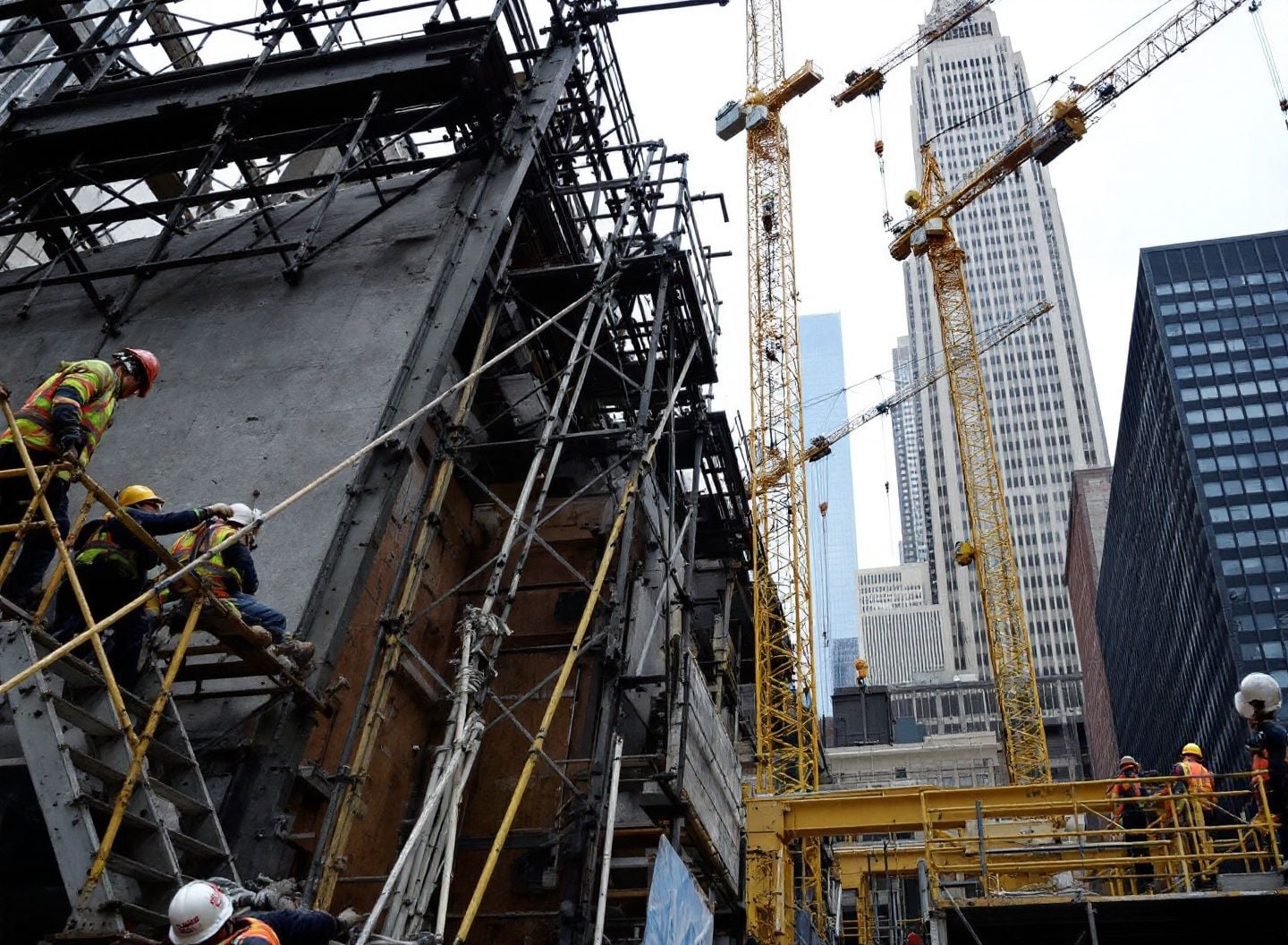
Demolition isn't just construction in reverse. It's one of the most physically dangerous categories of work on any New York job site, and the hazards it creates don't follow a tidy sequence. Floors give way before workers are warned. Debris cascades from above without notice. Dust and silica hang in air that should have been cleared. And unlike new construction, where you're building upward with some predictability, demolition involves dismantling structures that may already be compromised, structurally unsound, or contaminated with hazardous materials. That combination of unpredictability and physical violence makes demolition accidents among the most severe in the industry.
If you're a demolition worker injured on a New York job site, or the family member of one, understanding the safety rules that were supposed to protect you, and what legal options exist when those rules are ignored, is essential. This article walks through the federal and state regulations governing demolition work, the most common injury mechanisms, and the framework New York law provides for injured workers seeking accountability.
The Distinct Dangers of Demolition Work
Demolition workers face a category of risk that's qualitatively different from what most other trades encounter. A carpenter working on new framing can look at a structure and reason about its integrity. A demolition worker often can't. Floors are weakened before removal begins. Load-bearing walls may have already been partially cut. Mechanical and electrical systems, if not properly de-energized and disconnected, pose additional hazards throughout the work.
The most catastrophic injury mechanisms in demolition include structural collapse, falling debris, unprotected floor openings, inadequate shoring, and exposure to hazardous materials. Partial collapses, where a portion of a floor or wall gives way unexpectedly, are particularly dangerous because workers may not have any warning before the ground simply disappears beneath them. Debris falls are similarly unpredictable. Workers on lower floors or in adjacent areas can be struck by materials dislodged from above, and without adequate debris netting, barricades, or covered walkways, the risk extends to anyone on or near the site.
Trade-specific risks vary. Ironworkers involved in structural steel demolition face unique hazards from cutting operations that can destabilize members before they're properly supported. Laborers clearing rubble work in environments where unseen voids and unstable debris piles create fall and burial risks. Asbestos abatement workers face respiratory and toxic exposure hazards layered on top of the physical dangers. No single trade in demolition is without significant risk.
Federal Standards: OSHA 1926 Subpart T and Fall Protection Rules
At the federal level, demolition work on construction sites is governed primarily by OSHA's 29 CFR 1926 Subpart T, which specifically addresses demolition operations. Subpart T requires that before any demolition begins, a competent person must conduct an engineering survey of the structure to determine the condition of framing, floors, and walls, and to assess the possibility of unplanned collapse. This isn't paperwork for its own sake. It's the mechanism by which hazards are identified before workers are exposed to them. Subpart T also addresses utility disconnection, hazardous material control, stairways, floor openings, and the removal of materials.
Fall protection requirements under 29 CFR 1926.501 apply directly to demolition work. Under that standard, workers who may be exposed to fall hazards of six feet or more must be protected by guardrail systems, safety net systems, or personal fall arrest systems. In fiscal year 2024, fall protection violations under 29 CFR 1926.501 generated 6,307 citations nationwide, making it the single most-cited OSHA standard year after year. That number reflects a persistent, industry-wide failure to protect workers from the hazard most likely to kill them. In demolition, where floor openings are routinely created and edges are constantly changing, the failure to comply with 29 CFR 1926.501 is especially dangerous.
OSHA citations against an employer can be significant evidence in a civil lawsuit, but they aren't the same as a civil judgment. An OSHA citation establishes that a regulatory violation occurred. It doesn't automatically resolve what damages a worker is owed or who bears legal responsibility for the injury. That analysis requires applying New York's own statutory framework.
New York's Industrial Code: 12 NYCRR 23-1.7 and Part 23-3
New York has its own industrial safety code, and for demolition workers, two sections are especially important: 12 NYCRR 23-1.7 and Part 23-3.
12 NYCRR 23-1.7 sets out safety rules designed to protect persons employed in construction, demolition, and excavation work. It addresses a range of hazards that demolition workers face, including protection from falling materials, requirements for overhead protection, and safeguards against hazards in areas where workers could be struck or fall. These regulations exist to implement Labor Law Section 241(6) by defining, with specificity, the safety practices required on covered job sites. When a violation of 12 NYCRR 23-1.7 contributes to a worker's injury, that violation can form the basis of a civil claim under Section 241(6).
12 NYCRR Part 23-3 deals specifically with demolition operations. It covers requirements for the methodical removal of materials, prohibitions against certain dangerous practices like dropping debris through floors without adequate protection, requirements for structural support during partial demolition, and obligations around dust and debris control. These aren't aspirational guidelines. They're mandatory minimum standards, and contractors and property owners who fail to follow them can be held legally accountable when workers are injured as a result.
Labor Law Section 241(6): The Core Legal Claim for Injured Demolition Workers
Labor Law § 241(6) is one of New York's most powerful tools for construction and demolition workers injured on the job. It requires that construction, excavation, and demolition work be conducted in a way that provides reasonable and adequate protection and safety for workers. Critically, it imposes that obligation on owners and general contractors, not just on the direct employer. This matters enormously for demolition workers, who are often employed by subcontractors with limited resources, working on projects where a general contractor or building owner controlled the overall safety conditions of the site.
Under Labor Law § 241(6), a worker doesn't have to prove that the owner or general contractor was directly negligent in the traditional sense. They have to show that a specific, concrete regulatory standard, such as a provision of 12 NYCRR 23-1.7 or Part 23-3, was violated and that the violation was a proximate cause of the injury. This is sometimes called a "non-delegable" duty. Even if the owner hired a general contractor, and the general contractor hired a subcontractor, and the subcontractor employed the worker, the owner and the general contractor remain legally responsible under Section 241(6) for violations that injured the worker.
Hurt on a Construction Site?
Tell us what happened. A licensed New York attorney will review your case and call you — free, no obligation.
Labor Law § 241(6) also expressly includes demolition within its scope. The statute covers construction, excavation, and demolition work, meaning that injured demolition workers have the same access to this statutory framework as any other covered trade. This is significant because workers' compensation alone rarely covers the full scope of a serious injury. A Section 241(6) claim against an owner or general contractor can reach damages that workers' compensation doesn't address, including pain and suffering. The value of those damages varies with the severity of the injury, the impact on the worker's ability to earn a living, and the long-term nature of any disability.
Fireproof Flooring and the Duty to Protect as Work Progresses
Labor Law § 241 also includes a specific obligation related to flooring. Builders must complete fireproof flooring as work progresses. In a demolition context, this provision reflects a broader principle: the duty to maintain safe surfaces and protect workers from fall hazards created by the ongoing work doesn't pause just because the project involves taking something apart rather than building it. As floors are removed, the remaining structure must be shored, protected, or clearly barricaded to prevent workers from falling into open areas below.
When demolition crews remove floors in sequence without maintaining adequate protection at the perimeter or around interior openings, they're violating both this statutory principle and the specific requirements of 12 NYCRR 23-1.7. Falls through floor openings are one of the more common catastrophic injury mechanisms in demolition, and they're among the most preventable.
Who Can Be Held Responsible After a Demolition Accident?
New York's Labor Law claims are primarily directed at property owners and general contractors, because those are the parties with the authority to ensure that safety rules are followed across the entire project. A property owner who hires a general contractor to oversee demolition can't escape liability simply by pointing to the contractor. The duty under Labor Law § 241(6) is non-delegable, meaning it follows the owner regardless of who they hired.
General contractors, in turn, are responsible for coordinating safety across all subcontractors on the site. If a subcontractor's crew creates a fall hazard by removing a section of floor without covering or barricading the opening, and another trade's worker falls through, the general contractor's failure to enforce safety standards is relevant to liability.
Architects, engineers, and demolition supervisors may also have independent legal exposure depending on their role in the project and how closely they were involved in directing the manner of the work. Equipment manufacturers may be liable if a tool or machine failure contributed to the injury. Workers' compensation covers injuries from an employee's own employer, but it doesn't bar claims against third parties, and third-party claims under Labor Law § 241(6) are often the most significant legal avenue available to a seriously injured demolition worker.
Practical Steps After a Demolition Accident
If you're injured in a demolition accident, the actions you take in the days and weeks immediately after the injury can affect your legal options significantly. Report the accident in writing to your employer and supervisor as soon as possible. Seek medical attention immediately and follow your doctor's instructions, both for your health and because the medical record documents the nature and severity of your injury. If you're physically able to do so safely, photograph the accident scene before conditions change. Conditions on demolition sites change rapidly. Evidence of an unguarded opening, missing shoring, or inadequate debris protection can disappear quickly once work resumes or the site is cleaned up.
Identify any witnesses who saw the accident or who are familiar with the unsafe conditions that caused it. Preserve any documents you have, including your work assignment, any safety training records, and any communications about conditions on the site. And consult with an attorney who handles New York Labor Law cases before making any statements to insurance adjusters for the owner or general contractor. Those adjusters represent the interests of the party that may be liable to you, not your interests.
The statutes of limitations on construction accident claims in New York are not unlimited. Claims under Labor Law § 241(6) are generally subject to a three-year statute of limitations, but certain defendants, particularly government entities, require notice filings within much shorter windows. Waiting too long can permanently foreclose your right to recover.
Why Demolition Cases Are Complex
Demolition accident cases present legal and factual challenges that make experienced legal representation important. Unlike a straightforward construction accident, demolition cases often involve questions about the structural condition of the building before the accident, whether a pre-existing defect caused the collapse or whether it resulted from the demolition method. Defendants routinely argue that the injured worker was the one who created the hazard, or that the worker's own conduct was the primary cause of the accident. New York's comparative fault rules mean that a worker's own negligence can reduce recovery, so the factual record of exactly what happened and why matters enormously.
Expert witnesses, including structural engineers, demolition safety specialists, and occupational health experts, are frequently necessary to establish what safety standards required, what the actual conditions on the site were, and what caused the accident. The intersection of federal OSHA standards under 29 CFR 1926.501 and Subpart T with New York's Industrial Code provisions under 12 NYCRR 23-1.7 and the statutory framework of Labor Law § 241(6) requires careful analysis in each case.
None of that complexity is a reason not to pursue a claim. It's a reason to take the claim seriously, build the factual record carefully, and work with attorneys who understand the specific legal standards that govern demolition work in New York. Workers injured in demolition accidents often suffer serious, long-term consequences. The law gives them real avenues for accountability.
Attorney Advertising. Prior results do not guarantee a similar outcome. This article is for general informational purposes only and does not constitute legal advice. NY Construction Advocate connects injured workers with experienced New York construction accident attorneys.
Frequently Asked Questions
Does Labor Law § 241(6) apply to demolition workers, or only to workers doing new construction?▼
What is 12 NYCRR 23-1.7, and how does it apply to a demolition accident claim?▼
Can I sue the building owner if I was employed by a demolition subcontractor?▼
How does 29 CFR 1926.501 relate to a New York demolition accident claim?▼
What if the collapse was caused by the existing condition of the building before demolition started?▼
How long do I have to file a claim after a demolition accident in New York?▼
What kinds of damages can a seriously injured demolition worker recover in a Labor Law claim?▼
Get a Free Case Review
Find out if you have a claim under New York Labor Law. A licensed NY attorney will review your case and call you back.