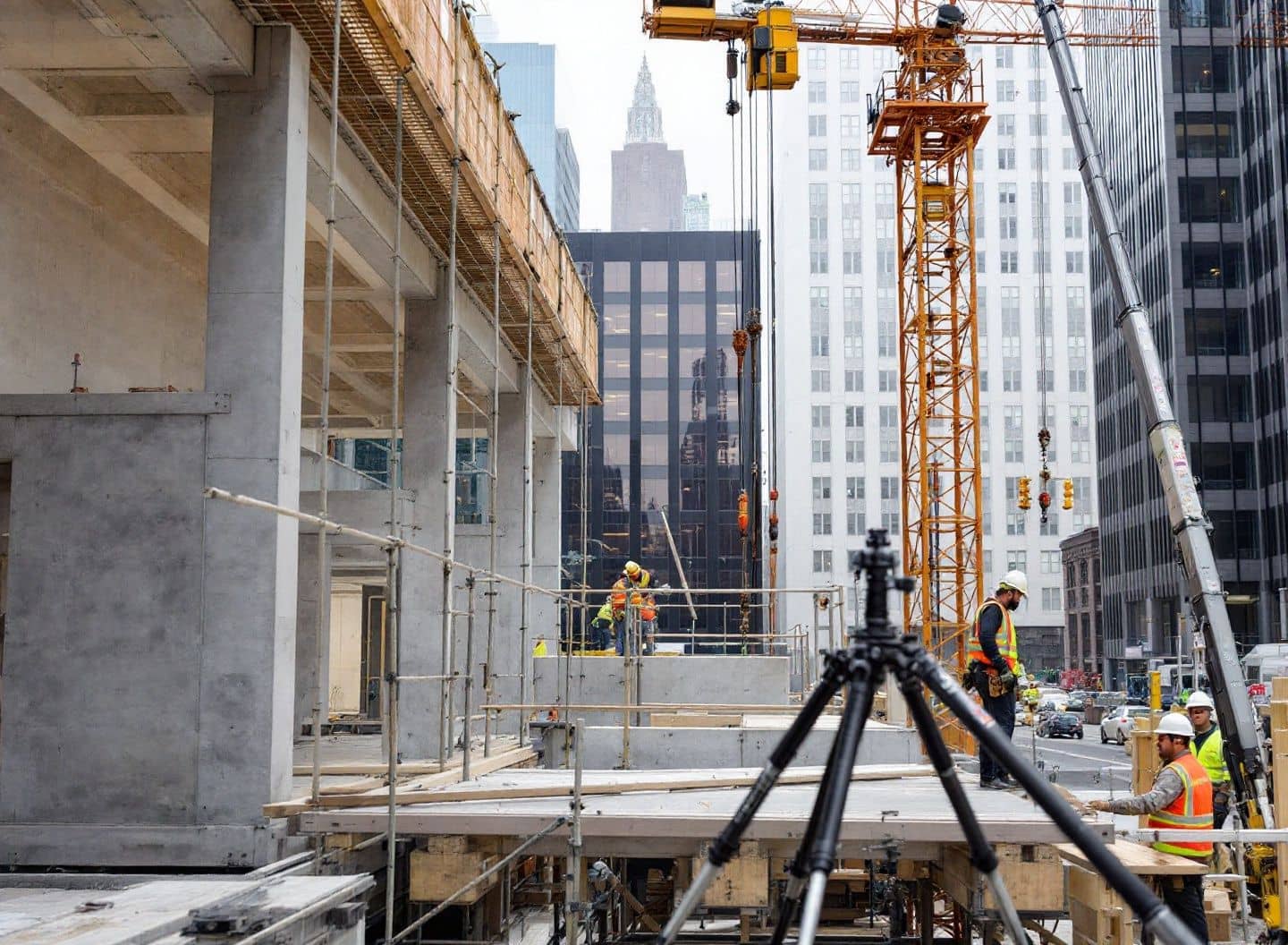
New York's construction industry is built on height. Ironworkers walk steel beams dozens of stories above street level. Carpenters erect scaffold platforms across the faces of skyscrapers. Laborers hoist materials up through open elevator shafts. Gravity is a constant presence, and when safety systems fail, the consequences are severe or fatal. To address that reality, the New York State Legislature enacted what practitioners call the Scaffold Law, codified as Labor Law § 240. The statute is unusually broad by national standards, but it doesn't operate as a single, uniform rule. Within its text, courts have developed two distinct branches of analysis: one for workers who fall, and one for objects that fall onto workers. Understanding how those two branches work—and where they diverge—can mean the difference between a viable claim and a dismissed one.
What Labor Law § 240 Actually Says
Labor Law § 240 imposes a duty on contractors, property owners, and their agents to furnish or erect scaffolding, hoists, stays, ladders, slings, hangers, blocks, pulleys, braces, irons, ropes, and other devices so that workers are properly protected during construction, demolition, or repair work. An injured worker doesn't need to prove that the owner or contractor was negligent in the traditional sense. Under § 240(1), an owner or general contractor can be liable when a required safety device was missing or failed to give proper protection against an elevation-related risk and that violation was a proximate cause of the injury. Once both are shown, the worker's comparative negligence does not reduce recovery.
That liability rule is what makes Labor Law § 240 so significant in New York practice. It's also what makes the two branches of the law worth examining carefully, because not every gravity-related accident fits comfortably into one category.
Branch One: When the Worker Falls
The falling-worker branch of Labor Law § 240 is the one most people picture when they hear 'Scaffold Law.' A carpenter stands on a scaffold platform, a plank gives way, and he drops ten feet onto concrete. A roofer leans against a parapet that isn't secured, loses her footing, and tumbles off the edge of a building. An ironworker descends a ladder that shifts under his weight because it isn't tied off at the top, and he hits the ground before anyone can react.
In each scenario, the worker's own body is the object acted upon by gravity. Courts analyzing these claims ask a straightforward question: did the safety device—scaffold, ladder, harness, lifeline—fail to protect the worker from an elevation-related risk? If the answer is yes and that failure was a proximate cause of the injury, the owner and contractor can be liable. The worker doesn't have to identify exactly which plank split or exactly which guardrail was missing. What matters is that the protective system didn't do its job.
How Scaffold Planks Fail and Why It Matters
Planking failure is one of the most common mechanisms in falling-worker cases. A scaffold platform is only as safe as the planks supporting it. When planks are undersized for the span, improperly overlapped, or allowed to become wet and brittle over a long project, they can deflect suddenly under a worker's weight. At ten feet—a height common on interior renovation jobs—a free fall onto concrete or steel produces forces that exceed what the human spine, pelvis, and skull are designed to absorb. At thirty or forty feet, the injuries are often unsurvivable.
The federal scaffold safety standard, 29 CFR 1926.451, received 1,873 citations nationwide in fiscal year 2024, according to preliminary OSHA data reported by Safety+Health magazine, making it one of OSHA's most-cited regulations. That number reflects how frequently scaffold-related hazards exist on real job sites. New York has its own parallel scaffolding safety rules under 12 NYCRR 23-5, which sets out detailed requirements for scaffold construction, capacity, planking, guardrails, and access. When a worker is injured and those state regulations were violated, the violation can support not only a Labor Law § 240 claim but also a separate claim under Labor Law § 241(6), which expressly incorporates specific safety regulations like 12 NYCRR 23-5.
Guardrail Absence: A Preventable Hazard
Guardrail absence is the other frequent culprit in falling-worker cases. Both 29 CFR 1926.451 and 12 NYCRR 23-5 require top rails, mid-rails, and toeboards at open scaffold edges above certain heights. When those components are missing—because a supervisor decided they slowed production, or because no one on the crew was assigned to install them—a worker who loses balance has nothing to arrest the fall. It doesn't matter that the worker was experienced or that conditions seemed fine all morning. A single misstep, a jostling coworker, or a momentary loss of concentration can be enough.
Courts have consistently held that an owner or contractor can't escape liability under Labor Law § 240 simply by arguing that the worker should have been more careful. The whole point of the statute is to place the burden of providing safe working conditions on the parties with the resources and authority to do so, not on individual workers who often can't refuse dangerous assignments without risking their jobs.
Branch Two: When an Object Falls on a Worker
The falling-object branch of Labor Law § 240 protects workers who are struck by materials, tools, or equipment that fall from an elevation. Think of a bundle of rebar that slips from a crane sling, a bucket of concrete that tips off an unsecured platform, or a heavy wrench that falls from a scaffold tier above where another trade is working below.
On the surface, falling-object claims look similar to falling-worker claims because both involve gravity and height. But the New York Court of Appeals has drawn a meaningful distinction. In a falling-worker case, the analysis is relatively direct: was there a safety device, and did it fail? In a falling-object case, the courts have required an additional showing: the object must have been a load that required securing for the purposes of the work being performed, and it must have fallen because an adequate safety device wasn't provided to prevent it from falling.
The 'Required Securing' Requirement
Hurt on a Construction Site?
Tell us what happened. A licensed New York attorney will review your case and call you — free, no obligation.
That 'required securing' element has generated substantial litigation. Courts have found that Labor Law § 240 covers falling-object injuries when the object was being hoisted, stored at elevation, or otherwise positioned in a way that required it to be secured against falling. It doesn't cover every situation where something heavy happens to drop. If a worker drops a hand tool from waist level and it falls a few inches, that's not a Labor Law § 240 case. But if that same tool falls from a scaffold platform twenty feet above a worker's head because there was no toeboard or netting to catch it, courts are more willing to find coverage.
The practical consequence of this distinction is that falling-object plaintiffs often face more scrutiny during litigation. Defense attorneys will challenge whether the object was actually 'being secured' or was simply in use. Plaintiffs need to build a factual record showing that the object was at an elevation, that it posed a foreseeable falling risk, and that an appropriate safety device (a debris net, a toeboard under 12 NYCRR 23-5, a secured platform edge) would have prevented the injury.
Where the Two Branches Overlap and Diverge
Both branches share the statute's core features: owner and contractor liability for a § 240(1) violation that was a proximate cause of the injury, coverage during construction and demolition, and the requirement that the injury arise from a risk related to elevation. Both branches also share the same defenses. Liability won't attach if the worker was the 'sole proximate cause' of the injury, meaning adequate safety devices were available, the worker knew both that they were available and that he or she was expected to use them, chose for no good reason not to, and would not have been injured had they been used. The related recalcitrant-worker defense requires more than a warning: it applies when a worker deliberately refused to use safety devices that were actually provided.
But the branches diverge in important ways. In a falling-worker case, a fall alone is insufficient; the worker must show a § 240(1) violation that proximately caused the injury. Falling-object cases require the extra step of demonstrating that the object needed to be secured and wasn't. That said, falling-object cases can be just as serious in terms of injury severity. A heavy beam or masonry block falling even a modest distance can cause traumatic brain injury, spinal cord damage, or crush injuries to the chest or limbs. The value of any given claim varies with the severity of the injury and its long-term impact on the worker's ability to earn a living and perform daily activities.
Trade-Specific Risks Worth Knowing
Different construction trades face different gravity-related exposures, and those differences shape which branch of Labor Law § 240 is most relevant.
What Injured Workers Should Know About Pursuing a Claim
If you've been hurt in a gravity-related construction accident in New York, a few things matter from the start. First, the statute of limitations is three years from the date of injury for a Labor Law § 240 claim. That sounds like a long time, but evidence disappears quickly on construction sites. Scaffolds get reconfigured or torn down. Broken planks get discarded. Witness recollections fade. Getting legal advice as early as possible helps preserve the evidence that supports either branch of a claim.
Second, notify your employer in writing about the accident and preserve any photos or video you or a coworker took at the scene. If OSHA inspected the site after the accident, the inspection records can be valuable. If the site was governed by a general contractor, that contractor may be liable alongside the property owner, regardless of which subcontractor employed you.
Third, don't assume that because you have workers' compensation coverage you can't bring a Labor Law § 240 claim. Workers' compensation and a third-party Labor Law action are separate. Workers' comp covers your employer's liability; a Labor Law § 240 claim runs against the owner and general contractor, who are third parties relative to your employment relationship. Many injured construction workers in New York pursue both simultaneously.
Labor Law § 240 exists because the New York Legislature made a deliberate policy choice: the parties with the power and money to make construction sites safe should bear the consequences when they don't. That policy doesn't change depending on whether you fell from a scaffold or something fell on you. But knowing which branch applies to your situation helps you and your attorney frame the claim correctly from the beginning.
Attorney Advertising. Prior results do not guarantee a similar outcome. This article is for general informational purposes only and does not constitute legal advice. NY Construction Advocate connects injured workers with experienced New York construction accident attorneys.
Primary sources
Frequently Asked Questions
What is the difference between a falling-worker claim and a falling-object claim under Labor Law § 240?▼
Does a worker's own carelessness defeat a Labor Law § 240 claim in New York?▼
Who can be held liable under Labor Law § 240?▼
How do state scaffold regulations like 12 NYCRR 23-5 relate to a Labor Law § 240 claim?▼
Can a worker bring a Labor Law § 240 claim if they also receive workers' compensation benefits?▼
Does a falling-object injury have to involve something falling a great distance to qualify under Labor Law § 240?▼
How long does a construction worker have to file a Labor Law § 240 claim in New York?▼
Get a Free Case Review
Find out if you have a claim under New York Labor Law. A licensed NY attorney will review your case and call you back.