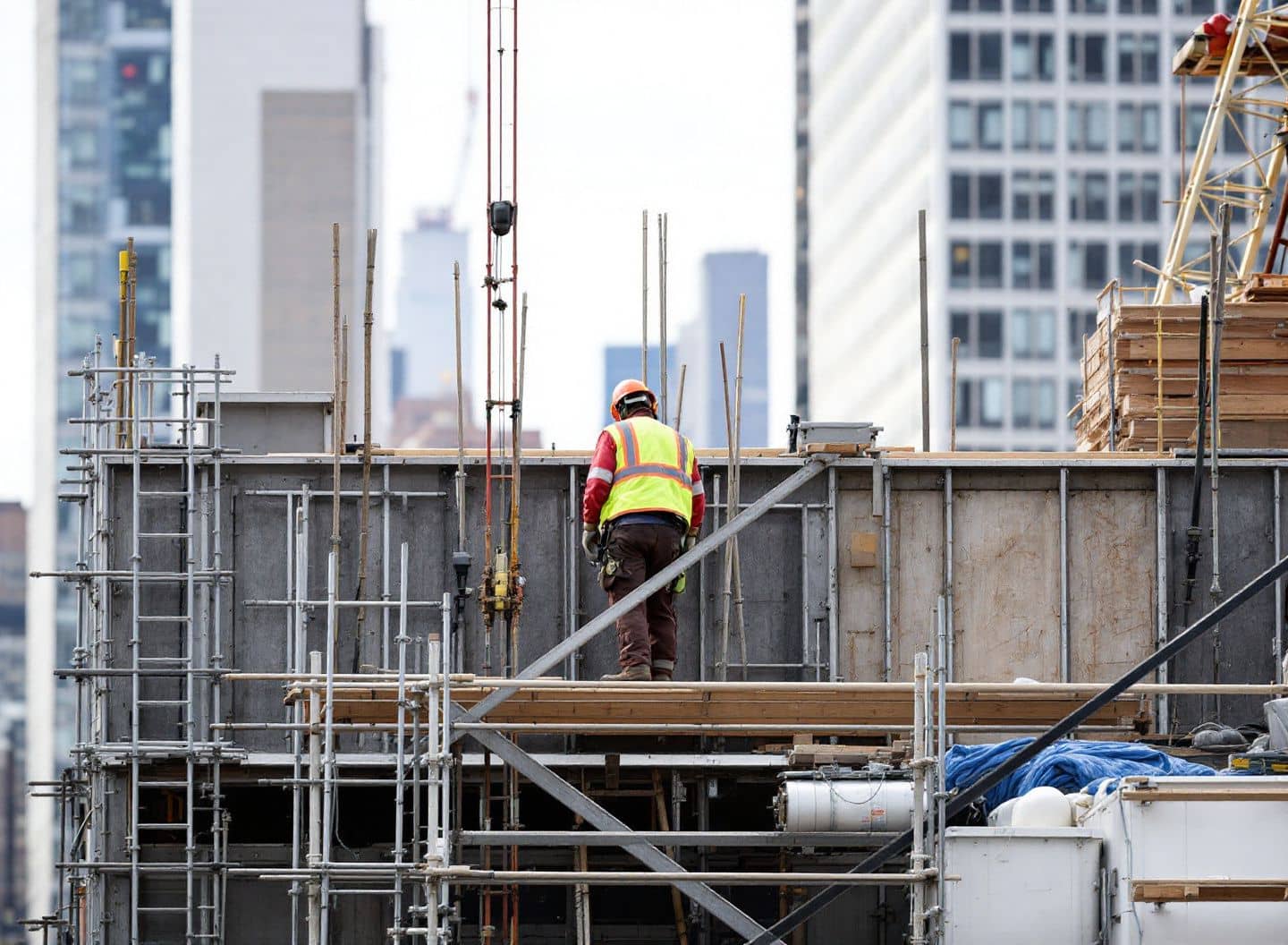
A worker walks across a roof deck to reach the far side of a job site. The surface looks solid. Then, without any warning creak or visual cue, a skylight cover or a section of corrugated fiberglass gives way. The fall is instant. The injuries that follow can change a person's life permanently. This kind of accident doesn't get the same public attention as a crane collapse or a scaffold drop, but falls through skylights and fragile roofing materials are among the most dangerous events on New York construction sites. They're also among the most preventable—which is exactly why state and federal law impose strict duties on owners, contractors, and their agents.
Why Skylights and Fragile Roofs Are So Dangerous
The mechanism of injury here is deceptively simple. A worker is on an elevated surface, often a low-slope commercial roof, performing tasks like roofing, HVAC installation, electrical work, or general construction. Skylights are frequently covered with lightweight plastic, fiberglass, or glass panels that were never designed to support a person's weight. On older buildings, those panels may have become brittle or cracked over time. They don't look different from the surrounding roof deck. A worker who steps on one doesn't get a second chance to course-correct.
Fragile roof sections are a separate but related hazard. Metal decking that hasn't been fastened, deteriorating fiberglass panels used as skylighting on industrial buildings, rot-weakened wooden sheathing, and corroded metal roofing can all give way under a worker's weight. Roofers, sheet metal workers, ironworkers, electricians, and HVAC technicians are especially exposed because their work routinely takes them across the full surface of a roof, not just along fixed pathways. That means more exposure, more steps, and more chances for an unguarded opening or a weak surface to become a fatal hazard.
Falls from roof level to a floor below can involve drops of ten, twenty, thirty feet or more. The injuries that follow vary enormously but commonly include traumatic brain injury, spinal cord damage, shattered pelvis and femur fractures, internal organ damage, and severe soft tissue injuries. Many of these injuries require surgery, extended hospitalization, and long-term rehabilitation. Some result in permanent disability. The value of a legal claim varies with the severity of the injury, the permanence of any disability, the nature of the work lost, and other factors specific to each worker's situation.
What New York's Industrial Code Requires for Roof and Skylight Protection
New York State's Industrial Code, specifically 12 NYCRR 23-1.7, sets out detailed safety requirements for workers employed in construction, demolition, and excavation operations. This regulation implements Labor Law Section 241(6), which means a proven violation of 12 NYCRR 23-1.7 can serve as the basis for a negligence claim against a property owner or general contractor even if they claim they didn't know about the hazard. That's an important distinction. Under Section 241(6), liability isn't absolute the way it is under Section 240, but a specific regulatory violation still creates a powerful basis for legal accountability.
Under 12 NYCRR 23-1.7, hazardous openings in floors, roofs, and similar surfaces must be guarded or covered. A skylight that has been removed, broken, or was never structurally sound qualifies as a hazardous opening. The regulation requires that such openings be covered with material strong enough to support any load likely to be imposed on it, or that they be guarded by standard railings or equivalent barriers. Leaving a skylight frame open without any cover or barrier, or placing a flimsy plastic sheet over a skylight and calling it a cover, doesn't meet this standard.
Fragile roof sections that aren't openings but that can't safely support worker weight present a different compliance challenge. The code requires that workers walking or working on such surfaces be provided with crawling boards, ladders, or other devices that distribute load and prevent a worker from making direct contact with the fragile material. The obligation to supply those devices rests on the contractor and, under certain circumstances, the property owner. It doesn't shift to the worker just because the worker was experienced or was told to be careful.
Labor Law § 240 and the Gravity-Related Injury Rule
Labor Law § 240 is often called the Scaffold Law, but its reach extends far beyond scaffolding. The statute requires that contractors, owners, and their agents furnish or erect scaffolding, hoists, ladders, stays, braces, irons, ropes, and other protective devices to give workers proper protection when engaged in building construction, repair, or demolition. Falls through skylights and fragile roof surfaces fall squarely within the statute's scope because they are gravity-related events where the worker falls from one level to a lower one.
New York courts have consistently held that Labor Law § 240 applies to skylight falls and through-the-roof accidents. The injured worker doesn't have to prove that someone was careless in a traditional negligence sense. They need to show that a protective device that should have been in place was absent or inadequate, and that this failure was a contributing cause of the fall. Comparative fault on the worker's part doesn't automatically reduce recovery under Section 240 the way it does in a standard negligence case. If the sole proximate cause of the accident was the worker's own conduct, that can be a defense, but the bar for establishing that defense is high.
This matters because construction workers often have no control over the condition of the roof they're sent to work on. The general contractor, the building owner, or both had the authority and the obligation to inspect the work environment, identify the hazardous skylight or weak roof section, and make sure proper protection was in place. When they fail to do that, the law holds them responsible for the consequences.
Federal OSHA Requirements Under 29 CFR 1926.501
Hurt on a Construction Site?
Tell us what happened. A licensed New York attorney will review your case and call you — free, no obligation.
Federal law adds its own layer of protection. Under 29 CFR 1926.501, employers on construction sites are required to provide fall protection for any worker exposed to a fall of six feet or more to a lower level. Skylights and roof openings receive specific attention in the regulation. Employers must either guard skylights with covers that can support the weight of a worker and equipment, or install standard guardrails on all exposed sides. Simply covering a skylight with something that can't bear a load, or relying on a worker's awareness of the hazard, doesn't satisfy the standard.
For low-slope roofs, 29 CFR 1926.501 requires fall protection systems for workers within six feet of an unprotected edge. That protection can take the form of guardrails, safety nets, or personal fall arrest systems. On steep roofs, the requirements are similar. Employers are not permitted to substitute warnings, verbal cautions, or general training for actual physical protection. The regulation is straightforward: either the worker is protected by a system that will stop a fall, or the employer is in violation.
The scale of non-compliance nationally is significant. In FY2024, there were 6,307 citations issued nationwide under 29 CFR 1926.501, making fall protection the single most-cited OSHA construction standard for yet another year. That statistic tells us something important: skylight and roof falls aren't rare accidents that happen despite everyone's best efforts. They happen because fall protection requirements aren't being followed, consistently, across the industry.
Who Bears Legal Responsibility When a Worker Falls Through a Roof
In New York construction injury cases, identifying the responsible parties requires looking carefully at the project structure. Labor Law § 240 and Labor Law § 241(6) both impose liability on owners of the property and general contractors. A general contractor who directed, supervised, or controlled the work, or who had the authority to correct the condition, can be held liable even if the worker was employed by a subcontractor. Building owners who hired the general contractor are also covered, with limited exceptions for true owner-occupied single-family homes.
The worker's direct employer is a separate question. Under New York's workers' compensation system, an injured worker generally can't sue their own employer directly. But they can bring claims under Labor Law § 240 and § 241(6) against the owner and general contractor, and those claims are separate from any workers' compensation benefits. Workers' compensation and a Labor Law claim can both be pursued; they serve different purposes and cover different aspects of the harm.
There may also be product liability angles if the skylight itself was defective, or third-party claims if another subcontractor created or ignored the hazard. These issues are fact-specific and depend on the particular details of each case. An attorney who handles New York construction accidents can assess which theories apply based on who owned the site, how the work was structured, and what safety measures were or weren't in place.
Steps Workers and Families Should Take After a Skylight or Roof Fall
If you or a family member has been injured in a fall through a skylight or fragile roof on a New York construction site, there are a few things that matter a great deal in the period right after the accident. First, get medical care immediately and make sure all treatment is documented thoroughly. The medical record is a foundational piece of any legal claim. Second, if it's safe to do so, photographs of the site taken before conditions change can be invaluable. Skylights get covered, boards get placed, warnings get posted after the fact. Evidence of what was actually in place at the time of the fall is critical.
Third, be careful about what you say to the general contractor, site supervisor, or insurance adjuster in the hours and days after an accident. You're not required to give a recorded statement to anyone other than law enforcement, and statements made in pain or confusion can sometimes be taken out of context later. Fourth, consult a construction accident attorney as soon as possible. Preservation of evidence, identification of responsible parties, and compliance with any notice requirements are all time-sensitive. New York's statute of limitations for personal injury claims is generally three years, but certain claims against public entities require a notice of claim within 90 days, so timing matters.
The Broader Safety Picture: Prevention Is the Real Goal
Legal rights matter, but prevention matters more. Every fall through a skylight or fragile roof represents a failure somewhere in the safety chain. A site safety plan should identify every skylight on the roof before work begins. Covers should be installed, secured, and marked. Fragile sections should be identified during a pre-work survey and appropriate walking surfaces, crawling boards, or barriers should be established before workers go anywhere near those areas. Personal fall arrest systems should be available and worn when workers are near unprotected edges or working on surfaces that can't be fully evaluated.
The duty to create that safety environment rests primarily on owners, contractors, and their agents, not on individual workers. That's the whole point of Labor Law § 240, 12 NYCRR 23-1.7, and 29 CFR 1926.501. These laws exist because workers are often in no position to demand better conditions without risking their jobs. The legal framework shifts the incentive to the parties who control the worksite and have the authority to make it safe.
Attorney Advertising. Prior results do not guarantee a similar outcome. This article is for general informational purposes only and does not constitute legal advice. NY Construction Advocate connects injured workers with experienced New York construction accident attorneys.
Primary sources
Frequently Asked Questions
Does Labor Law § 240 cover falls through skylights, or only falls from scaffolding?▼
What does 12 NYCRR 23-1.7 actually require for skylight protection on construction sites?▼
What does OSHA require for skylight protection under 29 CFR 1926.501?▼
Can I still make a claim if my employer says I was at fault for stepping on the skylight?▼
If I'm receiving workers' compensation, can I still sue the building owner or general contractor?▼
What trades are most at risk for skylight and fragile roof falls on New York construction sites?▼
How soon after a construction fall should I contact an attorney?▼
Get a Free Case Review
Find out if you have a claim under New York Labor Law. A licensed NY attorney will review your case and call you back.