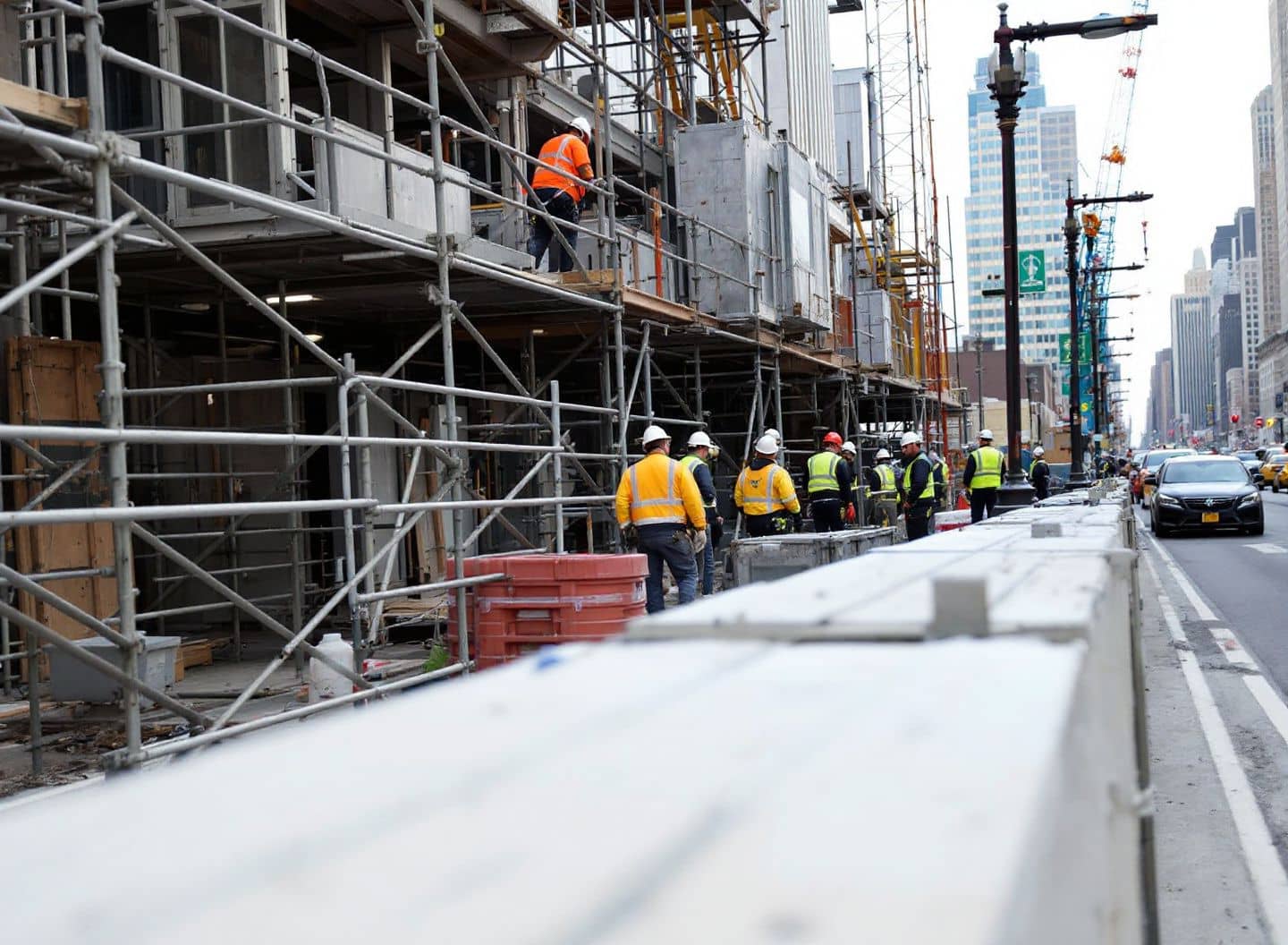
When scaffold planks are coated with ice or frost, a worker can slip and fall from height in an instant, and New York Labor Law § 240 almost certainly applies. Owners and contractors bear strict liability for elevation-related falls caused by inadequate safety devices, including those made worse by winter weather. The potential value of a claim varies with the severity of the injury.
Why Winter Weather Makes Scaffolding Especially Dangerous
Ice, snow, and frost change scaffold planks from a stable work surface into a surface that can behave almost like a hockey rink. Construction workers in New York face this hazard from November through March, and sometimes well into April when overnight temperatures still dip below freezing. The problem isn't limited to obvious snowstorms. A light overnight frost, a brief freezing rain event, or even condensation that freezes before sunrise can leave a thin, nearly invisible glaze on wooden or metal planking.
The mechanism of injury in these cases follows a predictable pattern. A worker steps onto a plank that looks dry. The ice film is too thin to see clearly in low morning light. The foot slides forward or sideways, the worker's center of gravity shifts past the scaffold edge, and there's nothing to catch them. At heights as low as ten feet, a free fall onto concrete or steel generates forces that the human skeleton simply cannot absorb without serious injury. At greater heights, the consequences are frequently fatal. Even when a worker doesn't clear the edge entirely, a violent slip can cause them to strike a rail, a lower level of scaffold, or equipment stored on the deck.
What Does New York Labor Law § 240 Actually Require?
New York Labor Law § 240(1) imposes a non-delegable duty on owners, general contractors, and their agents to furnish or erect scaffolding, hoists, ladders, stays, hangers, and other safety devices during building construction, repair, or demolition work. 'Non-delegable' is a critical concept: even if a general contractor hands scaffold erection off to a subcontractor, the general contractor and the property owner remain legally responsible if something goes wrong. A worker injured by a fall from an inadequately protected scaffold can bring a claim directly against the owner or contractor, regardless of which company actually built the scaffold.
Labor Law § 240 is often called the Scaffold Law, and courts have consistently held that it applies to gravity-related injuries, meaning falls from height and, in some situations, objects falling onto workers below. For an icy scaffold fall, the key question courts ask is whether the safety device that should have prevented the fall was absent, defective, or inadequate for the task. A scaffold with no guardrails, or with guardrails too low to stop a sliding worker, satisfies that test. So does a scaffold with planks that were never treated or covered to address foreseeable ice accumulation.
How Do the State and Federal Scaffold Regulations Define the Duty to Protect Against Ice?
The specific safety regulations that govern New York construction sites sit in 12 NYCRR 23-5, the section of the New York Industrial Code that covers scaffolding in construction, demolition, and excavation operations. These rules set out detailed requirements for scaffold planking, including plank thickness, overlap dimensions, and how planks must be secured against displacement. Displacement is exactly what ice promotes: a plank that rests loosely on ledgers can shift when a worker slides across it, creating a gap or causing the plank to drop entirely.
The federal standards add another layer of obligation. Under 29 CFR 1926.451, OSHA requires that scaffolds be maintained free of slippery conditions, that planking meet specified grade and thickness standards, and that guardrail systems meet minimum height and load-bearing requirements. This regulation received 1,873 citations nationwide in fiscal year 2024, making it one of the most frequently cited construction standards in the country. That number tells you something important: violations are common, and they happen on job sites of every size.
Taken together, 12 NYCRR 23-5 and 29 CFR 1926.451 create a detailed map of what a properly maintained scaffold looks like. When a worker is hurt, their attorney will compare that map against what actually existed on the day of the fall. Missing toe boards, undersized planks, absent mid-rails, no anti-slip treatment on the deck surface: each deviation is a potential violation that can support a claim.
Does a Contractor Have a Duty to Stop Work When Ice Is Present?
Yes, and that duty is grounded in both the specific regulations and the general principles behind Labor Law § 240. The obligation to provide a safe work surface doesn't disappear when the weather turns bad. If anything, it intensifies. A responsible contractor in New York will monitor overnight forecasts, inspect scaffold decks at the start of each shift, and either clear ice before workers mount the scaffold or stop work until conditions improve.
The pressure to keep a project on schedule is real, and it's one of the main reasons winter scaffold accidents happen. Superintendents sometimes tell workers to 'be careful up there' and send them onto icy decks rather than absorbing the cost of a weather delay. From a legal standpoint, that decision can be devastating to the contractor and owner. A court won't accept 'production pressure' as a defense to a Labor Law § 240 claim. The statute exists precisely because the people most likely to make the safety call are the same people who face financial pressure to ignore it.
What Role Does Comparative Fault Play in an Icy Scaffold Case?
Under Labor Law § 240, comparative negligence is not a complete defense for the owner or contractor. A defendant cannot escape liability simply by arguing that the worker should have been more careful. Courts in New York have held that the strict liability created by § 240 means a worker's own conduct is largely irrelevant, as long as the absence or failure of a required safety device was a proximate cause of the fall. The one exception courts recognize is the 'recalcitrant worker' doctrine, which applies when a worker deliberately ignores an explicit instruction and an adequate safety device was actually available. That's a narrow carve-out, and it doesn't apply when no adequate protection was provided in the first place.
Which Trades Face the Highest Exposure to Winter Scaffold Falls?
Hurt on a Construction Site?
Tell us what happened. A licensed New York attorney will review your case and call you — free, no obligation.
Ironworkers, bricklayers, carpenters, laborers, and facade workers all spend significant time on elevated scaffold platforms, and all of them work through New York winters. Bricklayers and masons face particular exposure because masonry work often continues well into cold weather, with scaffold systems that may have been erected during warmer months and never retrofitted for winter conditions. Facade repair and restoration projects, common on older New York buildings, frequently keep workers on swinging or supported scaffold dozens of feet above the sidewalk through the coldest months of the year.
Laborers tasked with general cleanup and material handling on multi-level scaffold systems face a compounded risk: they often move quickly across multiple platform levels, carrying loads that shift their balance, on surfaces they didn't inspect themselves. When ice is present, that combination is genuinely dangerous. The worker carrying a hod of mortar or a bundle of rebar up a scaffold ladder doesn't have a free hand to grab a rail if a foot slips.
What Should an Injured Worker Do Immediately After a Winter Scaffold Fall?
Get medical attention first, without exception. The adrenaline that follows a traumatic fall can mask the severity of injuries, particularly fractures, internal bleeding, and spinal trauma. Beyond immediate medical care, a few practical steps matter a great deal to any future legal claim.
How Does the Severity of a Fall Affect a Labor Law 240 Claim?
The strength of the liability case under § 240 doesn't change much based on the severity of the injury, as long as a qualifying safety device failure caused the fall. What does change significantly is the value of the claim. A worker who suffers a broken wrist and returns to work in three months faces a very different economic reality than one who sustains a traumatic brain injury, a spinal cord injury, or a severe hip fracture requiring multiple surgeries and months of rehabilitation. Lost wages, medical expenses, the cost of future care, and the impact on quality of life all factor into what a claim is worth, and that value varies enormously with the severity of the injury.
Workers' compensation may cover some immediate expenses, but it caps benefits and doesn't compensate for pain and suffering. A Labor Law § 240 claim against the owner and general contractor sits on top of workers' compensation. The two systems can run in parallel, which is one reason injured workers benefit from understanding both.
The Broader Safety Picture: Why Winter Scaffold Accidents Keep Happening
The construction industry in New York has seen significant progress on overall safety over the decades, but winter scaffold falls remain a persistent problem. Several factors explain why. First, the pressure to complete exterior work before the worst of winter arrives creates a push to keep workers on elevated surfaces even when conditions are borderline. Second, scaffold systems erected for warm-weather work are often not re-evaluated when temperatures drop. Third, brief freeze events overnight can leave ice that isn't visible from the ground, and supervisors making a morning assessment from the street may not realize what their workers will find when they climb up.
The legal framework of Labor Law § 240, combined with the specific safety requirements of 12 NYCRR 23-5 and the federal standards in 29 CFR 1926.451, exists precisely because the construction industry has historically underinvested in safety when left entirely to its own financial calculus. Strict liability shifts the economic incentive: if an owner or contractor knows they'll bear the full cost of a worker's injuries, they have a strong reason to invest in proper winterization, anti-slip surfaces, adequate guardrails, and weather monitoring. The law is, in that sense, a policy choice about who should bear the risk when someone works at height.
For workers, understanding that framework means understanding your rights before an accident happens. If you're being asked to work on icy planks, you have the right to raise the concern. If you're hurt because that concern was dismissed, the law provides a meaningful avenue for accountability.
Attorney Advertising. Prior results do not guarantee a similar outcome. This article is for general informational purposes only and does not constitute legal advice. NY Construction Advocate connects injured workers with experienced New York construction accident attorneys.
Primary sources
Frequently Asked Questions
Does Labor Law 240 apply if I slipped on ice on a scaffold rather than falling off the edge?▼
Can my employer fire me for refusing to work on an icy scaffold?▼
Who can be held liable under Labor Law 240 for a winter scaffold fall?▼
What if I was partly at fault for the fall because I didn't check the planks for ice before stepping on them?▼
How long do I have to file a Labor Law 240 claim after a scaffold fall in New York?▼
Does workers' compensation affect my right to sue under Labor Law 240?▼
Get a Free Case Review
Find out if you have a claim under New York Labor Law. A licensed NY attorney will review your case and call you back.