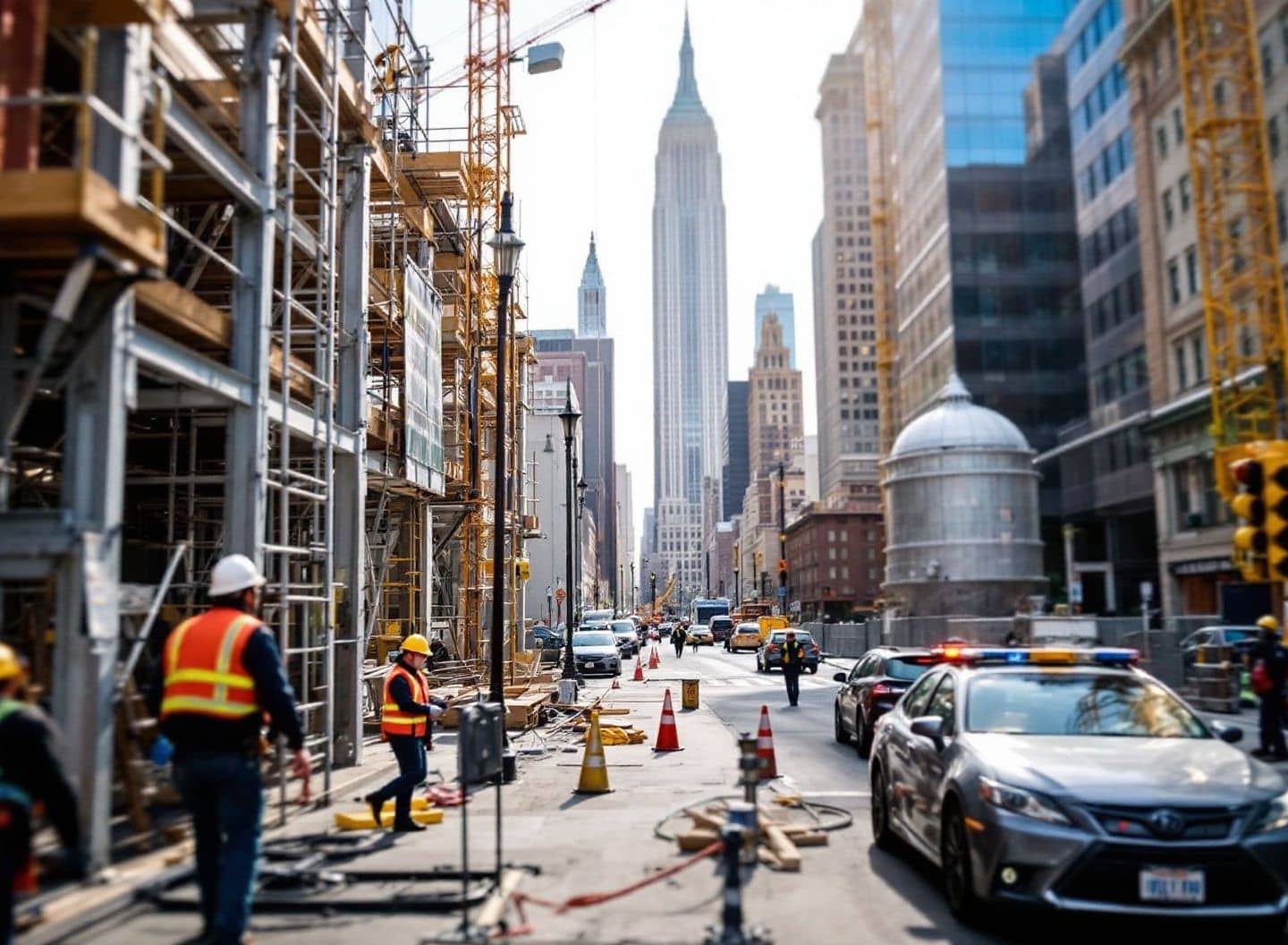
Walk onto any active New York construction site after sunset, or into a poorly ventilated interior space during the day, and you may find yourself in near-total darkness. Exposed rebar, open floor holes, unsecured ladders, uneven decking, and moving equipment surround you. You can't see any of it clearly. That's not just uncomfortable. It's illegal, and it's genuinely dangerous in ways that are specific to the trades and the physical conditions of construction work.
Inadequate lighting is one of the most consistently cited yet underappreciated safety violations on New York job sites. Owners, general contractors, and subcontractors often treat light as an afterthought, something to address when the electrical rough-in is done or when someone complains. But New York's Industrial Code sets hard numerical minimums for illumination, and failing to meet those minimums can directly cause a worker to be seriously hurt. When that happens, the lighting deficiency isn't just a regulatory problem. It becomes a central piece of a workers' compensation claim or a third-party personal injury lawsuit.
What 12 NYCRR 23-1.30 Actually Requires
New York's Industrial Code rule 12 NYCRR 23-1.30 sets specific minimum lighting standards for construction, demolition, and excavation work. The rule requires that all work areas be illuminated to at least the minimums spelled out in the code, and it places the duty to provide adequate lighting squarely on the employer and the party controlling the work site. This isn't a suggestion or a best practice guideline. It's a binding legal standard enforceable through both regulatory action and civil litigation.
The code addresses several scenarios: indoor work areas, stairways, corridors, and exterior work during hours of darkness or in shaded areas where natural light is insufficient. Section 23-1.30 generally calls for at least 10 foot-candles in work areas and five foot-candles in passageways, stairways, landings, and similar areas. The point is that 12 NYCRR 23-1.30 doesn't leave lighting to the discretion of whoever happens to be running the shift that day.
How Poor Illumination Actually Causes Injuries
It's worth being specific here, because the mechanism of injury in lighting-related accidents is sometimes misunderstood. People assume that a worker simply 'didn't see where they were going,' as if the issue is carelessness. But the human visual system requires adequate light to perceive depth, contrast, and edge definition. In normal daylight, a worker can see the edge of an open floor hole from several feet away. In a poorly lit interior, that same hole may be invisible until the worker steps into it.
This matters enormously across multiple trades. Ironworkers walking steel in low light can't reliably judge the position of beam edges. Electricians working in dark ceiling spaces can step off a ladder's edge while believing they're still on a rung. Carpenters carrying sheet goods through dim corridors can't see obstacles on the floor. Roofers working before sunrise or after sunset on tight schedules can misjudge the edge of a parapet or skylight opening. In every case, the injury mechanism isn't worker negligence. It's a sensory failure imposed on the worker by the site's conditions.
Falls are the most common consequence. Falls from height, trips over debris, and falls into floor openings are all substantially more likely when lighting is inadequate. That's why inadequate lighting intersects directly with federal fall protection standards. Under 29 CFR 1926.501, employers must protect workers from fall hazards on construction sites, including unprotected edges, holes, and elevated work surfaces. When a worker falls because they couldn't see the hazard, the inadequate lighting doesn't replace the fall protection violation. Both failures exist simultaneously, and both are legally significant.
The Legal Framework: Labor Law 241(6) and Its Reach
New York's Labor Law 241(6) is the cornerstone of construction injury litigation in this state. It imposes a non-delegable duty on property owners and general contractors to provide reasonable and adequate protection and safety to workers on construction, demolition, and excavation sites. Critically, this duty can't be passed off entirely to a subcontractor. If a subcontractor fails to maintain proper lighting, the owner and GC can still be liable under Labor Law 241(6).
The statute becomes most powerful when paired with a violation of a specific Industrial Code provision. That's where 12 NYCRR 23-1.30 comes in. A violation of an applicable, specific Industrial Code rule is some evidence of negligence in a Labor Law § 241(6) claim; comparative fault may still be considered. In practical terms, that means a plaintiff's attorney doesn't have to prove that the general standard of care was breached in some abstract way. They can point to the code, show that the site fell below the required illumination levels, and use that violation as a foundation for liability.
The broader safety regulations found in 12 NYCRR 23-1.7 also come into play in many of these cases. That section sets out general protection requirements in construction, demolition, and excavation operations, addressing hazards to persons employed on site. When inadequate lighting contributes to an injury caused by an unguarded hole, a slipping hazard, or a fall from an elevated surface, the intersection of 12 NYCRR 23-1.7 with the specific lighting requirements of 23-1.30 can support multiple theories of liability under the same 241(6) umbrella.
Hurt on a Construction Site?
Tell us what happened. A licensed New York attorney will review your case and call you — free, no obligation.
Trade-Specific Risks Worth Knowing
Different trades face different lighting-related risks, and understanding those differences matters both for safety and for legal analysis. Electricians are frequently asked to work in spaces where permanent lighting hasn't been installed yet, which creates a circular problem: the people responsible for installing the lights are the ones most likely to be working in darkness. Temporary lighting rigs are required in these circumstances, and failing to provide them is a direct code violation.
Carpenters and laborers doing rough framing or fireproofing work often operate in multi-story buildings where lower floors may be adequately lit while upper floors remain dark. New York law requires that fireproof flooring be completed as work progresses, which means workers are often present on floors that are structurally incomplete and potentially dark. That combination, incomplete flooring and inadequate lighting, dramatically increases fall risk.
Demolition workers face perhaps the highest lighting-related risk because they're intentionally operating in buildings where existing electrical systems have been disconnected. Dust, debris, unstable floors, and unexpected structural openings are all standard features of demolition work. Navigating those conditions without adequate temporary lighting is genuinely dangerous, and courts have recognized this by applying strict scrutiny to lighting conditions in demolition contexts.
Proving a Lighting Violation After an Injury
One of the underappreciated aspects of inadequate lighting cases is how well the violation can be documented after the fact. Lighting levels are measurable. A licensed engineer or safety expert can visit a site and take lux or foot-candle readings. Photographs taken at the time of an incident, or shortly after, can show the absence of temporary lighting rigs. Subcontractor schedules and electrical inspection records can show when permanent lighting was installed relative to when the injury occurred. Witness accounts from coworkers can confirm that the area was dark and that no portable lighting had been set up.
This documentary trail matters because it transforms lighting from a vague background fact into a specific, provable element of the case. In contrast to some injury claims where the cause of a fall is disputed, a lighting case can often be built around objective, physical evidence. The required illumination level is written into the code. The actual level on the date of the incident can be approximated through expert analysis. The gap between the two is the violation.
Workers should report inadequate lighting conditions formally whenever possible, in writing, before an injury occurs. A complaint to a supervisor that appears in a daily log or safety record becomes powerful evidence that the site operator had notice of the condition and failed to correct it. But even if no prior complaint was made, the absence of adequate lighting on the date of an injury is itself evidence of a systemic failure, not a momentary oversight.
What Injured Workers Should Do Next
If you're a construction worker who was injured in an area with poor or absent lighting, there are practical steps that matter immediately. Photograph the area where you were hurt as soon as you're able, or ask a coworker to do it. Note whether any temporary lighting was present, how many fixtures were operating, and whether the permanent electrical system in that area was active. Get the names of anyone who witnessed the conditions. Preserve any records of prior complaints you or coworkers made about the lighting.
Seek medical attention right away, even if injuries seem minor. Construction injuries often present delayed symptoms, and a documented medical record that begins immediately after the incident is far more useful than one that starts days later. Report the injury to your employer in writing. Then speak with an attorney who handles construction accident cases in New York before giving any recorded statement to an insurance company.
The value of a lighting-related construction injury claim varies with the severity of the injury, the degree of the violation, the number of parties who shared responsibility for the site, and how clearly the lighting deficiency can be connected to the specific harm. These cases are fact-intensive, and the strength of the evidence gathered in the immediate aftermath of an injury can make a significant difference in the outcome.
New York's Labor Law framework, including Labor Law 241(6), and its connection to specific Industrial Code violations like 12 NYCRR 23-1.30, exists precisely because the legislature recognized that construction workers are regularly exposed to hazards that employers and property owners can and should prevent. Poor lighting is one of those preventable hazards. When an employer chooses to cut corners on illumination, the law provides injured workers with meaningful legal options. Understanding those options starts with knowing the rules that were supposed to protect you in the first place.
Attorney Advertising. Prior results do not guarantee a similar outcome. This article is for general informational purposes only and does not constitute legal advice. NY Construction Advocate connects injured workers with experienced New York construction accident attorneys.
Primary sources
Frequently Asked Questions
What is 12 NYCRR 23-1.30 and why does it matter for injured workers?▼
Can I sue a general contractor or property owner if a subcontractor was responsible for the lighting?▼
How is a lighting violation actually proven after a construction accident?▼
Does federal law also apply to lighting on New York construction sites?▼
What should I do immediately after a construction injury involving poor lighting?▼
Are certain trades more at risk from inadequate construction site lighting than others?▼
Get a Free Case Review
Find out if you have a claim under New York Labor Law. A licensed NY attorney will review your case and call you back.