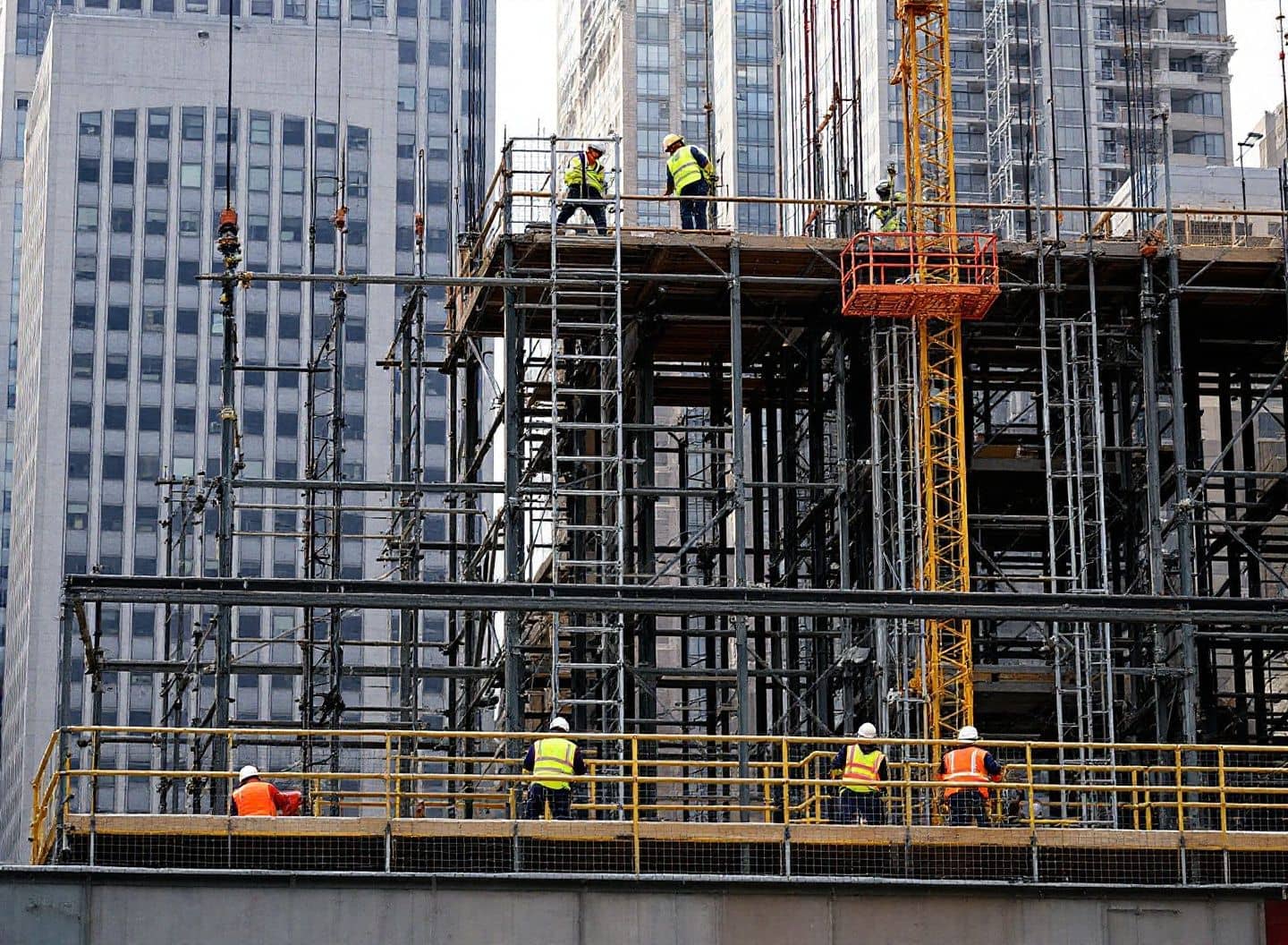
Construction workers in New York know that scaffolding is everywhere on the city's job sites. High-rises, brownstone renovations, bridge repairs, utility installations — nearly every significant project involves some form of elevated work platform. What many workers don't fully appreciate, though, is that their legal protection under New York's so-called Scaffold Law doesn't switch on only after the scaffold is fully assembled and someone climbs up to do finish work. The law also reaches the workers who are putting the scaffold together in the first place, and those who are breaking it down at the end of the job. If you were hurt during erection or dismantling, you're almost certainly within the statute's protective reach.
What Labor Law § 240 Actually Says
Labor Law § 240, commonly called the Scaffold Law, places a non-delegable duty on owners, general contractors, and their agents to furnish or erect scaffolding, hoists, ladders, slings, hangers, blocks, pulleys, braces, irons, ropes, and other devices to give proper protection to workers engaged in building or demolition work. 'Non-delegable' is a critical legal concept here. It means the owner or contractor can't transfer the duty to a subcontractor and then wash their hands of responsibility if something goes wrong. The worker's direct employer might bear fault, but so does the party at the top of the contractual chain.
The statute covers injuries caused by an elevation-related hazard — falls from height, and also objects falling onto workers below. Courts have interpreted this broadly over the decades. The critical question isn't whether the worker had finished building the scaffold; it's whether the worker was engaged in a covered activity at the time of the injury. Erecting a scaffold is covered. Dismantling one is covered. Both are construction activities in the plain sense of the term, and New York courts have consistently read the statute to protect workers in those situations.
Why Assembly and Teardown Are the Most Dangerous Phases
There's a tendency, even among experienced workers, to think the danger peaks when the scaffold is complete and in use at full height. The reality is more complicated. During erection and dismantling, the structure is in a transitional state. Guardrails haven't been installed yet, or they've already been removed. Planks may be unsecured, shifted, or partially supported. The geometry of the scaffold changes with each piece added or taken away, so a worker who took two steps safely a minute ago may find that the platform underfoot is gone or unstable when they take the same step again.
Planking failure is one of the most common mechanisms of injury during assembly. When a worker is placing or adjusting planks before they're secured to the ledgers beneath them, the plank can slide, tip, or split under body weight. Even at heights that seem modest — ten feet, fifteen feet — a free fall onto concrete generates forces on the human body that can fracture the spine, shatter an ankle, or cause traumatic brain injury. 'It wasn't that high' is a dangerous misconception. Falls from low heights kill and disable workers every year across New York.
Guardrail absence compounds the risk. A fully erected scaffold should have a top rail, a mid-rail, and a toe board on open sides and ends. During erection, those rails often don't exist yet. During dismantling, they're typically the last things workers want to remove, but in practice they sometimes come down early. When a worker loses their footing on an unsecured plank, or is jostled by a coworker handling a heavy tube-and-coupler frame, there's nothing to arrest the fall. That sequence of events, plank instability combined with missing guardrails, is exactly the type of gravity-related hazard Labor Law § 240 was designed to address.
Federal Safety Standards: 29 CFR 1926.451 and What It Requires
Federal OSHA standards under 29 CFR 1926.451 set detailed requirements for scaffold construction, use, and dismantling on covered worksites. These rules address platform construction, guardrail systems, access, and the conditions under which scaffolds may be moved or altered. In fiscal year 2024, OSHA issued 1,873 citations nationwide under this single standard, making it one of the most frequently cited construction regulations in the country. That number reflects just how often real-world scaffold practices fall short of what the law requires.
Under 29 CFR 1926.451, scaffolds must be erected, moved, dismantled, or altered only under the supervision of a competent person qualified in scaffold erection. Workers involved in those activities must be trained to recognize hazards associated with the type of scaffold being used. Where guardrails are not in place during erection or dismantling, fall protection in another form is generally required. The standard isn't academic. Violations of OSHA scaffold rules can provide important evidence in a civil case, even though OSHA itself doesn't create a private right of action.
New York's Own Construction Safety Regulations: 12 NYCRR 23-5
Hurt on a Construction Site?
Tell us what happened. A licensed New York attorney will review your case and call you — free, no obligation.
New York State has its own layer of scaffold-specific safety regulations under 12 NYCRR 23-5, which is part of the Industrial Code governing construction, demolition, and excavation work. These regulations provide detailed, trade-level specifications: the minimum width of scaffold platforms, the required overlap for scaffold planks, the intervals at which guardrails must be installed, and the load ratings scaffolds must meet. They also address specific scaffold types, including tube-and-coupler scaffolds, frame scaffolds, and suspended scaffolds, each of which presents different erection and dismantling hazards.
The importance of 12 NYCRR 23-5 in litigation is that a violation of a specific, concrete provision can support a claim under Labor Law § 241(6), which allows injured workers to sue based on the failure to follow a positive command in a regulation. For scaffold assembly and teardown injuries, both Labor Law § 240 and Labor Law § 241(6) may be available, and a violation of 12 NYCRR 23-5 can anchor the section 241(6) claim. The two theories work together rather than being mutually exclusive.
Who Is Responsible When a Scaffold Erector Gets Hurt?
Under Labor Law § 240, the parties with potential liability are the owner of the property and the general contractor. Agents of the owner or GC who controlled the work can also be brought in. Importantly, the worker's own employer is usually protected from direct suit by the Workers' Compensation Law, which provides benefits in exchange for limiting tort liability. But that doesn't leave the injured worker without options. The owner and GC are directly on the hook under the Scaffold Law, regardless of which subcontractor employed the injured worker.
There's also the issue of comparative fault. New York’s Scaffold Law may impose liability when an inadequate required safety device proximately causes a gravity-related injury (Blake v. Neighborhood Housing Services of New York City, 1 N.Y.3d 280 (2003)). If a required safety device was absent or inadequate and that violation proximately caused the injury, an owner or contractor may be liable despite the worker’s comparative fault; a worker’s conduct can defeat the claim if it was the sole proximate cause (Blake v. Neighborhood Housing Services of New York City, 1 N.Y.3d 280 (2003); Cahill v. Triborough Bridge & Tunnel Authority, 4 N.Y.3d 35 (2004)). Under Cahill, a sole-proximate-cause defense may apply when adequate safety equipment was available, the worker knew it was available and expected to use it, chose not to for no good reason, and that choice caused the injury. Simply being injured while working is not negligence on the worker's part.
The Scope of Injuries and Why These Cases Matter
Falls from scaffolds during erection or dismantling can produce injuries across a wide range of severity. At the less severe end, a worker might sustain fractures to the wrist or ankle from a reflexive attempt to break a fall. In more serious cases, spinal cord injuries, traumatic brain injuries, and severe orthopedic damage change a person's ability to work and live independently for the rest of their life. The value of a legal claim varies with the severity of the injury, the extent to which the worker can return to their trade, and the impact on the worker's family. There's no formula that fits every situation.
New York's Scaffold Law exists precisely because construction workers typically don't own the building being constructed, don't choose the materials, and often don't control the safety conditions on multi-employer sites. The legislature made a deliberate policy choice to place the burden of scaffold safety on the parties with the power and resources to prevent injuries. That policy choice is at its most meaningful during erection and teardown, when the structural protections that a finished scaffold provides simply don't exist yet.
Steps to Take If You're Injured During Scaffold Erection or Dismantling
If you're hurt on the job while assembling or dismantling a scaffold, the first priority is medical care. Beyond that, a few actions can significantly affect what happens later. Report the accident to your supervisor the same day, in writing if possible, and make sure the incident gets recorded in the job site log. Photograph the scaffold, the area where you fell, and the specific conditions that caused the fall, including missing guardrails, unsecured planks, or absent personal fall protection equipment. Get the names of coworkers who witnessed what happened.
Workers' compensation covers medical treatment and lost wages regardless of fault, so file that claim promptly. But workers' compensation doesn't cover pain and suffering, and it typically doesn't reach the full financial impact of a serious injury. A separate civil claim against the owner and general contractor under Labor Law § 240 operates independently of workers' comp and isn't limited by the same caps. The two claims can proceed at the same time. Consulting an attorney with specific experience in New York construction accident law, sooner rather than later, is a practical step worth taking.
Attorney Advertising. Prior results do not guarantee a similar outcome. This article is for general informational purposes only and does not constitute legal advice. NY Construction Advocate connects injured workers with experienced New York construction accident attorneys.
Primary sources
Frequently Asked Questions
Does Labor Law § 240 protect workers only when they fall from a completed scaffold, or does it also cover injuries during erection and dismantling?▼
My employer says I was negligent because I stepped on an unsecured plank while helping erect the scaffold. Can I still make a claim?▼
What role do the federal OSHA scaffold regulations under 29 CFR 1926.451 play in a New York civil lawsuit?▼
How does 12 NYCRR 23-5 affect a scaffold injury claim in New York?▼
I was hired specifically to erect scaffolding as a scaffold erector, not to do the construction work the scaffold supports. Am I still covered?▼
If I collect workers' compensation benefits after a scaffold injury, does that prevent me from also pursuing a Labor Law § 240 claim?▼
Get a Free Case Review
Find out if you have a claim under New York Labor Law. A licensed NY attorney will review your case and call you back.