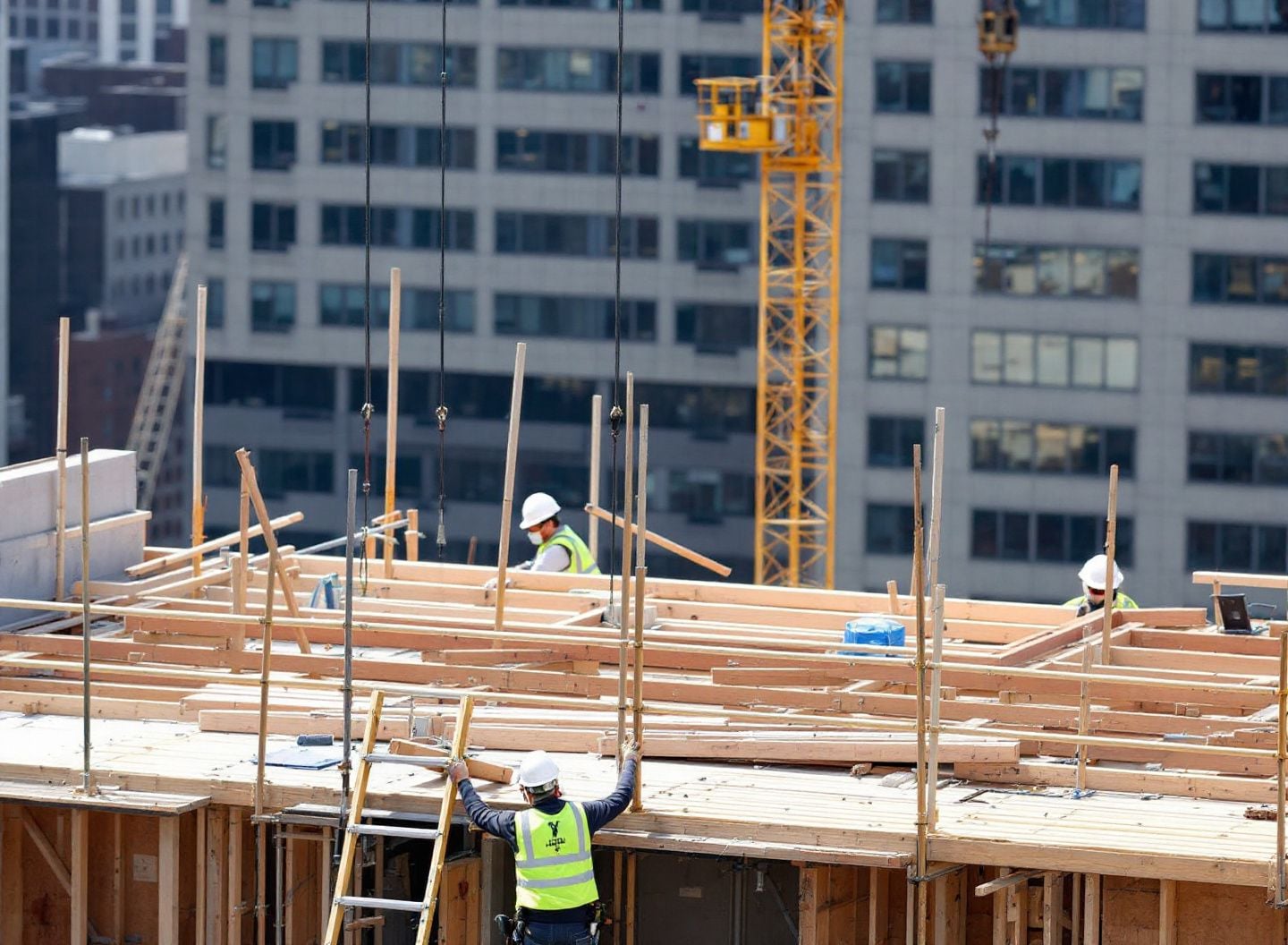
New York City's skyline depends on a constant cycle of facade construction and restoration. Curtain wall installation, brick repointing, precast panel placement, and window replacement all share one common need: a working platform that keeps pace with the building face. Mast climbing work platforms (MCWPs) have largely replaced traditional tube-and-coupler scaffolding on mid- and high-rise jobs because they're faster to erect and can carry heavier loads than most suspended systems. That power is also their danger. When something goes wrong on a mast climber, the consequences are severe and the fall distances can be catastrophic.
What Makes Mast Climbers Different From Other Scaffolds
A mast climbing work platform uses one or more vertical mast sections anchored to a building's face, with a motorized platform that travels up and down the mast by a rack-and-pinion or chain drive. Unlike a suspended scaffold hanging from roof davits, the MCWP pushes upward from its own base and is held laterally by tie-back anchors embedded in or attached to the building structure. That design means the platform's stability depends on two completely separate systems working correctly at the same time: the base and mast assembly below, and the tie-back connections into the building above. If either fails, the platform can tip, slide, or fall.
On a typical Manhattan curtain wall project, MCWPs carry not just workers but also the facade panels themselves, sealant guns, power tools, welding equipment, and sometimes motorized material hoists attached to the platform's cantilevered arms. The rated load capacity of a given platform can run into several thousand pounds, and it isn't unusual on busy job sites for foremen to underestimate what's actually sitting on the deck at any given moment. That's how overload failures start.
Three Primary Failure Modes That Injure Workers
Overload and Structural Collapse
Every MCWP has a rated platform load capacity established by the manufacturer's engineering data. When workers, tools, and materials collectively exceed that number, the platform's structural members can yield, the drive system can lose its hold on the mast rack, or the entire assembly can begin to buckle at a lower mast section. Overloads don't always announce themselves with obvious bending. The failure can happen fast, sometimes mid-travel while the platform is ascending. Workers rarely have time to react before the platform drops or tips outward.
On masonry restoration jobs, this risk is especially acute. Workers often load multiple pallets of brick or pre-mixed mortar onto a platform for efficiency, not wanting to make repeated trips to the material hoist. A single pallet of modular brick can weigh close to 3,000 pounds. Add two masons, their tools, and a mortar pan, and it's easy to see how the rated capacity gets exceeded before anyone does the math.
Tie-Back Anchor Failures
Tie-back anchors are the connection points between the mast and the building, and they're placed at intervals specified in the manufacturer's erection plan and the site-specific engineering drawings. When those anchors pull out, shear off, or were never properly installed in the first place, the mast loses its lateral support. At that point, the platform is essentially a tall, top-heavy structure with nothing keeping it vertical. Wind loading, an unbalanced load on the deck, or even the vibration of the drive motor can initiate a tip-over.
Anchor failures on NYC facade jobs often trace back to inadequate substrate. Concrete spandrel beams that look solid from the outside may be cracked, carbonated, or contaminated in ways that reduce pullout capacity dramatically. Sometimes anchors are installed in brick veneer rather than structural masonry because it was faster, or because the workers doing the installation weren't the ones who reviewed the engineering drawings. Either way, the tie that was supposed to hold a loaded mast against wind and eccentric loading gives way.
Drive System Failures and Uncontrolled Descent
The rack-and-pinion or chain drive that moves the platform must hold the platform's full load whenever the unit is stopped or traveling. Worn pinion gears, hydraulic failures, inadequate maintenance, or failure to engage the secondary brake system can result in an uncontrolled descent. Some platforms have secondary braking systems that engage automatically if descent speed exceeds a threshold. If those brakes are disabled, poorly maintained, or not tested before use, the safety net disappears. Workers on a runaway descent have no practical way to stop the platform and no warning before it hits the base.
New York Labor Law § 240 and the Scaffold Law's Reach
New York's Labor Law § 240, often called the Scaffold Law, creates absolute liability for owners, general contractors, and their agents when a worker is injured because proper safety devices were not furnished or maintained. The statute covers not just traditional scaffolding but any elevated work platform, hoist, or protective device used during construction, demolition, or repair work. Mast climbing work platforms fall squarely within that definition.
Under Labor Law § 240, a worker injured in a free-fall event caused by a platform collapse doesn't need to prove that the owner or contractor was negligent in the ordinary sense. The question is whether the proper device was furnished and whether it failed to protect against the gravity-related hazard. If the mast climber tipped, dropped, or collapsed while in use, and the worker fell as a result, the statutory duty has been violated. The injured worker's own conduct can be raised as a defense only in very limited circumstances. This is one of the most powerful worker-protection statutes in the country, and it exists precisely because falls from height on construction projects produce some of the most serious injuries workers suffer.
Industrial Code 23-5: Specific Duties for Mast Climbers and Scaffolding
Hurt on a Construction Site?
Tell us what happened. A licensed New York attorney will review your case and call you — free, no obligation.
Where Labor Law § 240 sets the broad duty, 12 NYCRR 23-5 fills in the specific technical requirements. The Industrial Code's Part 23-5 governs scaffolding in construction, demolition, and excavation operations throughout New York State. It establishes requirements for scaffold erection, planking, guardrails, load ratings, and the qualifications of persons who may erect or dismantle scaffold systems. Because Labor Law § 241(6) incorporates violations of specific Industrial Code provisions as a basis for liability, a plaintiff who can show that a particular requirement of 12 NYCRR 23-5 was violated has a direct path to holding responsible parties accountable.
For mast climbing work platforms, several provisions of 12 NYCRR 23-5 are particularly relevant. The code requires that scaffolds be capable of supporting at least four times the maximum intended load. It requires that all scaffolding be erected, moved, dismantled, or altered only under the supervision of a competent person. It requires guardrails on open sides of elevated platforms. And it sets out duties for inspection before each work shift. When any of these requirements go unmet, a worker who is injured as a result has a legal basis for a claim that goes beyond common-law negligence.
Federal OSHA Standards and Their Role in Civil Litigation
Federal scaffolding requirements under 29 CFR 1926.451 apply to mast climbing work platforms used on construction sites and set out duties covering load capacities, guardrail height and strength, access, and erection by qualified persons. OSHA violations by themselves don't create a private right of action in federal court, but in New York civil litigation they can be introduced as evidence of the standard of care. When a plaintiff's expert demonstrates that specific provisions of 29 CFR 1926.451 were violated, that testimony can reinforce a negligence or Labor Law § 241(6) claim significantly.
It's also worth noting that 29 CFR 1926.451 generated 1,873 citations nationwide in federal fiscal year 2024, making scaffolding one of OSHA's most frequently cited construction standards year after year. That number reflects how consistently scaffolding violations occur across the industry, not just in New York. On a mast climber, the most common regulatory failures involve inadequate tie spacing, failure to have a qualified person supervise erection, and missing or inadequate fall protection for workers on or near the platform.
The Curtain Wall and Masonry Context: Why These Jobs Carry Elevated Risk
Facade work in New York City is relentless. The city's Local Law 11 inspection cycle (now Local Law 126) means that building owners face recurring five-year inspection and repair deadlines, creating a constant demand for scaffold erection on buildings of every age and type. Contractors under deadline pressure sometimes make decisions that compromise safety, shortening tie-back intervals to save time, adding materials to the platform beyond rated capacity, or skipping pre-shift inspections when the crew is anxious to get to work.
Curtain wall installation adds its own complications. The panels being installed can be large, heavy, and awkward to position, which means workers are often working near the platform edge with an uneven load distribution on the deck. Wind is a constant factor on building faces above the fifth or sixth floor, and an overloaded or improperly tied mast is much more vulnerable to wind-induced lateral forces than one set up according to the manufacturer's specifications. Masonry restoration work has similar dynamics: mortar, stone, and brick are dense materials, and the temptation to stage as much material as possible on the platform to avoid repeated trips down is a recipe for overload.
What Injured Workers and Their Families Should Know
If you or someone in your family has been injured in a mast climber accident on a New York construction job, several steps matter immediately. First, get medical attention and make sure the injury is fully documented. Second, understand that workers' compensation covers you regardless of fault, but it doesn't come close to capturing the full value of a serious injury. Third, know that Labor Law § 240 and 12 NYCRR 23-5 may give you rights against the building owner, the general contractor, or both, even if your employer's insurance has already paid some benefits. Workers' compensation does not bar those additional claims.
The value of a Labor Law § 240 claim varies with the severity of the injury, the degree of permanent impairment, lost wages over time, and the cost of future medical care. There are no guarantees in litigation, and each case depends on its specific facts. What matters is acting quickly, because evidence on a construction site disappears fast. The mast climber may be repaired or removed before anyone documents the failure. Photographs, witness statements, the manufacturer's load rating data, the erection drawings, and inspection logs can all be critical to proving what happened.
Key Takeaways for Workers on NYC Facade Projects
Attorney Advertising. Prior results do not guarantee a similar outcome. This article is for general informational purposes only and does not constitute legal advice. NY Construction Advocate connects injured workers with experienced New York construction accident attorneys.
Primary sources
Frequently Asked Questions
Does Labor Law § 240 cover injuries that happen on a mast climbing work platform?▼
What specific requirements does 12 NYCRR 23-5 impose on mast climbers?▼
Can I bring a lawsuit against the building owner if my employer's workers' compensation insurance has already paid my medical bills?▼
What evidence is most important to preserve after a mast climber accident?▼
How does an overload cause a mast climber to fail, and why is it hard to notice in real time?▼
Are general contractors responsible for mast climber safety even if a subcontractor erected and operates the platform?▼
Get a Free Case Review
Find out if you have a claim under New York Labor Law. A licensed NY attorney will review your case and call you back.