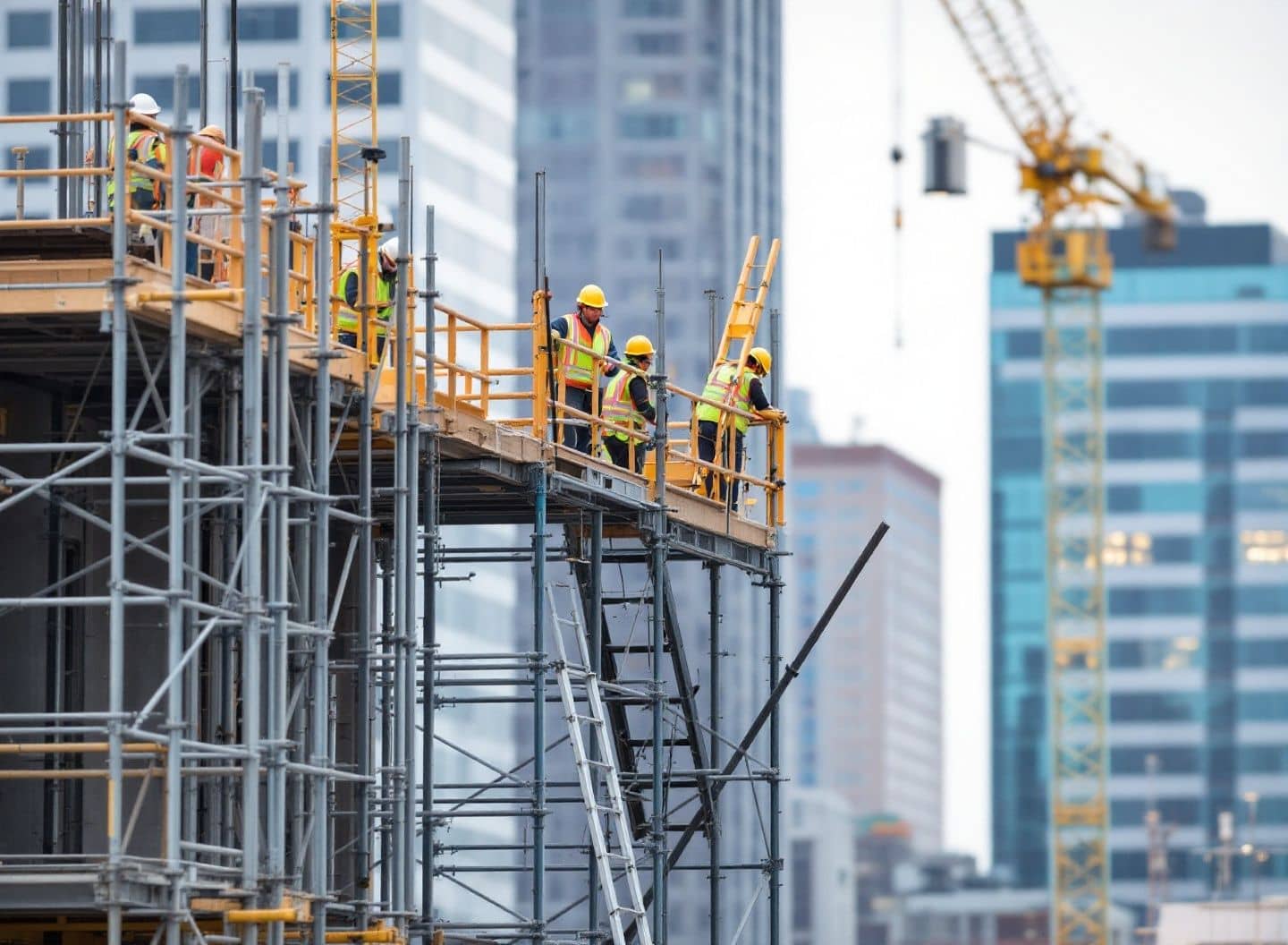
A scaffold that looks solid enough to work on can still be a death trap. The rail is missing. A plank has been pulled to another bay and never replaced. The toe board was never installed in the first place. These aren't minor oversights. Under New York law and federal safety regulations, each gap in a scaffold's fall-protection system represents a codified violation that can form the backbone of an injured worker's legal claim. If you've been hurt in a scaffold fall in New York, understanding what the law actually requires, in specific technical detail, is the first step toward protecting your rights.
Why Scaffolds Fail Workers Before They Fail Structurally
Most people picture a scaffold collapse when they think of a scaffold accident. The structure buckles, and workers plunge. That does happen, but it's not the most common story. Far more often, the scaffold stays standing while a worker falls from it, because a guardrail is absent, a plank slides, or the working surface has an unguarded opening. The scaffold didn't fail. The people responsible for outfitting it properly did.
That distinction matters legally. New York's scaffold accident framework isn't built solely around structural collapse. It's built around the duty to provide workers with the specific protective components that prevent falls in the first place. When those components are missing, the law has already decided that someone failed in a duty of care.
Labor Law § 240 and the Non-Delegable Duty It Creates
Labor Law § 240, commonly called the Scaffold Law, requires contractors, owners, and their agents to furnish or erect scaffolding, hoists, ladders, and other protective devices during building work. What makes this statute unusual, and unusually powerful for injured workers, is that the duty it creates cannot be delegated away. An owner can't hand the job to a general contractor and then claim the obligation followed with it. The general contractor can't pass it down to a subcontractor and wash their hands of liability. The duty stays with all of them.
The practical effect is significant. If a worker falls from a scaffold because a guardrail was missing, and the fall results in injury or death, Labor Law § 240 allows that worker (or their family) to hold the owner and contractor liable regardless of how the specific blame is distributed among parties. New York courts have consistently held that a violation of the statute that proximately causes a fall is sufficient to establish liability. You don't need to prove negligence in the ordinary sense. The absence of a required protective device is enough.
What 12 NYCRR 23-5 Actually Requires on a Scaffold
Labor Law § 240 sets the general obligation. But 12 NYCRR 23-5, part of the New York State Industrial Code covering protection in construction, demolition, and excavation operations, is where the specific, measurable requirements live. These rules implement Labor Law Section 241(6), and they define exactly what a scaffold must have to be considered compliant. When a violation of these rules causes an injury, that violation can support a Section 241(6) claim in addition to a claim under Section 240.
Under 12 NYCRR 23-5, scaffolds used in New York construction must meet detailed standards for guardrails, planking, and toe boards. The guardrail system on a scaffold platform more than a specified height above the ground or a lower level must include a top rail and a mid-rail. These aren't optional additions that a supervisor can skip when lumber is running short. They're mandated components. The top rail must be at a height sufficient to arrest a worker who loses their balance. The mid-rail fills the space between the top rail and the platform so that a worker can't simply slide beneath the top rail during a fall.
Toe boards are a separate requirement, and they protect against a different but equally serious hazard: tools, materials, and debris rolling or kicking off the platform edge and striking workers below. A toe board runs along the base of the guardrail system, typically at least three and a half inches high, and it creates a physical barrier at floor level. Omitting a toe board doesn't just expose the worker on the platform. It puts everyone working below at risk from falling objects, which can be fatal at even modest heights.
Planking requirements under 12 NYCRR 23-5 address the working surface itself. Scaffold planks must be of adequate thickness and span, free from visible defects, and secured against displacement. A plank that deflects severely under load, that has a split running along its grain, or that has been left unsecured at its ends can pitch a worker forward or drop them entirely. The code requires that planks overlap their supports by a minimum amount and that the platform be fully planked across its working width, with no gaps large enough for a foot or tool to fall through.
The Federal Layer: OSHA 29 CFR 1926.451
Federal OSHA's scaffolding standard, 29 CFR 1926.451, runs parallel to the state industrial code and in many respects mirrors its requirements while adding additional specificity. Under 29 CFR 1926.451, fall protection is required on scaffolds where workers are exposed to a fall of ten feet or more. The standard specifies that guardrail systems on supported scaffolds must have a top rail between 38 and 45 inches above the platform surface, a mid-rail positioned midway between the top rail and the platform, and toe boards at least 3.5 inches tall wherever workers could be struck by falling objects.
For suspended scaffolds, 29 CFR 1926.451 imposes additional requirements around the rigging, suspension lines, and the stability of the working platform. These systems carry workers at extreme heights, and a failure in any component, whether the rope, the stirrup, or the platform planking, can send workers on a free fall that no body can survive. OSHA cited scaffold-related violations 1,873 times nationwide in FY2024 alone, making scaffolding one of the most frequently cited categories in construction. That number reflects how persistently these requirements are ignored in the field.
Hurt on a Construction Site?
Tell us what happened. A licensed New York attorney will review your case and call you — free, no obligation.
OSHA violations don't create a private right of action the way New York's labor laws do. But they matter in litigation. An OSHA citation issued after a scaffold accident can be introduced as evidence that the defendant deviated from a recognized industry standard. Plaintiffs' attorneys use citation records to show that the hazard was known, that the regulation was clear, and that the employer or contractor chose not to comply.
How Guardrail Absence Translates into Injury: The Physics of a Platform Fall
Falls from scaffolds are not like falls in everyday life. A worker on a scaffold platform is often carrying materials, operating tools, or moving backward while guiding a load. Balance is constantly challenged. When a guardrail is present, a worker who stumbles makes contact with the rail and catches themselves. That's the system working as designed. When the rail is gone, a stumble becomes a fall.
At as little as ten feet, a free fall onto concrete produces forces exceeding what the human spine, skull, and pelvis are designed to absorb. Traumatic brain injuries, spinal cord damage, fractured pelvises, shattered heels, and internal organ rupture are common outcomes. Workers in trades that use scaffolding, including ironworkers, bricklayers, painters, window installers, and plasterers, often work at heights well above ten feet, sometimes well above a hundred feet on high-rise projects. The consequences of a fall scale with height, but even low-level scaffold falls can permanently disable a worker.
Planking failures follow a similar pattern. A worker steps onto a plank that has been improperly placed, has a hidden split, or projects too far beyond its support. The plank tips, deflects, or breaks. The worker's center of gravity shifts suddenly, and they go over the edge or through the platform. If the surrounding guardrail system is intact, there's at least some chance of catching the rail or being deflected rather than falling free. If both the planking and the guardrails are deficient, the worker has no protection at any stage of the incident.
Building the Claim: Code Violations as Proof of Liability
What separates New York scaffold cases from typical personal injury litigation is the role that specific code provisions play in establishing liability. Under a Section 241(6) theory, a plaintiff who proves a violation of 12 NYCRR 23-5 that caused their injury has established negligence per se. They don't need to separately prove that the defendant knew the rail was missing or that a reasonable person would have installed a toe board. The regulation says it was required. It wasn't there. That's the case.
That said, defendants don't simply fold. They'll investigate whether the worker was the sole proximate cause of their own injury, whether the device was actually missing or merely temporarily removed for a legitimate purpose, and whether the specific regulatory provision relied on is sufficiently specific to support a 241(6) claim. Not every provision in 12 NYCRR 23-5 has been held by New York courts to be specific enough. This is why having an attorney who knows the case law on which provisions are enforceable under 241(6) matters enormously.
Under a Section 240 theory, the analysis shifts to whether the absence of a guardrail or adequate planking represents a failure to provide proper protection against a gravity-related hazard, and whether that failure was a proximate cause of the fall. Courts have found liability under 240 where a worker fell from an unguarded scaffold edge, where planks were unsecured and shifted underfoot, and where the working platform lacked adequate fall protection for the height involved. The value of any claim varies with the severity of the injury, the degree of permanent disability, the worker's earning capacity, and the long-term medical costs involved.
Trade-Specific Risks Worth Knowing
Different trades interact with scaffolding in different ways, and that affects the risk profile. Bricklayers work close to the platform edge by necessity, laying courses outward from the scaffold. They're often bending, reaching, and shifting weight laterally. A missing mid-rail in that context isn't a minor gap. It's a direct fall path that opens up dozens of times per shift. Painters working on suspended scaffolds face the additional risk of swing-stage instability, particularly when the scaffold is overloaded or the suspension rigging hasn't been inspected. Ironworkers on supported scaffolding are often moving heavy steel components that can shift suddenly and throw a worker off balance. For all these trades, the guardrail system is the last line of defense, and its absence removes that protection entirely.
Supervisors sometimes remove guardrails to allow materials to be loaded onto the platform from a crane, with the intention of replacing the rail afterward. That intention often doesn't survive the next task. The materials get loaded, the crew moves on, and the rail stays off. Workers coming onto the platform for the next shift have no way of knowing the protection was removed temporarily. They step onto the platform assuming it meets code. That assumption, while reasonable, can be fatal.
Steps to Take After a Scaffold Fall in New York
If you've been injured in a scaffold fall, preserving evidence of the conditions that existed at the time of the accident is critical. Scaffold configurations change rapidly on active construction sites. Rails get reinstalled. Planks get replaced or repositioned. By the time an investigation begins, the physical conditions may look nothing like they did when you fell. Photographs taken immediately after the incident, witness statements collected while memories are fresh, and preservation letters sent to the site owner and general contractor can prevent this evidence from disappearing.
You should also report the injury through the proper workers' compensation channels, but understand that workers' compensation and a Labor Law claim are separate things. Workers' compensation covers medical costs and a portion of lost wages regardless of fault. A Labor Law claim can pursue compensation for the full range of damages your injury caused, including pain and suffering, loss of future earning capacity, and permanent disability, none of which workers' compensation fully addresses. These claims run on different legal tracks and can be pursued simultaneously.
Attorney Advertising. Prior results do not guarantee a similar outcome. This article is for general informational purposes only and does not constitute legal advice. NY Construction Advocate connects injured workers with experienced New York construction accident attorneys.
Primary sources
Frequently Asked Questions
Does Labor Law § 240 cover me if I fell from a scaffold because a guardrail was missing?▼
What specific guardrail requirements does 12 NYCRR 23-5 impose on New York construction scaffolds?▼
How does OSHA 29 CFR 1926.451 factor into a New York scaffold injury lawsuit if OSHA doesn't create a private right of action?▼
Can I bring a Labor Law claim even if my employer's workers' compensation insurer has already begun paying benefits?▼
What if the guardrail was temporarily removed by a supervisor to load materials, and I wasn't warned before stepping onto the platform?▼
Does the height of the scaffold matter? I fell from a relatively low platform.▼
Get a Free Case Review
Find out if you have a claim under New York Labor Law. A licensed NY attorney will review your case and call you back.