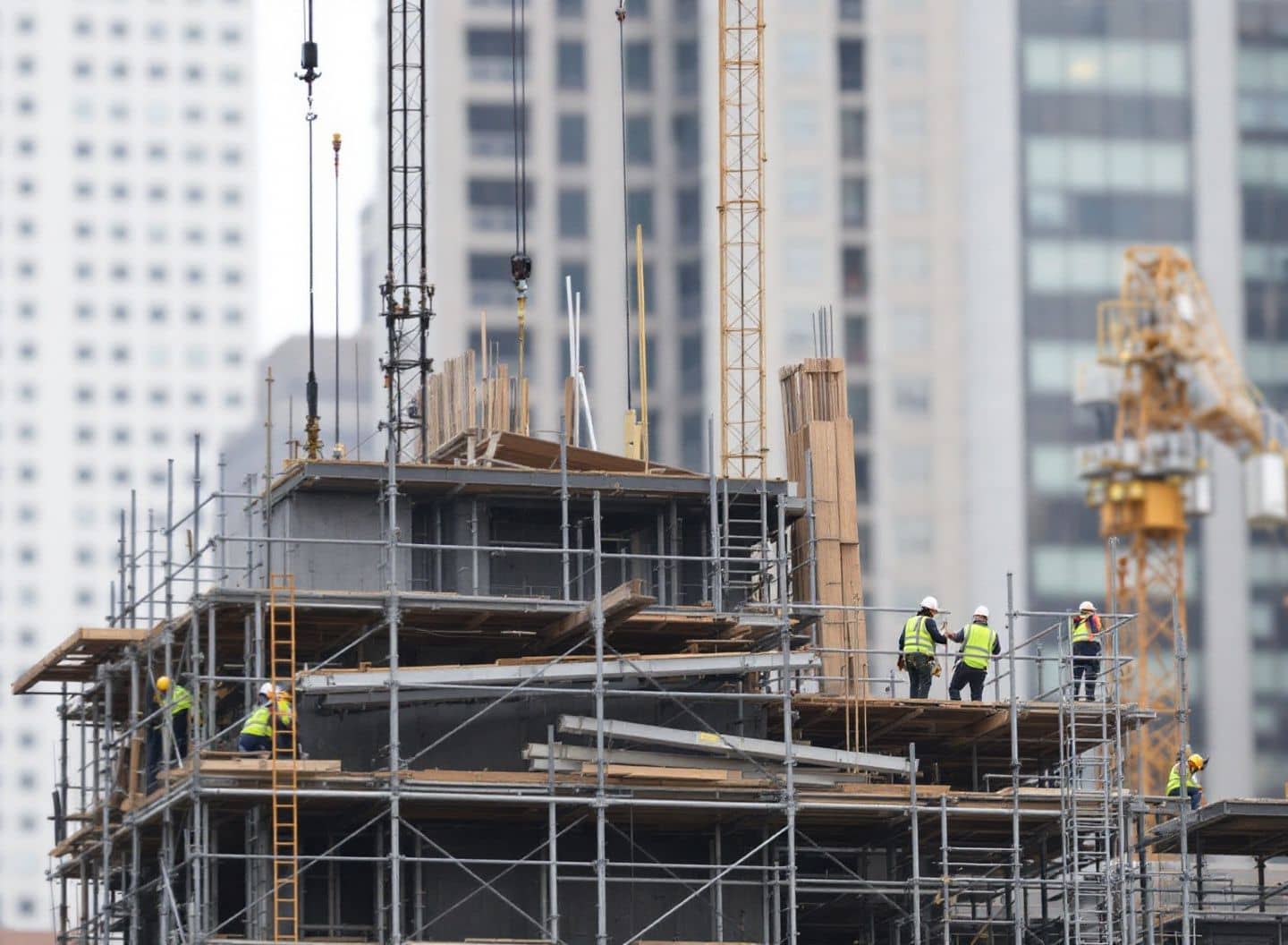
Every year, the federal Occupational Safety and Health Administration releases its list of the most frequently cited safety standards across American construction sites. And every year, one standard sits at the top: 29 CFR 1926.501, the fall protection rule. In fiscal year 2024 alone, OSHA issued 6,307 citations under this standard nationwide. That number isn't a bureaucratic curiosity. It's a signal about where workers are getting hurt and where employers are falling short of their most basic obligations.
For New York construction workers, this matters in a particular way. The state has its own overlapping framework of safety law that can independently give rise to a legal claim when someone is injured in a fall. Understanding how the federal OSHA standard interacts with New York's Labor Law is essential for any worker who has been hurt on a job site, or for anyone who wants to understand why fall protection failures are so legally significant in this state.
What 29 CFR 1926.501 Actually Requires
The regulation found at 29 CFR 1926.501 establishes fall protection requirements for workers on construction sites. At its core, the rule requires employers to provide guardrail systems, safety net systems, or personal fall arrest systems whenever workers are exposed to falls of six feet or more to a lower level. That threshold sounds simple, but applying it across a busy New York job site, with dozens of trades working at different elevations simultaneously, is where things get complicated.
The standard covers a wide range of work surfaces and scenarios. Unprotected sides and edges of floors, roofs, and mezzanines all trigger the requirement. So do leading edges (the advancing edge of a floor or deck as construction progresses), holes in walking surfaces, wall openings, ramps, runways, excavations, and formwork. The rule also addresses specific trade situations: roofing work on low-slope and steep roofs gets its own provisions, as do workers near skylights, hoist areas, and precast concrete erection. In other words, 29 CFR 1926.501 isn't a one-size-fits-all rule. It's a detailed framework that recognizes falls happen in different ways depending on what trade you're in and where you're working.
Why Falls Kill and Injure Construction Workers at Such High Rates
Falls from height are the leading cause of death in the construction industry. The mechanics of why are straightforward but worth stating clearly. When a person falls even a short distance, the deceleration forces on landing are enormous. A six-foot fall takes less than a second from start to impact, and the human body has almost no time to react. Injuries from falls at construction heights commonly include traumatic brain injury, spinal cord damage, fractured vertebrae, broken pelvis, shattered long bones, and internal organ damage. Falls from greater heights, those involving multiple stories or unprotected roof edges, can be and often are fatal.
Different trades carry different fall risks. Roofers face exposure at leading edges and near skylights, which are notoriously dangerous because a worker can step through a fragile skylight cover without warning. Ironworkers erecting structural steel work at extreme heights with limited footing. Carpenters installing floor decking face open holes and unprotected edges throughout the framing phase. Electricians and HVAC mechanics often work from ladders and elevated platforms inside partially constructed buildings where guardrails haven't been installed yet. Even laborers cleaning up debris on upper floors can encounter unguarded floor openings without warning. The common thread is that every one of these workers is relying on the employer to have set up proper fall protection before they start the task.
When employers skip that step, whether to save time, to cut costs, or simply out of carelessness, the results are predictable. Falls from height can be fatal. When they aren't fatal, they frequently cause injuries serious enough to end a career.
New York's Labor Law § 241(6): The State's Own Fall Protection Framework
New York has a long history of aggressively protecting construction workers through its own statutes, and Labor Law § 241(6) is one of the most important tools available to an injured worker. The statute requires that construction, demolition, and excavation work be conducted in a manner that provides reasonable and adequate protection and safety. Critically, it imposes that duty on owners and general contractors, not just the worker's direct employer.
That distinction matters enormously. On a typical New York construction project, a laborer or tradesperson might be employed by a subcontractor who has no direct relationship with the building owner. Under Labor Law § 241(6), the owner of the property and the general contractor who controls the site can both be held liable for injuries caused by safety violations, regardless of whether they directly employed the injured worker. This is what lawyers call non-delegable duty. The owner and general contractor can't pass off responsibility to a subcontractor and walk away clean.
But Labor Law § 241(6) doesn't operate in isolation. It requires a predicate: a violation of a specific, concrete safety rule. That's where the Industrial Code comes in.
12 NYCRR 23-1.7 and the Industrial Code's Role
New York's Industrial Code, found at 12 NYCRR 23-1.7, provides the specific safety regulations that give Labor Law § 241(6) claims their teeth. These rules implement the broader mandate of Labor Law § 241(6) by defining exactly what safety practices are required on construction, demolition, and excavation sites. 12 NYCRR 23-1.7 covers protection from falling objects, slipping hazards, tripping hazards, overhead hazards, and other site-specific dangers. Importantly, courts have consistently found that violations of the Industrial Code's specific provisions can serve as the predicate violation needed to support a § 241(6) claim.
This creates a layered legal structure. Federal OSHA sets baseline protections through 29 CFR 1926.501. New York's Industrial Code at 12 NYCRR 23-1.7 sets state-level requirements. And Labor Law § 241(6) provides an injured worker with a legal claim when those state rules are violated. An injured worker's attorney will typically examine violations at every layer: what OSHA required, what the Industrial Code required, and whether the conduct of the owner and general contractor fell short of both.
Hurt on a Construction Site?
Tell us what happened. A licensed New York attorney will review your case and call you — free, no obligation.
Labor Law § 241(1) also requires fireproof flooring to be completed as construction work progresses. This specific requirement reflects the broader principle that the construction environment must be made safe as the work advances, not after the fact. The obligation to install safe walking surfaces isn't deferred until the end of a project phase. It exists continuously.
How an OSHA Violation Strengthens a New York Labor Law Claim
Some injured workers and their families wonder whether an OSHA citation actually helps their legal case. The answer is nuanced but generally yes, for several reasons.
First, an OSHA citation for a violation of 29 CFR 1926.501 is documentary evidence that a specific safety standard was not followed. While OSHA citations aren't always admissible as direct proof of negligence in a New York court, they can support the factual narrative that fall protection was absent or inadequate. They document conditions, identify the employer's knowledge of the hazard, and may reflect an investigator's on-site observations.
Second, the same facts that give rise to an OSHA citation will often also support the predicate violation required for a Labor Law § 241(6) claim. If workers were exposed to an unguarded floor edge in violation of 29 CFR 1926.501, that same condition likely violated specific provisions of 12 NYCRR 23-1.7. When an attorney can point to parallel violations of both the federal standard and the New York Industrial Code, the liability picture becomes clearer.
Third, the sheer frequency of 29 CFR 1926.501 citations (6,307 in a single fiscal year) tells a story that resonates: fall protection failures aren't accidents in the sense of random, unforeseeable events. They're predictable, repeated, and documented across the industry. That pattern of non-compliance matters when establishing that a hazard was or should have been known.
What an Injured Worker Should Know About Documenting a Fall
If you've been injured in a construction fall in New York, the steps you take in the immediate aftermath matter. Report the accident to your supervisor and make sure an incident report is generated. Seek medical attention right away, and make sure all injuries are documented by treating providers. If possible, take photographs of the location where the fall happened, including any unguarded edges, missing barriers, absent safety nets, or broken personal fall arrest equipment. Get the names of any witnesses.
Physical evidence disappears quickly on construction sites. By the time an attorney conducts an inspection, guardrails may have been installed, holes may have been covered, and the condition that caused the fall may no longer exist. Preserving evidence of what existed at the time of the accident is critical. An attorney experienced in New York construction accident law will often send a spoliation letter to the site owner and general contractor early in the process, demanding that all evidence be preserved.
The value of a construction fall claim in New York varies with the severity of the injury, the extent of lost wages, the long-term impact on the worker's ability to earn a living, and the degree of liability attributable to the owner and general contractor. These cases can be factually and legally complex, and the intersection of workers' compensation, third-party liability, and Labor Law claims requires careful analysis.
The Bigger Picture: Why This Standard Gets Cited So Often
It's worth pausing on what it means that 29 CFR 1926.501 has been OSHA's most-cited construction standard year after year. Falls from height are entirely preventable with proper planning, equipment, and supervision. OSHA designed the standard to be practical. Guardrails, safety nets, and harness systems exist precisely because the engineering solutions to fall hazards are well understood. The tools are available. The regulations are clear.
And yet 6,307 citations were issued in a single year. That number reflects a systemic failure to apply known solutions consistently. Some of it is cost-cutting pressure. Some is the chaotic pace of production on large job sites where safety setup doesn't keep pace with work progress. Some is inadequate supervision of subcontractors. But whatever the cause, the consequence falls on workers, often literally.
For New York workers specifically, the state's Labor Law framework was designed with exactly this dynamic in mind. Legislators understood that workers often have no power to insist on safety equipment when a foreman says to keep moving. Placing non-delegable responsibility on property owners and general contractors shifts the incentive structure. When the parties with the most authority and resources on a job site face real legal consequences for safety failures, the calculus changes.
That's why understanding the connection between 29 CFR 1926.501, 12 NYCRR 23-1.7, and Labor Law § 241(6) isn't just legal theory. It's the architecture that determines whether an injured worker can hold the right parties accountable after a fall changes their life.
Attorney Advertising. Prior results do not guarantee a similar outcome. This article is for general informational purposes only and does not constitute legal advice. NY Construction Advocate connects injured workers with experienced New York construction accident attorneys.
Primary sources
Frequently Asked Questions
What is 29 CFR 1926.501 and who does it apply to?▼
How does an OSHA fall protection violation relate to a Labor Law § 241(6) claim in New York?▼
Can I bring a Labor Law § 241(6) claim against a property owner who wasn't my employer?▼
What does 12 NYCRR 23-1.7 cover that's relevant to fall injuries?▼
Why does OSHA cite 29 CFR 1926.501 more than any other construction standard?▼
Does it matter what trade I work in when evaluating a fall protection claim?▼
What evidence is most important to preserve after a construction fall in New York?▼
Get a Free Case Review
Find out if you have a claim under New York Labor Law. A licensed NY attorney will review your case and call you back.