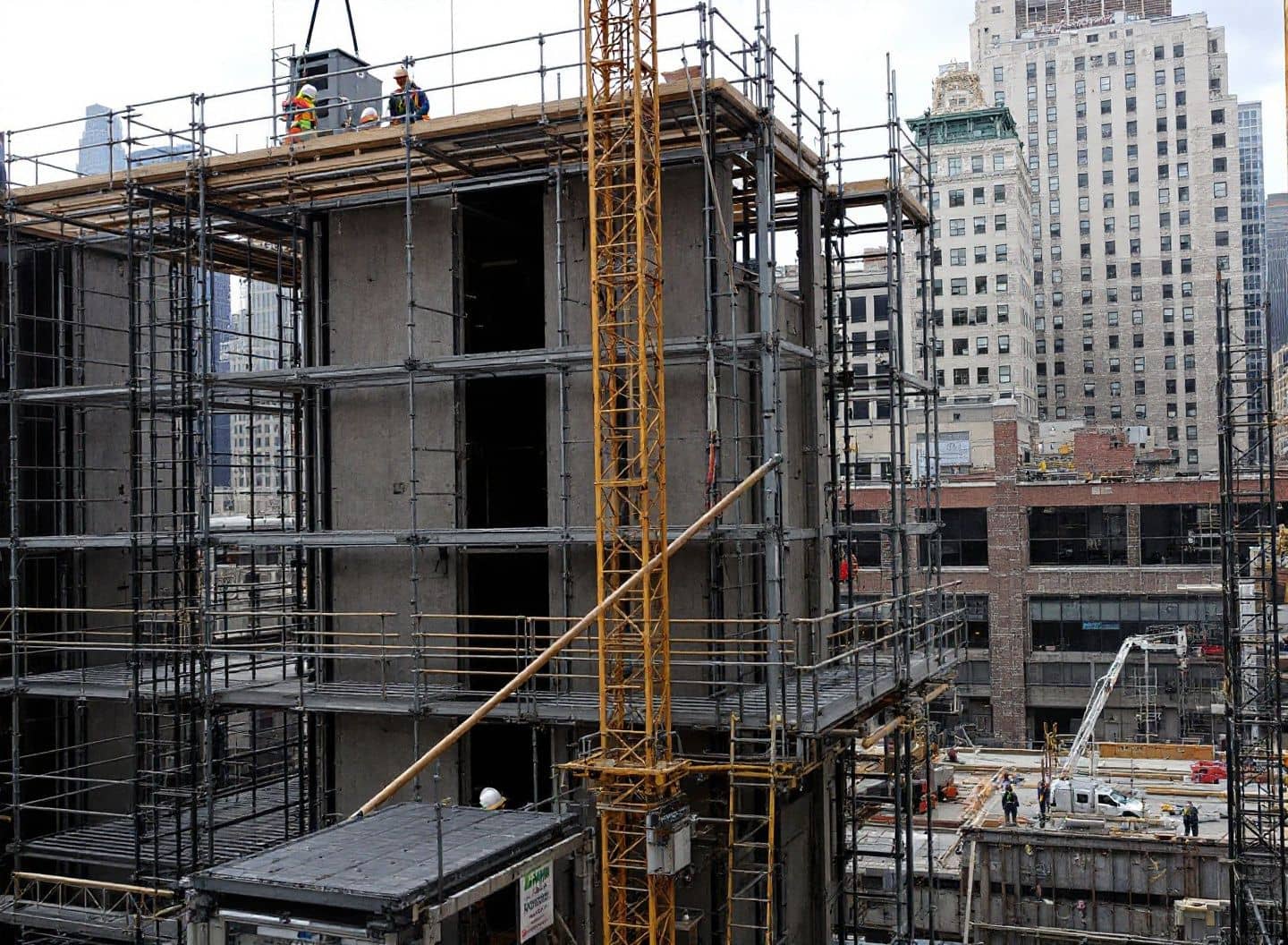
On virtually every high-rise or mid-rise construction project in New York City and across the state, workers depend on personnel hoists and temporary construction elevators to move between floors. These machines look industrial-grade and utilitarian, and they are — but they're also temporary, constantly modified, and often maintained by whoever is cheapest or most convenient to a general contractor running behind schedule. When something goes wrong, the results aren't minor. A free-fall event inside a temporary hoist shaft, or a worker stepping through a defective landing door into an open shaft, can produce traumatic brain injuries, spinal cord damage, internal organ injuries, crush injuries, and fatalities. Falls from height remain one of the leading causes of worker death in construction, and construction elevator incidents represent some of the most preventable of those events.
This article explains the mechanics of how these accidents happen, the specific trade activities that put workers at greatest risk, and the framework of New York law that determines who may be held legally responsible.
How Personnel Hoists and Temporary Construction Elevators Actually Work
A personnel hoist is not a finished elevator. It's a temporary, rack-and-pinion or cable-driven platform designed to be erected quickly, extended as a building rises, and dismantled when permanent elevators are operational. Because the structure is temporary, the components change constantly: the shaft enclosure is often wire mesh or partial framing, landing doors (called gates or landing-level barriers) are mechanical rather than fully automatic, and the car itself may lack the safety redundancies built into a finished elevator. Maintenance and inspection obligations shift depending on who installed the unit, who is operating it, and what the owner-operator agreements say.
Temporary construction elevators are also used by multiple trades simultaneously. Ironworkers, electricians, plumbers, carpenters, and laborers all share the same hoist during the same shift. That heavy traffic creates wear on latches, gates, and mechanical components far faster than the manufacturer's baseline assumptions. A latch that worked fine at 7 a.m. may be failing by noon.
The Two Primary Mechanisms of Injury
Injuries in construction elevator incidents generally fall into two broad categories: free-fall events and shaft-entry falls. Both are devastating. Understanding them helps workers recognize hazards before an incident occurs, and helps injured workers and their attorneys articulate what went wrong.
Free-Fall and Mechanical Failure Inside the Car
A free-fall event occurs when the hoist car drops uncontrolled, either because a cable parts, a rack-and-pinion drive malfunctions, or a braking system fails. These events may be brief — a drop of a few feet — or catastrophic, where the car falls several stories before striking the bottom of the shaft or a mechanical stop. Even a relatively short free-fall subjects everyone inside the car to sudden deceleration forces that can fracture vertebrae, tear ligaments, and cause brain injury from the whiplash-type loading on the cervical spine. Workers who brace themselves against the car walls or grab handrails often suffer severe upper-extremity injuries on top of the deceleration trauma. If the car strikes the bottom hard, compressive forces on the lower extremities and spine can be extreme.
Overspeed governors and safety brakes are supposed to prevent free-fall. When they're properly maintained and regularly inspected, they work. When they're not, they fail. Failure often results from inadequate lubrication, debris in the rack, or deferred maintenance by a hoist operator cutting corners on a tight project schedule.
Shaft-Entry Falls Through Defective or Missing Landing Doors
The second and equally serious mechanism involves the landing-level doors or gates that prevent workers from stepping into the shaft when the car isn't present. On a properly maintained construction hoist, these gates interlock with the car: the gate should only open when the car is sitting at that landing. In practice, interlock systems on temporary hoists are mechanical and subject to defeat, either accidentally or intentionally by impatient workers in a hurry.
When a worker opens or forces a gate while the car is at another floor, there's nothing between them and the open shaft. On a 20-story building, that's a fall measured in hundreds of feet. But even where the shaft is only a few stories deep at the time of the incident, the injuries are typically catastrophic. Workers don't anticipate the void. They step forward expecting a floor and find nothing.
During construction, elevator shafts are open at each floor level until the permanent car and doors are fully installed. Temporary coverings — plywood sheets, planks, or gate guards — are required to protect those openings. These coverings must be strong enough to support the weight of anyone who might step on them, and they must be secured so they can't shift or be accidentally displaced. When coverings are absent, inadequately secured, or made of materials that can't bear the load, the shaft becomes an unguarded opening. Workers installing rails, counterweights, or door frames at the shaft perimeter face this hazard directly. They're often working on temporary platforms constructed from 2x10 or 2x12 lumber, positioned close to an open shaft edge, without adequate fall protection.
Trade-Specific Risk: Who Is Most Vulnerable
While every worker who rides a construction hoist assumes some baseline risk, certain trades face elevated exposure because of the work they do near the shaft itself. Ironworkers and carpenters installing hoist rails or mast sections work directly at the open top of the climbing mast. Electricians running power to the hoist panel often work near the shaft enclosure at multiple floor levels. Laborers tasked with loading materials into the car may be at the landing with less formal training on gate interlock requirements than a hoist operator would have. Hoist operators themselves face risk when mechanical failures occur without warning, particularly during the early morning when cold temperatures affect cable and brake performance.
It's worth noting that workers who are simply riding the hoist, not operating it or working on its components, are still injured when the car fails. A free-fall event doesn't distinguish between an experienced mechanic and a first-week laborer. Everyone inside the car is subject to the same forces.
The Legal Framework: New York Labor Law and Federal Standards
New York has a layered set of legal protections for construction workers, and personnel hoist accidents can implicate several of them simultaneously.
Hurt on a Construction Site?
Tell us what happened. A licensed New York attorney will review your case and call you — free, no obligation.
Labor Law § 240(1) and the Gravity-Related Injury Doctrine
New York's Labor Law § 240(1) is often called the Scaffold Law, but its reach extends well beyond scaffolding. It imposes absolute liability on property owners and general contractors for gravity-related injuries, including falls from elevation and injuries caused by falling objects. When a worker falls into an elevator shaft through a missing or defective gate, or when a free-falling hoist car injures workers inside it, § 240(1) is frequently the primary basis for a claim. The statute is strict: if the protective device (the interlock, the gate, the braking system, the shaft cover) failed to provide adequate protection, and that failure was a proximate cause of the injury, the owner and general contractor face liability regardless of their own fault. The injured worker doesn't have to prove that anyone was negligent in the ordinary sense.
Labor Law § 241(6) and Specific Industrial Code Violations
Labor Law § 241(6) provides a separate and important cause of action by requiring owners and general contractors to comply with specific safety rules promulgated by the Commissioner of Labor. Unlike § 240(1), a § 241(6) claim requires proof that a specific regulatory provision was violated and that the violation caused the injury. But the range of potentially applicable regulations in a hoist accident is broad.
The relevant state-level regulatory framework is found in 12 NYCRR 23-9, which addresses protection in construction, demolition, and excavation operations, specifically the safety rules governing powered equipment and hoisting apparatus used on construction sites. 12 NYCRR 23-9 sets out requirements for equipment inspection, maintenance, operation, and the physical safeguards that must be in place during use. Violations of these provisions, such as operating a hoist with a defective braking system or failing to maintain gate interlocks in working condition, can support a § 241(6) claim. The statute requires that owners and GCs comply with these codes, and the industrial code provisions under 12 NYCRR 23-9 are sufficiently specific to qualify.
Labor Law § 241 also addresses the physical condition of the building under construction. One of its requirements is that builders must complete fireproof flooring as work progresses. This provision matters in elevator shaft incidents because incomplete or improperly protected floor openings at each landing level are sometimes the direct cause of a shaft-entry fall. If permanent flooring or fire-rated decking hasn't been laid around the shaft opening at a given floor, the absence of that surface creates the void that swallows a worker.
Federal OSHA Standards: 29 CFR 1926.300
On the federal side, OSHA regulations for construction sites require that tools and equipment, including hoisting equipment and the machinery associated with it, be guarded, maintained, and operated within their rated specifications. 29 CFR 1926.300 establishes general requirements for tools and equipment used in construction, including the mandate that all guards and safety devices remain in place and in working order. While OSHA violations don't create a private right of action the way New York's Labor Law does, they can be relevant evidence in a negligence claim and may reflect the general standard of care expected of equipment owners and operators. A documented OSHA violation following a hoist accident can be powerful corroborating evidence in a lawsuit.
Who Can Be Held Responsible?
Liability in a construction hoist accident is rarely limited to a single party. Potentially responsible parties include the property owner, the general contractor, the hoist manufacturer (if the equipment was defective by design or manufacture), the hoist maintenance company (if they were under contract to service the unit), the subcontractor who erected or modified the hoist, and in some cases the hoist operator's employer. New York's Labor Law provisions protect workers by holding owners and general contractors liable even when they weren't the ones who directly created the hazardous condition. That's a critical protection because most construction workers are employed by subcontractors who have no direct contractual relationship with the owner, and who may be judgment-proof on their own.
Product liability claims against a hoist manufacturer are separate from the Labor Law claims. If the overspeed governor was defectively designed, or if the gate interlock mechanism had a known design flaw that made it easy to defeat, the manufacturer may face independent liability regardless of how the site was managed. These claims require expert analysis of the equipment and its maintenance records.
What Injured Workers and Families Should Know About Their Rights
If you or someone you love has been injured in a personnel hoist or construction elevator accident in New York, the legal picture is genuinely complex, but several principles are important to understand from the start.
Personnel hoist accidents aren't freak events. They're the predictable result of cost-cutting on safety, deferred maintenance, and inadequate supervision. New York law exists precisely to hold the parties who control construction sites accountable when those failures injure the workers who build our buildings.
Attorney Advertising. Prior results do not guarantee a similar outcome. This article is for general informational purposes only and does not constitute legal advice. NY Construction Advocate connects injured workers with experienced New York construction accident attorneys.
Primary sources
Frequently Asked Questions
Does New York's Labor Law § 240(1) cover injuries that happen inside a construction elevator car, or only falls outside the car?▼
What if a coworker opened the gate and caused me to fall into the shaft? Can I still bring a claim against the owner or general contractor?▼
How does 29 CFR 1926.300 fit into a New York construction injury lawsuit?▼
My employer told me I can only get workers' compensation and can't sue anyone. Is that true?▼
What physical evidence should be preserved after a construction hoist accident?▼
Does it matter that I was just a passenger in the hoist car, not the operator or a mechanic?▼
Get a Free Case Review
Find out if you have a claim under New York Labor Law. A licensed NY attorney will review your case and call you back.