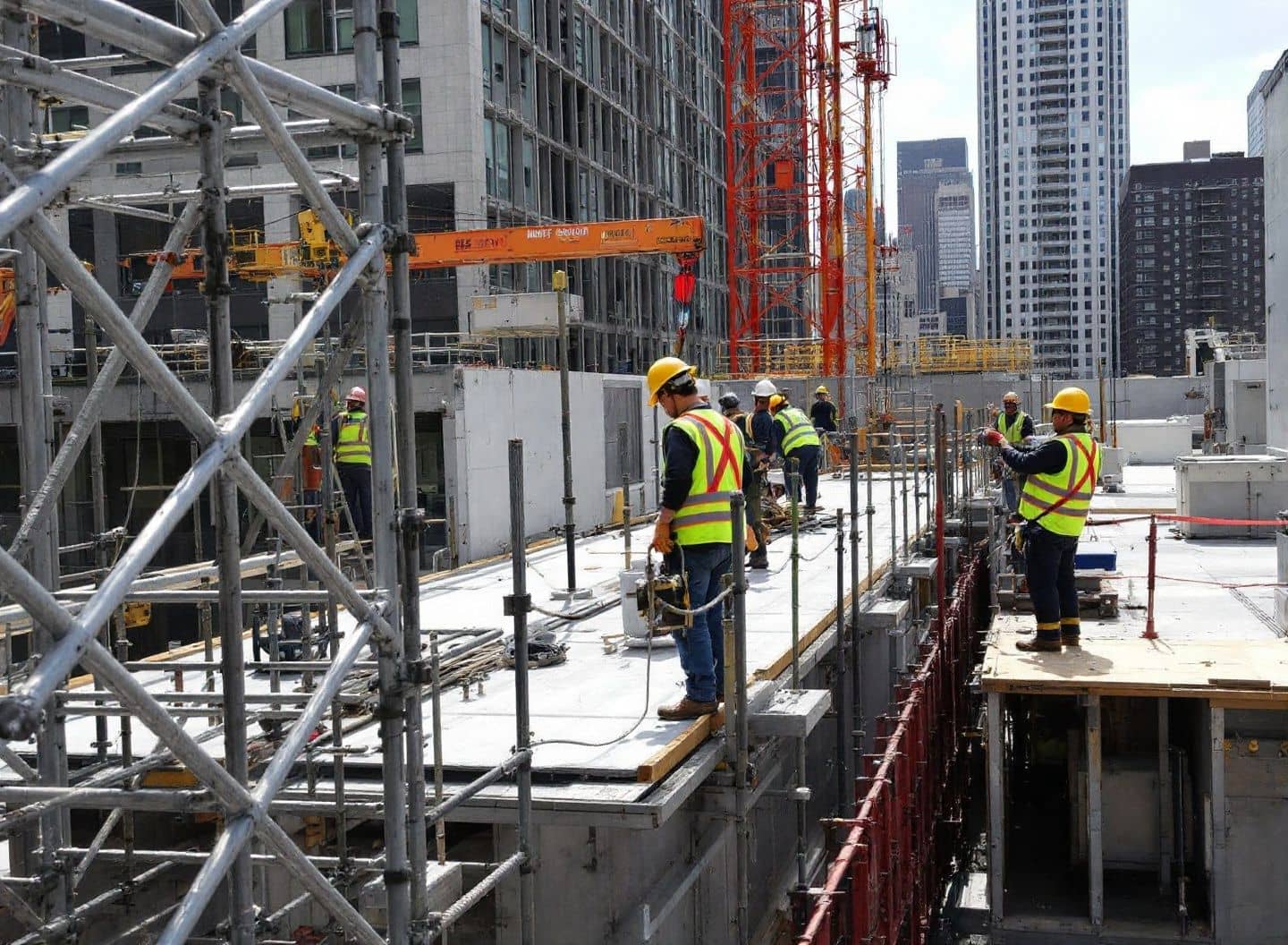
Roofing is one of the most dangerous trades in New York's construction industry. Workers spend entire shifts at the outermost edge of a building, often on sloped or flat surfaces that offer no natural barrier between them and the ground below. When a contractor or property owner fails to provide adequate fall protection, the consequences can be catastrophic. Fortunately, New York's Labor Law § 240 — commonly called the Scaffold Law — was written with exactly this kind of hazard in mind. Understanding how that statute works alongside federal OSHA regulations gives injured roofers and their families a clearer picture of their rights.
Why Roofing Work Is Inherently a Leading-Edge Hazard
By its very nature, roofing work takes place at a leading edge. Whether a crew is rolling out EPDM membrane, nailing down asphalt shingles, soldering copper flashing, or applying spray polyurethane foam, the work keeps pushing outward toward the perimeter. That perimeter is where workers are most exposed. There's no wall, no guardrail, and often no safety net between the worker and a two-, three-, or four-story drop.
The problem compounds on flat commercial roofs. A flat surface feels stable underfoot, which can actually reduce a worker's natural caution. Workers carry heavy rolls of material, walk backward while spreading adhesive, or crouch at the parapet to secure a termination bar. Any of those movements near an unprotected edge can send a worker over the side before they even realize they've lost their footing.
Slope adds another layer of risk on residential projects. Even a modest 4-in-12 pitch becomes treacherous when it's wet, when debris accumulates, or when a worker is carrying a bundle of shingles that shifts their center of gravity. Falls from sloped roofs frequently happen not at the ridge but at the eaves, exactly where the roof terminates over open air with nothing below.
Skylights and Roof Openings: The Hidden Fall Trap
Unprotected edges aren't the only danger on a roof. Skylights are a serious, and often underappreciated, fall hazard. Most residential and commercial skylights are made of fiberglass or polycarbonate panels. They look solid. They look like they can support weight. They cannot. A standard fiberglass skylight dome is designed to admit light, not to bear a person's weight. A roofer who steps on one — even briefly, even with one foot — can punch through in an instant and fall the full interior height to the floor below.
The same risk applies to other roof penetrations: open elevator shaft hatches, mechanical equipment curbs left uncovered, and HVAC duct openings that workers may not even see until they're on top of them. Each of these represents what safety professionals call an "unprotected opening," and each one is a recognized, preventable hazard that should be covered, barricaded, or guarded before any worker sets foot on the roof.
Falls through skylights often result in more severe injuries than edge falls. The worker doesn't just fall from the roof level; they fall the height of the building's interior, frequently landing on hard flooring, machinery, or shelving. The absence of any skylight guard or cover is a straightforward failure of basic safety planning.
What OSHA Requires: 29 CFR 1926.501 and Its Specific Mandates
Federal OSHA's fall protection standard for the construction industry is codified at 29 CFR 1926.501. It was the single most-cited OSHA standard in federal enforcement during fiscal year 2024, with more than 6,300 citations issued nationwide. That number reflects the persistent gap between what the regulation requires and what actually happens on job sites.
Under 29 CFR 1926.501, workers on low-slope roofs (a slope of 4-in-12 or less) who are within six feet of an unprotected roof edge must be protected by guardrail systems, safety net systems, or personal fall arrest systems. Workers on steep-slope roofs need those same protections regardless of their distance from the edge. For skylights and other roof openings, the regulation requires covers capable of supporting twice the weight of workers, equipment, and materials that could be placed on them, or alternative protection such as guardrails around the opening.
What the OSHA standard makes clear is that fall protection on a roofing job isn't optional equipment. It's a baseline legal requirement. When a contractor skips the safety net, foregoes a personal fall arrest system, or leaves skylight openings unguarded, they're not just taking a shortcut — they're violating a federal mandate that exists for a specific reason: because people die when these protections are absent.
Labor Law § 240: New York's Stronger Protections for Injured Workers
Federal OSHA violations matter for regulatory enforcement, but for an injured roofer in New York, the more powerful legal tool is often Labor Law § 240. Known informally as the Scaffold Law, this statute does something that most states' laws do not: it places absolute liability on contractors and property owners when certain gravity-related accidents occur on a construction site.
Labor Law § 240 requires that contractors, owners, and their agents must furnish or erect scaffolding, hoists, ladders, stays, hangers, blocks, pulleys, braces, irons, ropes, and other devices that give proper protection to workers engaged in covered construction activities. The duty is non-delegable. That means a general contractor can't point to a subcontractor and say it was their responsibility. A property owner can't say they hired someone else to handle safety. The obligation attaches to them directly, and it doesn't go away just because another party was also responsible.
For a roofing worker to bring a claim under Labor Law § 240, several elements generally need to be present. First, the work must be a covered activity — construction, demolition, repair, or painting of a building or structure. Roofing work clearly qualifies. Second, there must be a gravity-related hazard. Falls from heights and falls through openings like skylights squarely fit that description. Third, there must be a failure to provide adequate safety devices. An unguarded roof edge, a missing guardrail, no personal fall arrest system, or an uncovered skylight opening all represent exactly that kind of failure.
When those elements are met, the injured worker doesn't have to prove that the owner or contractor was negligent in the traditional sense. The statute creates what courts have described as absolute liability for the specific safety violation. This is deliberately strong protection, because the New York legislature recognized that workers have little control over site conditions set by owners and general contractors above them in the chain of command.
Hurt on a Construction Site?
Tell us what happened. A licensed New York attorney will review your case and call you — free, no obligation.
The Role of 12 NYCRR 23-1.7 in Roofing Fall Cases
Beyond Labor Law § 240, injured roofers in New York may also have claims under Labor Law § 241(6), which requires construction sites to comply with specific safety regulations set by the Commissioner of the Department of Labor. One of the most important sets of those regulations for fall-related injuries is found at 12 NYCRR 23-1.7.
12 NYCRR 23-1.7 addresses protection in construction, demolition, and excavation operations, with specific provisions about elevated workplaces, floor openings, and similar hazards. These regulations implement Labor Law § 241(6) by setting out concrete requirements rather than general standards. When a contractor violates one of these specific provisions and a worker is injured as a result, that violation can form the basis of a § 241(6) claim.
The practical difference between a § 240 claim and a § 241(6) claim matters in litigation. Under § 240, the injured worker's own comparative negligence is not a defense for the contractor or owner. Under § 241(6), comparative fault can be considered. But both statutes can apply to the same accident, and attorneys representing injured roofers often pursue both theories when the facts support it. 12 NYCRR 23-1.7 effectively gives § 241(6) claims the specificity courts require, because the regulation itself states exactly what the worksite should have had in place.
Common Scenarios Where These Laws Apply to Roofers
It helps to think through the kinds of situations where Labor Law § 240, 29 CFR 1926.501, and 12 NYCRR 23-1.7 typically come into play on roofing projects.
In each of these scenarios, the failure is not primarily the worker's. The failure belongs to whoever controlled the site and was responsible for providing the safety equipment required by law. Workers often don't get to choose whether guardrails go up. That decision is made by supervisors, contractors, and owners before the crew arrives.
What Injured Roofers Should Know About Pursuing a Claim
New York's Labor Law exists specifically to give injured construction workers a viable path to compensation. Falls from height can be fatal, and even survivable falls frequently cause injuries that are life-altering: spinal fractures, traumatic brain injuries, shattered limbs, nerve damage. The value of a claim varies with the severity of the injury, the extent of lost wages and future earning capacity, and the specific facts surrounding the accident.
Workers' compensation is generally available regardless of fault, and collecting workers' comp doesn't prevent a worker from also pursuing a Labor Law claim against a third party like the general contractor or property owner (as opposed to the direct employer). That combination is important, because workers' comp benefits alone rarely cover the full extent of a serious injury's economic and non-economic impact.
Evidence matters enormously. If you've been injured in a roofing fall, or if a family member has been, preserving photographs of the site, the location of the fall, and the absence of any protective equipment is critical. Witness statements from coworkers, incident reports, OSHA inspection records, and the contractor's own safety plan (if one exists) can all become important later. Act quickly: physical evidence changes, crews move on, and memories fade.
New York has a three-year statute of limitations for Labor Law personal injury claims, but there are exceptions that can shorten that window, particularly when a municipality or public authority owns the property. Getting a consultation with an attorney who focuses on construction accident cases as early as possible is the best way to protect your rights and your evidence.
Attorney Advertising. Prior results do not guarantee a similar outcome. This article is for general informational purposes only and does not constitute legal advice. NY Construction Advocate connects injured workers with experienced New York construction accident attorneys.
Primary sources
Frequently Asked Questions
Does Labor Law § 240 cover roofers, or only workers on scaffolds?▼
Can I sue the property owner as well as the contractor if I'm hurt in a roofing fall?▼
What if my employer says I should have been more careful near the edge?▼
Is a fall through a skylight covered by Labor Law § 240?▼
What is 12 NYCRR 23-1.7 and why does it matter for my case?▼
Can I file both a workers' compensation claim and a Labor Law lawsuit?▼
What evidence should I try to preserve after a roofing accident?▼
Get a Free Case Review
Find out if you have a claim under New York Labor Law. A licensed NY attorney will review your case and call you back.