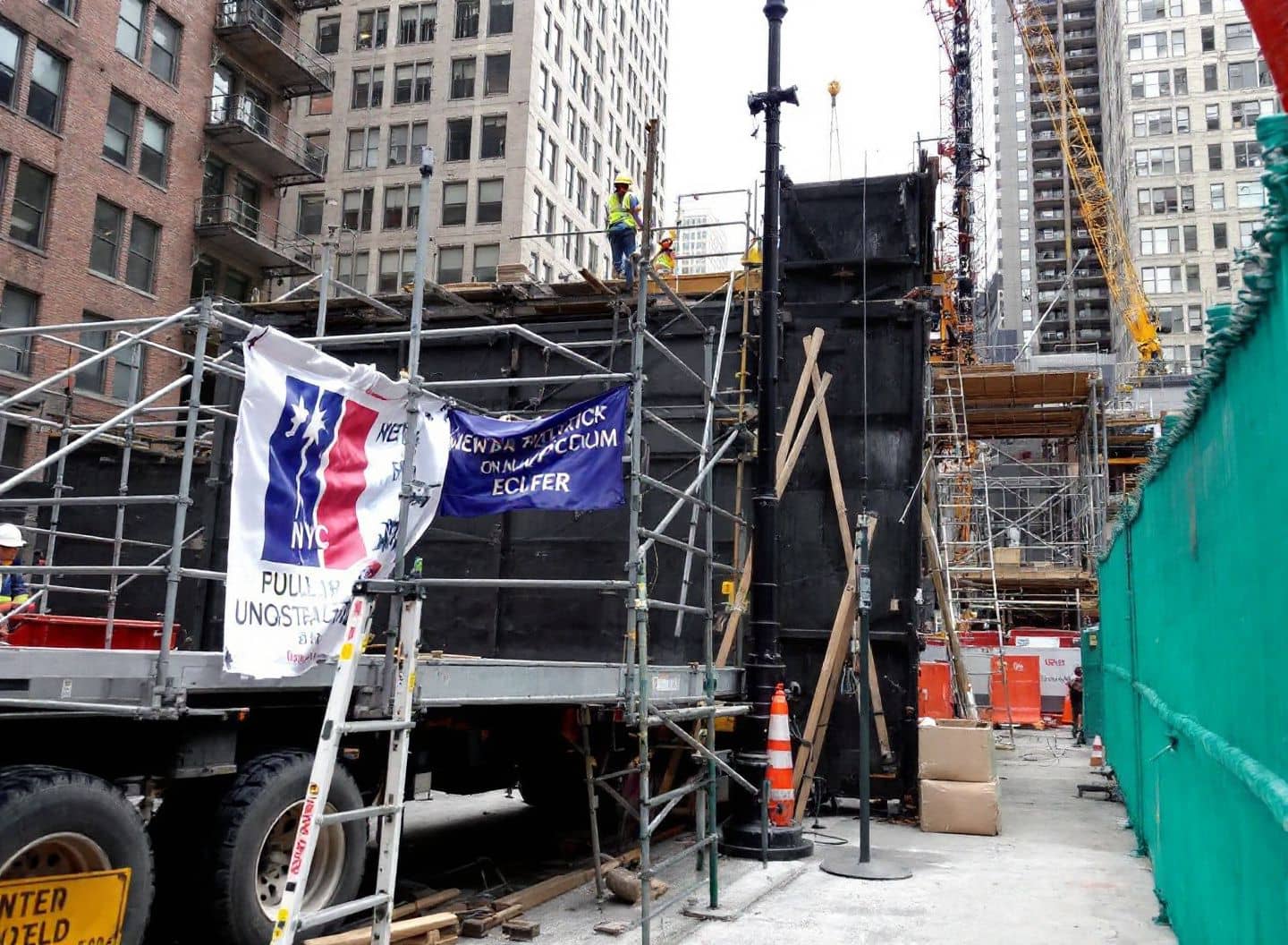
Sidewalk sheds and supported scaffolds collapse in New York City when their structural systems are compromised by base instability, missing cross-bracing, overloaded decks, or poor inspection practices. Workers on the scaffold and pedestrians passing beneath it can both suffer catastrophic injuries. New York Labor Law § 240, federal scaffold regulations, and state safety codes all assign legal responsibility to owners and contractors when those failures occur.
What Is a Sidewalk Shed and Why Does It Collapse?
A sidewalk shed, sometimes called a Local Law 11 shed or a pedestrian protection shed, is a temporary wood-and-steel tunnel built over a sidewalk to protect people walking below while façade repair, window replacement, or other exterior building work is performed above. They're a permanent feature of the New York streetscape: at any given time, hundreds of these structures line Manhattan and the outer boroughs. Most people walk through them without giving them a second thought.
That familiarity is part of the danger. Because sheds look permanent and feel solid, property owners, contractors, and inspection crews sometimes treat them as low-priority maintenance items. Planks rot. Connections loosen. Cross-braces get removed to move materials through and never go back. Legs settle into soft or disturbed soil over months. And then the structure fails.
The collapse mechanism usually involves one of a handful of recurring failure modes. Base instability is among the most common. Scaffold legs need to bear on solid concrete or on wooden mudsills sized to distribute the load. When base plates sit on loose fill, recently disturbed backfill, or unpaved ground, settlement is uneven. One corner drops a fraction of an inch; the frame rakes; the cross-braces, which were never designed to handle that kind of lateral shift, begin to fail in sequence. The whole structure can come down quickly once that process starts.
How Does Missing Cross-Bracing Cause a Scaffold to Fail?
Missing or incomplete cross-bracing is one of the leading structural causes of supported scaffold collapse. Modular scaffold frames are designed as a system. The vertical frames carry vertical load; the diagonal cross-braces provide lateral stiffness and tie the frames together so they act as a unit. Remove those braces from even one bay and you've created a weak link in a chain that the rest of the structure can't compensate for.
On a working jobsite, braces get pulled all the time. Workers need to move lumber, pipe, tools, or debris through the scaffold, and the diagonal braces block the path. The intent is always to put them back. In practice, on a busy site with multiple trades, shifting supervision, and pressure to keep the work moving, that doesn't always happen. The next crew doesn't know the brace was removed. The next inspection doesn't catch it. And the next significant lateral load, whether from wind, a material pick, or workers shifting weight together on a deck, finds the missing member.
Federal law addresses this directly. Under 29 CFR 1926.451, scaffolds must be erected, moved, dismantled, or altered only under the supervision of a competent person, and all components must be in place before the scaffold is loaded. That provision exists precisely because the piecemeal removal of components is so common and so dangerous.
What Happens When a Scaffold Deck Is Overloaded?
Overloading a scaffold deck is a different failure mechanism but an equally serious one. Every supported scaffold has a rated capacity, typically expressed in pounds per square foot, that reflects the combined weight of workers, tools, and stored materials the structure is engineered to carry. On renovation and façade projects in New York, that limit is routinely approached and sometimes exceeded.
The problem is that material staging on scaffold decks is often informal. A foreman decides to store a pallet of brick on the platform because it's convenient. Scaffold planks are not selected or laid out with the load rating in mind. Multiple crews work the same deck on the same shift. None of these decisions gets run through an engineer. The cumulative weight can exceed the rated capacity significantly before anyone realizes it.
Overloading stresses connections, bends frames, and can cause plank failure independent of any structural collapse. A worker standing on an overloaded plank that snaps, or on a deck that buckles under sudden additional weight, faces a fall from elevation with all the injuries that entails: fractures, spinal injuries, traumatic brain injuries, and worse. Falls from height can be fatal. That's not a statement about any single incident; it's the basic physics of the situation.
Understanding Who Is at Risk: Workers and Pedestrians
Two very different populations are injured when a sidewalk shed or supported scaffold comes down. Workers on or near the scaffold face the direct structural hazard: falling with the structure, being struck by collapsing members, or being ejected from a platform. The trades most frequently present on these structures include ironworkers, laborers, bricklayers, carpenters, and window installation crews.
Pedestrians face a different but equally serious risk. A collapsing shed doesn't give warning. Someone walking to work, pushing a stroller, or stepping out of a shop has no ability to predict or avoid what's about to happen. Falling lumber, steel planks, and pipe sections at any height are capable of causing severe head trauma, crush injuries, and death. The fact that the pedestrian had no role in the construction project doesn't reduce their legal rights; if anything, their position as a member of the public strengthens certain claims.
What Does New York Labor Law § 240 Require?
Hurt on a Construction Site?
Tell us what happened. A licensed New York attorney will review your case and call you — free, no obligation.
New York Labor Law § 240(1), often called the Scaffold Law, imposes a non-delegable duty on property owners and general contractors to furnish or cause to be furnished proper scaffolding, hoists, ladders, stays, hangers, blocks, pulleys, braces, irons, ropes, and other protective devices for workers engaged in construction, demolition, or repair work on a building or structure. Non-delegable means that the owner and contractor can't escape liability by pointing to a subcontractor who actually built the scaffold. If the scaffold fails and a worker falls, the owner and general contractor are directly responsible under § 240.
The statute is broadly written and has been interpreted by New York courts to cover not just falls from scaffolds but also injuries caused by falling objects dislodged from elevation. If a scaffold collapses and debris strikes a worker below, that can fall within § 240's protections. The law applies when a worker is injured or killed. It does not generally cover pedestrians, who typically pursue separate legal theories, but it is one of the most powerful tools available to injured construction workers in New York.
How Do State and Federal Safety Regulations Define What Contractors Must Do?
State safety regulations under 12 NYCRR 23-5 set out detailed construction requirements for scaffolds used on New York worksites. These regulations, which implement New York Labor Law § 241(6), go well beyond the general duty language of § 240 and specify what scaffolds must actually look like: how they must be erected, what kind of planking is required, how guardrails must be constructed, how bases must be supported, and what inspection obligations exist. Violations of 12 NYCRR 23-5 can support a § 241(6) claim, which allows an injured worker to argue that the failure to follow a specific, concrete safety standard was a proximate cause of their injury.
At the federal level, 29 CFR 1926.451 is the primary OSHA standard governing scaffold safety in construction. It requires that scaffolds be capable of supporting their own weight plus four times the maximum intended load, that platforms be planked or decked to the full width of the scaffold where possible, that guardrails and midrails be installed on all open sides and ends, and that a competent person inspect the scaffold before each work shift. In fiscal year 2024, OSHA cited this standard 1,873 times nationwide, making it one of the most frequently cited construction safety violations in the country. That number reflects how routinely these requirements are ignored on real worksites.
What Types of Injuries Do Scaffold Collapse Victims Typically Suffer?
The injuries from a scaffold or shed collapse depend on the height of the fall, what the victim lands on, and whether they're struck by falling structural members. Workers and pedestrians involved in these incidents commonly suffer traumatic brain injuries, spinal cord injuries, broken vertebrae, pelvic fractures, femur fractures, crush injuries from collapsing members, and internal organ damage. Recovery from these injuries can span months or years, involve multiple surgeries, and leave lasting physical limitations.
The severity varies enormously. A worker who falls six feet from a scaffold deck to a concrete sidewalk faces a very different injury profile than one who falls twenty feet with a section of framing on top of them. Pedestrians struck by falling scaffold planks may suffer injuries ranging from lacerations to fatal head trauma. The value of a legal claim varies with the severity of the injury, the duration of disability, and the nature of the work that can no longer be performed.
What Should a Victim Do After a Scaffold or Shed Collapse?
Getting medical attention is the first priority, full stop. Injuries from structural collapses are often more serious than they initially appear. Adrenaline masks pain. Spinal injuries can worsen with movement. A full medical evaluation immediately after any collapse is essential, both for health reasons and because a documented medical record is critical to any future legal claim.
After getting medical care, documenting the scene matters. Photographs of the collapsed structure, the base conditions, the state of the cross-bracing, and any visible overloading can preserve evidence that disappears quickly once a general contractor's crew begins cleanup. Witness information should be gathered if possible. Workers should report the incident to their employer, and pedestrians should report it to building management and the relevant city agency.
Time limits apply. New York has statutes of limitations for personal injury claims, and the clock starts running from the date of injury. Claims against government entities have much shorter notice requirements. Speaking with a construction accident attorney promptly protects the ability to pursue any claim at all.
Does Workers' Compensation Cover Everything a Hurt Worker Is Owed?
Workers' compensation covers a worker's medical expenses and a portion of lost wages, but it doesn't cover everything. It doesn't compensate for pain and suffering. It doesn't account for the full extent of long-term earning loss in the way a civil lawsuit can. And it doesn't hold the parties who created the unsafe condition accountable in the same way that a Labor Law claim does.
Workers injured on New York construction sites can often pursue both a workers' compensation claim and a separate personal injury lawsuit against the property owner, general contractor, or another responsible party. These are not mutually exclusive. Labor Law § 240 claims, in particular, are specifically designed for this kind of situation and exist separately from the workers' compensation system.
Pedestrians injured by a collapsing shed or scaffold are not part of the workers' compensation system at all. Their claims run through standard negligence law, and potentially through Labor Law § 240's falling object provisions, depending on the circumstances. An attorney familiar with New York construction accident law can assess which theories apply.
Attorney Advertising. Prior results do not guarantee a similar outcome. This article is for general informational purposes only and does not constitute legal advice. NY Construction Advocate connects injured workers with experienced New York construction accident attorneys.
Primary sources
Frequently Asked Questions
Can a pedestrian sue if a sidewalk shed collapses and injures them?▼
Does Labor Law § 240 apply if the scaffold partially collapsed but I didn't fall all the way to the ground?▼
What is 12 NYCRR 23-5 and how does it help my scaffold injury case?▼
Who is responsible when a scaffold collapses on a New York construction site?▼
Why are Local Law 11 sheds particularly dangerous after long periods of installation?▼
Does OSHA 29 CFR 1926.451 apply to New York City construction sites?▼
Get a Free Case Review
Find out if you have a claim under New York Labor Law. A licensed NY attorney will review your case and call you back.