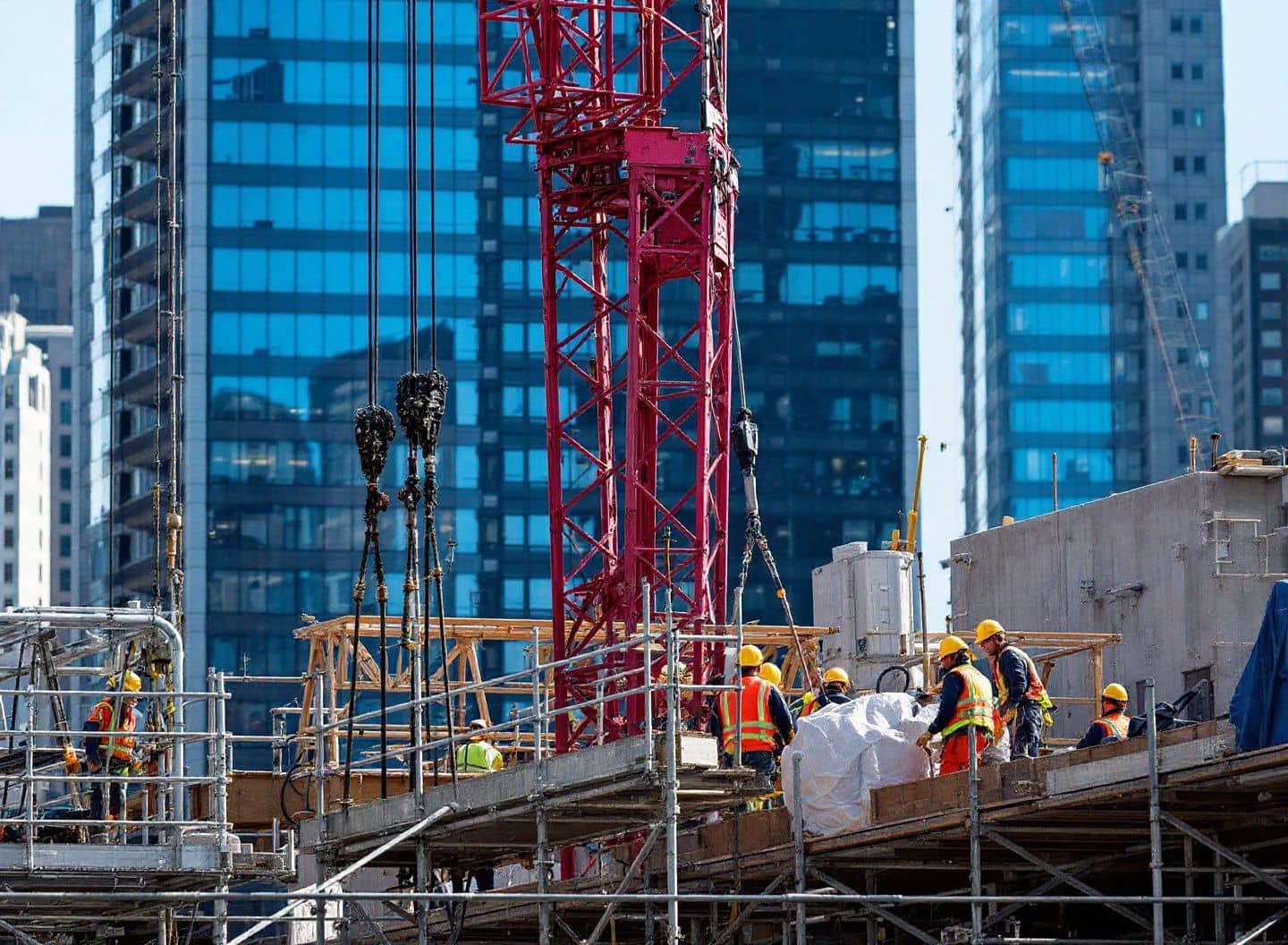
Look up at any Manhattan high-rise under renovation and you'll likely spot workers suspended dozens, sometimes hundreds, of feet above street level on what the industry calls a swing stage: a two-point suspension scaffold hung by wire ropes from roof-mounted outriggers. These platforms carry window washers, facade restoration crews, caulkers, painters, and brick masons through their entire workday. They're indispensable on tall buildings where fixed scaffolding would be impractical. They're also one of the most dangerous workplaces in New York construction when they're not designed, rigged, inspected, and maintained with absolute care.
When something goes wrong on a swing stage, there's no soft landing. Workers who survive a partial or complete platform failure routinely suffer spinal fractures, traumatic brain injuries, shattered extremities, and psychological trauma that can define the rest of their working lives. Falls from height can be fatal, even at distances that might seem modest compared to the full height of a tower. The physics are unforgiving: a free-fall onto concrete from as little as ten feet generates forces that exceed what the human body can absorb without serious injury. At the altitudes typical of facade work on New York's mid- and high-rise buildings, the outcome of a fall is almost always catastrophic.
How Two-Point Suspension Scaffolds Are Supposed to Work
A two-point suspension scaffold consists of a work platform (the stage) suspended from two independent wire ropes or fiber ropes, each attached to a separate overhead anchor point. The ropes pass through powered hoists or hand-operated descent devices that allow workers to raise and lower themselves along the building's facade. When every component is properly rated, inspected, and operated, this system functions safely. The trouble is that every link in that chain, from the roof anchor to the wire rope to the hoist to the platform planking to the guardrail system, must perform correctly at the same time.
Failures rarely announce themselves in advance. A wire rope develops internal corrosion invisible to the naked eye until the day it parts under load. An outrigger beam shifts because it wasn't properly counterweighted or secured to the building structure. A hoist brake wears unevenly, allowing one end of the platform to descend faster than the other, tilting the stage and sending tools, materials, and workers toward the edge. Planking that hasn't been inspected since the previous job develops a split that opens the moment someone steps on it. Each of these failure modes has injured and killed real workers on real New York job sites, and each of them is preventable under rules that have existed for decades.
The Federal Baseline: 29 CFR 1926.451 and What It Requires
Federal OSHA's scaffold standard, 29 CFR 1926.451, sets the national floor for suspended scaffold safety. It appears on OSHA's list of its ten most frequently cited standards for fiscal year 2025, which tells you how often employers fall short of even the minimum requirements. The regulation addresses load ratings, platform construction, guardrail systems, access, and the critical requirement that suspension scaffolds be designed by a qualified person. It requires that wire ropes be inspected before each workday and immediately after any incident that could have affected the scaffold's structural integrity. It mandates fall protection for workers on suspension scaffolds, typically a personal fall arrest system tied off to a separate lifeline anchor, not to the scaffold itself.
On any New York construction site where federal contractors are involved, or where OSHA jurisdiction applies, these requirements carry the force of law. Violations can result in citations and fines, and, more importantly for injured workers, documented OSHA violations create a powerful record that a suspension scaffold was not maintained or operated as required. That record matters when building a legal claim.
New York's Own Rules: 12 NYCRR 23-5
New York State imposes its own layer of scaffold safety requirements through the Industrial Code. The relevant section, 12 NYCRR 23-5, contains detailed specifications for scaffold construction, materials, erection, and operation on construction, demolition, and excavation sites throughout the state. These regulations implement Labor Law Section 241(6) by defining specific safety practices that contractors and owners must follow, and they often go beyond the federal minimums.
Under 12 NYCRR 23-5, suspended scaffolds must meet requirements covering platform width, guardrail height, the condition of suspension ropes, and the qualifications of the people responsible for the scaffold's design and inspection. When an employer or contractor violates a specific, applicable provision of 12 NYCRR 23-5, an injured worker may use that violation as the basis for a Labor Law Section 241(6) claim. A § 241(6) claim requires that the violation amounted to negligence and was a proximate cause of the injury; the violation is some evidence of negligence, and the worker's comparative fault can reduce recovery.
Labor Law § 240 and the Scaffold Law's Safety-Device Duty
Labor Law § 240, commonly called the Scaffold Law, requires contractors, owners, and their agents to furnish or erect proper scaffolding, hoists, ladders, stays, braces, irons, ropes, and other safety devices for workers engaged in building construction, repair, or demolition. Under § 240(1), an owner or general contractor can be liable when a required safety device was missing or failed to give proper protection against an elevation-related risk and that violation was a proximate cause of the injury, whether or not they were personally careless. Once both are shown, they can't escape liability by arguing that they delegated scaffold setup to a subcontractor or that they didn't know about a defect, and the worker's comparative negligence does not reduce recovery.
This matters enormously for suspended scaffold workers. Facade and window work on a high-rise is precisely the kind of elevation-related hazard that Labor Law § 240 was written to address. The law explicitly covers workers performing alterations, cleaning, painting, or repair of a building or structure. When a swing stage drops, tilts, or collapses and a worker falls, the first legal question isn't 'who was negligent?' It's 'was the scaffold adequate for its intended purpose?' If the answer is no, the owner and general contractor can be liable, subject to the proof of causation described below.
There is a catch. The injured worker must show that the scaffold's inadequacy was a proximate cause of the injury, meaning it wasn't enough that the scaffold was defective; the defect must have contributed to the fall or the injury. Courts have also recognized a narrow defense when a worker is the 'sole proximate cause' of their own injury, which requires showing that adequate safety devices were available, the worker knew both that they were available and that he or she was expected to use them, chose for no good reason not to, and would not have been injured had they been used. In practice, this exception is difficult for defendants to establish, but it's worth understanding so that injured workers can work with an attorney to document exactly what happened and why.
Hurt on a Construction Site?
Tell us what happened. A licensed New York attorney will review your case and call you — free, no obligation.
Common Ways Swing Stage Claims Arise
The mechanisms by which a Labor Law § 240 claim arises from a suspended scaffold accident are varied. Guardrail failures are among the most common. When a top rail, mid-rail, or toeboard is missing from a scaffold edge, or when an existing rail is improperly secured and gives way under pressure, a worker who loses balance or is bumped by a co-worker has nothing to stop a fall. The absence of a required guardrail on an elevated platform is almost textbook Labor Law § 240 territory.
Planking failures follow a similar pattern. A worker stands on scaffold planks that deflect, split, or slide off their supports. The result can be a partial fall through the platform or a total loss of footing. Platform planks are supposed to be inspected, properly spaced, and secured so they can't shift during use. When that doesn't happen, falls occur at heights where the consequences are life-altering.
Rope and hoist failures are unique to suspension scaffolds and particularly dangerous. A sudden loss of support at one end of a two-point platform causes the stage to tilt violently. Workers have only a fraction of a second to react, and personal fall arrest equipment (which may itself have been improperly rigged or omitted entirely) is their only chance of surviving. When the scaffold's suspension system fails and no secondary protection was provided, the Labor Law § 240 analysis is straightforward: the safety devices furnished were inadequate to protect against exactly the kind of gravity-related risk the law exists to address.
Who Is Covered and Who Bears Liability
Labor Law § 240 covers workers employed in the erection, demolition, repair, alteration, painting, cleaning, or pointing of a building or structure. Window washers and facade restoration workers performing pointing, caulking, waterproofing, or surface treatment all fall comfortably within this definition. The law also extends to workers whose regular duties bring them to locations where the hazard exists, even if their specific task at the moment of injury was incidental.
Liability under Labor Law § 240 attaches to owners of the property, general contractors, and their agents. It does not typically extend to the worker's direct employer (the subcontractor), because workers' compensation is generally that employer's exclusive remedy exposure. This is actually important to understand: a worker injured on a swing stage may have a direct claim against the building owner and the general contractor even though neither employed them directly. This is the mechanism that makes the Scaffold Law so significant in practice. A worker whose injury was caused by a scaffold furnished or permitted by the owner or GC can bring a direct claim against parties who have the resources to provide meaningful compensation.
Practical Steps After a Suspended Scaffold Injury
If you're a worker injured in a swing stage or suspended scaffold accident, or a family member trying to act on a worker's behalf, the first priority is medical care. Document everything. Seek emergency treatment immediately and keep records of every diagnosis, procedure, and follow-up visit. There is no typical value for these cases. What a claim may be worth depends on the injury, the evidence, the available insurance and the venue, and results in other cases do not predict the outcome of yours. A thorough medical record is the foundation of the claim.
Beyond medical care, preserve evidence. Don't let the scaffold be modified, repaired, or removed from the site before photographs and measurements are taken. If possible, identify witnesses, record the names of co-workers and supervisors who were present. Note whether any safety equipment was present, absent, or damaged. Incident reports should be filed, but be cautious about signing statements that characterize the cause of the accident before you've spoken to an attorney familiar with New York construction law.
File a workers' compensation claim promptly. Workers' compensation and a Labor Law § 240 claim against the owner and general contractor are not mutually exclusive. In most cases, a worker can pursue both. Workers' compensation provides wage replacement and medical benefits from the employer's insurer, while a Labor Law claim can address the full range of damages that workers' compensation doesn't cover. There are strict deadlines for both, so getting legal advice early is critical.
Why Facade and Window Work Demands Extra Vigilance
Facade work on New York's older building stock presents conditions that compound the inherent danger of suspended scaffolding. Buildings constructed in the early and mid-twentieth century often lack modern anchor points, requiring workers and contractors to improvise roof rigging that may not meet current load ratings. Parapet walls that serve as outrigger anchor points may be deteriorated. Buildings undergoing Local Law 11 facade inspection and repair work are often occupied, creating pressure to move quickly and limit disruption, which can translate to shortcuts in scaffold inspection and setup.
Workers on these projects are often members of trade unions whose collective bargaining agreements and training programs provide some protection, but union membership alone doesn't prevent accidents when the scaffold system itself is defective. Non-union workers on smaller facade jobs may have even less structured safety oversight. In either case, the legal protections offered by Labor Law § 240 and 12 NYCRR 23-5 apply regardless of union status.
The combination of aging building infrastructure, compressed project timelines, multi-layer subcontracting arrangements, and the extreme consequences of any failure at height makes suspended scaffold work on New York high-rises among the most legally significant hazard categories in the state's construction industry. The Scaffold Law exists precisely because the legislature recognized that workers in these conditions needed stronger protection than ordinary negligence law provides.
Attorney Advertising. Prior results do not guarantee a similar outcome. This article is for general informational purposes only and does not constitute legal advice. NY Construction Advocate connects injured workers with experienced New York construction accident attorneys.
Primary sources
Frequently Asked Questions
Does Labor Law § 240 apply to window washers and facade maintenance workers, not just construction workers?▼
Can I bring a Labor Law § 240 claim against the building owner even though I was employed by a subcontractor?▼
What is 12 NYCRR 23-5 and how does it differ from the Labor Law § 240 claim?▼
What should I do immediately after a swing stage accident on a New York job site?▼
Are there deadlines I need to worry about for a Labor Law § 240 scaffold claim in New York?▼
Can I still recover if I was partly at fault for the swing stage accident?▼
Get a Free Case Review
Find out if you have a claim under New York Labor Law. A licensed NY attorney will review your case and call you back.