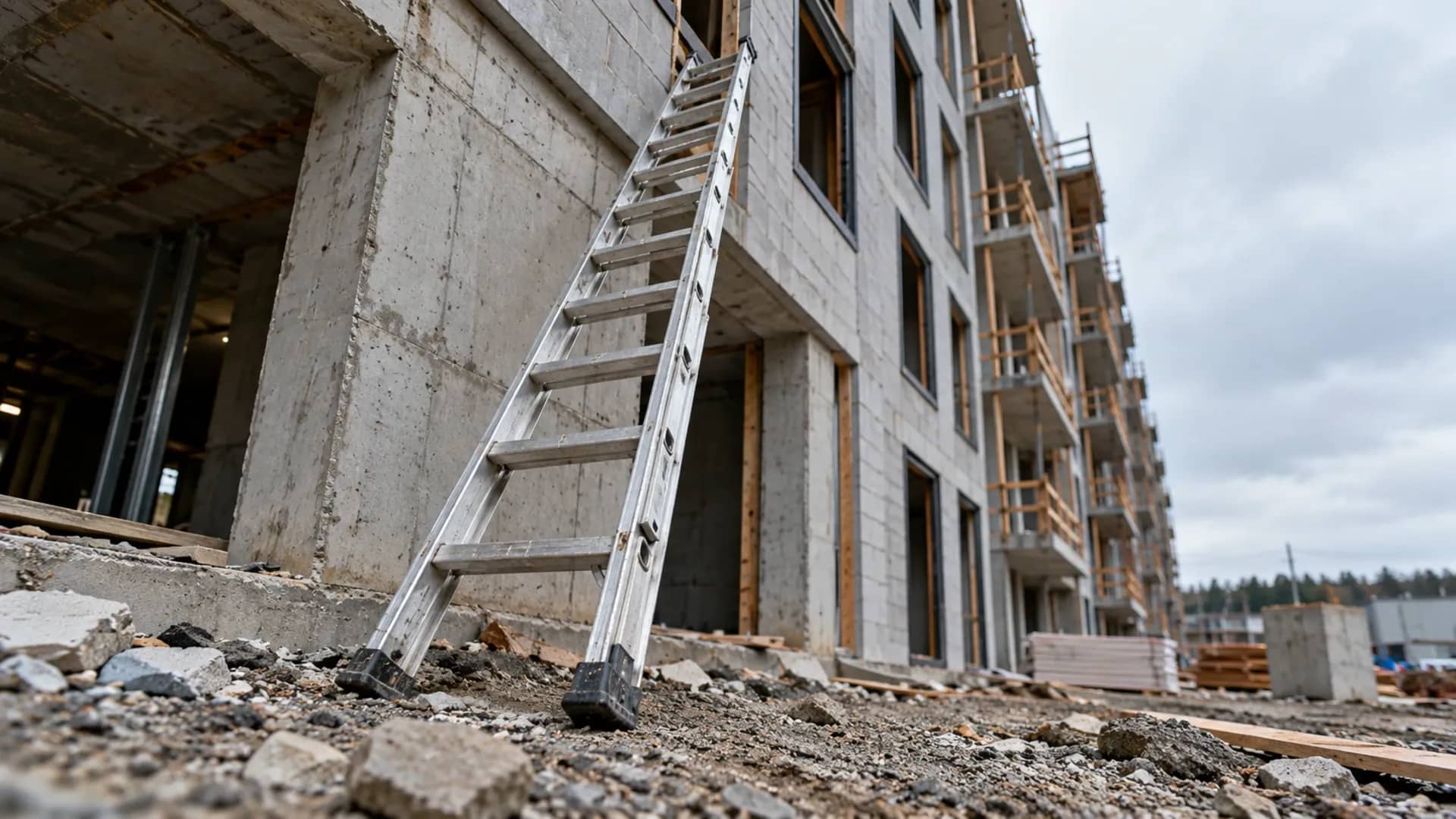
A worker who falls when an extension ladder slides out from under them may have a Labor Law 240(1) claim, not only a workers' compensation claim. New York treats an unsecured ladder as a failure to furnish proper protection against a gravity risk, and when that failure causes the fall, responsibility sits with the owner and the general contractor rather than with the worker who climbed it.
Why does an unsecured ladder create a Labor Law 240 claim?
Labor Law 240(1) requires contractors, owners, and their agents to furnish and erect ladders, scaffolding, hoists, slings, braces, and other devices so that a worker doing building work is given proper protection. Ladders are named in the statute directly. It is not a negligence rule with a comparison of fault at the end of it: a covered worker hurt by the force of gravity, using a device that was absent, defective, or inadequately secured, does not have their recovery reduced because they were also careless.
The label attached to that standard causes more confusion than the standard itself. Courts have long called it absolute liability, and in Blake v. Neighborhood Housing Services (2003) the Court of Appeals cautioned that the phrase is easily misread as meaning automatic. It does not. The statutory violation still has to be a proximate cause of the injury. Where the violation caused nothing, there is no liability — which is the opening every defense in a ladder case aims for, and the reason the sole proximate cause argument below matters so much.
An extension ladder that kicks out at the base, slides sideways at the top, or drops a worker as the rungs shift is the textbook version of the failure the statute addresses. The ladder was furnished, but it was not placed or operated so as to give proper protection. The same fall on a flat floor is an ordinary negligence question, where the defense argues about notice and about who controlled the work. A fall from a ladder that was never tied off moves the analysis onto ground where those arguments carry much less weight.
What does the Industrial Code require for ladders?
A Labor Law 241(6) claim runs on a different engine. It requires a specific provision of the New York Industrial Code, 12 NYCRR Part 23, that applies to the work, was violated, and helped cause the injury. A general safety exhortation does not qualify; under Ross v. Curtis-Palmer Hydro-Electric (1993), only concrete specifications support the claim.
For ladder work the provision to look at is 12 NYCRR 23-1.21, which sets the requirements for ladders and ladderways: the condition the ladder has to be in, how it has to be footed and held in place, and how it has to be positioned. Two neighboring provisions often matter alongside it. 12 NYCRR 23-1.16 governs safety belts, harnesses, tail lines, and lifelines, which is where the case goes when a worker was sent up with no tie-off point. 12 NYCRR 23-1.7(d) covers slipping hazards, which is where wet or icy footing under the ladder comes in.
Pleading both theories is normal practice, and the practical difference between them is worth understanding. Under 240(1), a worker's own carelessness does not reduce the recovery. Under 241(6), it can — comparative negligence applies, so a jury may assign the worker a share of the fault. A 241(6) claim anchored to 23-1.21 is still worth pleading, because it survives in situations where a defendant argues the fall was not the kind of elevation risk the Scaffold Law was written for. For how a broken Industrial Code rule becomes the spine of a claim, see construction site housekeeping failures and 12 NYCRR 23-1.7(e) claims in New York.
What does OSHA say about ladder use?
The federal standard for ladders in construction is 29 CFR 1926.1053. It is consistently among the most-cited standards OSHA writes: in fiscal year 2024 it ranked third, with 2,573 violations, according to OSHA's own top ten list. The scenarios behind those citations repeat on job after job — a damaged or defective ladder kept in service, a ladder set at the wrong angle, a ladder never secured at the top, a ladder that does not extend three feet above the landing, and a worker carrying tools or materials while climbing.
The prevention measures are just as repetitive. Inspect the ladder before each use. Hold the four-to-one angle, one foot of base for every four feet of height. Secure the ladder at the top and at the bottom. Face the ladder while climbing, keep at least one hand on it, and never carry a load that could throw off your balance — hoist materials separately instead.
An OSHA citation is not the same thing as civil liability in New York, and a violation of the federal standard does not by itself support a 241(6) claim. What the standard supplies is the industry benchmark: a clear, written statement of the practice required on the day of the fall, which an expert can hold up against what actually happened.
How does the defense usually attack a ladder case?
The most common defense is that the worker was the sole proximate cause of the fall. It gets made in almost every ladder case, because if it succeeds in full the Labor Law 240 claim fails entirely. The defense has to show all of it: that adequate safety devices were available, that the worker knew they were expected to use them, that the worker chose for no good reason not to, and that this choice alone caused the injury.
Every link in that chain is contestable. A ladder standing in a hallway is not an available device if it could not be tied off where the work was. A harness in a gang box is not available protection if there was no anchor point within reach. Testimony that a foreman told the crew to hurry, or that the only ladder on the floor was too short for the work, goes directly at whether the worker had a real alternative. That fight over anchor points is explored in falling from a scaffold access ladder or stair tower in New York.
A second line of attack is the recalcitrant worker defense, which argues that the worker refused a direct instruction to use available protection. A standing safety rule in an employee handbook is not enough. In Cahill v. Triborough Bridge and Tunnel Authority (2004) the Court of Appeals looked for evidence of a specific instruction, given close enough in time to the work to matter.
Hurt on a Construction Site?
Tell us what happened. A licensed New York attorney will review your case and call you — free, no obligation.
What evidence decides these cases?
Ladder cases turn on physical facts that disappear within days:
The single most useful step after a fall is a set of photographs taken before the ladder is moved, put back in a truck, or returned to a rental yard. A ladder that leaves the site is very hard to examine later.
Who can be held responsible?
Labor Law 240 and 241 reach the property owner and the general contractor even when neither one supervised the work and neither one owned the ladder. That is the point of the statutes: responsibility follows ownership and control of the site, not the payroll. A construction manager acting as the owner's agent can be covered as well.
There is an important exception written into the statute itself. Owners of one- and two-family dwellings who contract for work but do not direct or control it are exempt from both sections. A fall on a single-family home renovation therefore raises a different question from the start: whether the homeowner did anything to direct the work.
The direct employer is usually outside the case, because workers' compensation is the exclusive remedy an injured worker has against their own employer. The grave injury rule in Workers' Compensation Law § 11 is often misunderstood here: it does not let the worker sue the employer directly. It allows the owner or contractor being sued to bring the employer into the case for contribution when the injury meets the statutory definition. This is why a ladder fall typically produces two proceedings — a compensation claim for medical care and wage replacement, and a separate third-party action against the owner and the general contractor for the rest of the loss.
Where is the case filed?
A third-party action is generally brought in Supreme Court, and venue usually follows the county where the accident happened or where a party resides. That makes the borough or town on the job ticket a practical matter, not a formality: it sets the courthouse, the judge, and often how long the case takes.
A fall in Manhattan is filed in New York County, one in Brooklyn in Kings County, and one in Queens or the Bronx in their own county courts, each with its own construction-case backlog. Outside the city the pattern is the same — a fall in Huntington goes to Suffolk County — but the calendars, the jury pools, and the local contractors involved all differ.
Attorney Advertising. Prior results do not guarantee a similar outcome. This article is for general informational purposes only and does not constitute legal advice. NY Construction Advocate connects injured workers with experienced New York construction accident attorneys.
Primary sources
Frequently Asked Questions
Do I still have a claim if I set up the ladder myself?▼
What if I was only a few feet off the ground?▼
How long do I have to bring a case in New York?▼
Does my immigration status affect my right to file?▼
What if my employer says the accident was not reported?▼
Get a Free Case Review
Find out if you have a claim under New York Labor Law. A licensed NY attorney will review your case and call you back.