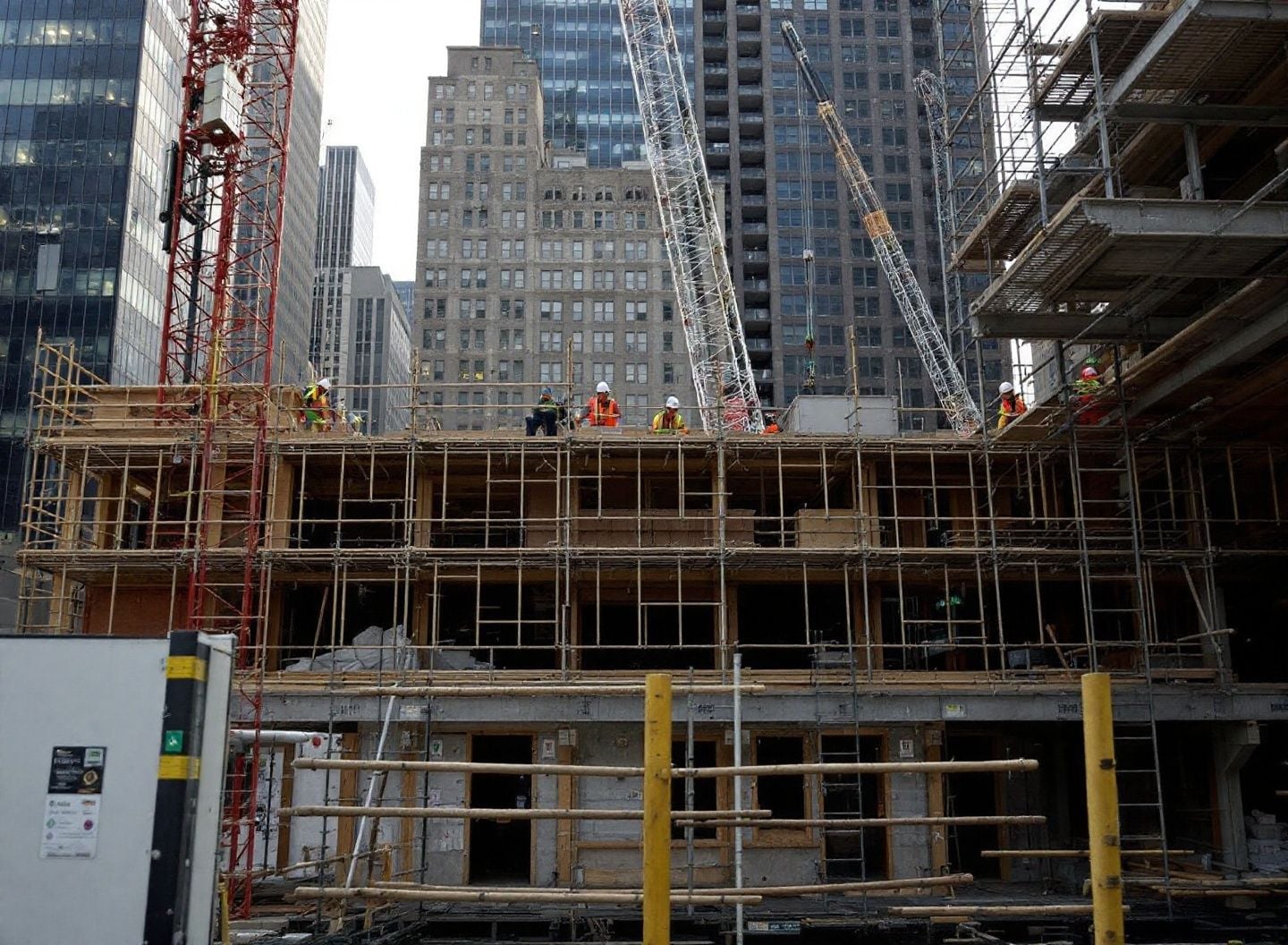
A trench doesn't announce when it's about to fail. One moment a worker is standing in it, laying pipe or forming a footing; the next, hundreds or thousands of pounds of soil are moving laterally at a speed that leaves almost no time to react. Trench collapses kill and catastrophically injure construction workers every year, and the overwhelming majority of those incidents share a single preventable feature: no protective system was in place. Under New York law and federal safety standards, that absence isn't just a lapse in judgment. It's the foundation of legal liability.
Why Soil Moves: The Physics Behind a Trench Collapse
To understand why the law draws a hard line at five feet, it helps to understand what's actually happening inside a trench wall. Soil stays vertical because of two forces working together: cohesion (the way particles bond to each other) and internal friction (the resistance particles create as they're pushed to slide past one another). In clay-rich soils, cohesion is relatively high, and a freshly cut wall can hold for a while. But in what OSHA classifies as Type C soil — sandy fill, granular material, gravel, or previously disturbed earth — cohesion is minimal. The wall is essentially a temporary structure with almost no internal support, and it degrades continuously from the moment it's cut.
The failure mode is called unsupported wall shear failure. Gravity pulls the soil mass downward; lateral earth pressure pushes it inward. When the depth of the cut exceeds what the soil's natural cohesion and friction can resist, the wall doesn't crumble gradually. It shears. A wedge or slab of material breaks free along a failure plane and moves into the trench in a fraction of a second. A worker standing at the bottom has almost nowhere to go. Even a partial collapse in a narrow trench can pin a person's lower body with enough force to cause crush injuries, traumatic amputations, or fatal compression of the chest.
Surcharge loading makes all of this dramatically worse. When excavated spoil, equipment, or materials are piled near the trench edge — the standard prohibits placement within two feet — that weight increases the lateral pressure bearing on the wall from above. Think of the soil column not just as a vertical wall but as a wedge being pushed from the top. As surcharge weight increases, the resultant lateral force on the wall increases proportionally, lowering the threshold at which shear failure occurs and often triggering collapse in conditions that otherwise might have held. On active construction sites, spoil piles, concrete forms, compactors, and delivery pallets routinely end up within a foot or two of the edge unless a supervisor is actively enforcing clearance rules.
The Federal Standard: What 29 CFR 1926.652 Actually Requires
Federal OSHA addressed excavation safety in detail under 29 CFR 1926.652, which applies to any excavation where workers are required or permitted to enter. The core rule is straightforward: each employee in an excavation must be protected from cave-ins by an adequate protective system. The standard provides three acceptable methods. Sloping means cutting the trench walls back to an angle that won't shear under the expected soil conditions. Shoring means installing a structural support system (typically hydraulic shores or timber bracing) against the walls to resist lateral earth pressure. Trench boxes (also called trench shields or slide-rail systems) are pre-fabricated steel boxes that workers operate inside of, so that even if the surrounding soil moves, the box absorbs the load.
The five-foot threshold is explicit: any excavation five feet or deeper that workers enter requires one of these protective systems unless a competent person examines the site and determines the excavation is made entirely in stable rock. That exception is vanishingly rare in New York City's built environment, where subgrade conditions typically involve fill, soft clays, sand, urban debris, or previously disturbed soil from prior construction. In Type C soils, the required slope under 29 CFR 1926.652 is 1.5 horizontal to 1 vertical (a 34-degree angle), which is dramatically flatter than the near-vertical walls commonly seen in unprotected urban trenches. When a contractor digs a six-foot trench with vertical walls and no shoring in Type C soil, it's not a borderline situation. It's a direct violation of federal standards.
New York's Parallel Requirement: 12 NYCRR 23-4
New York doesn't rely solely on federal OSHA enforcement. The state's own Industrial Code imposes independent obligations under 12 NYCRR 23-4, which governs protection in construction, demolition, and excavation operations. These regulations exist specifically to protect persons employed in construction, demolition, or excavation work, and they implement Labor Law Section 241(6) by defining the specific safety practices required on construction sites.
That relationship between the Industrial Code and the Labor Law matters enormously in civil litigation. When a worker is injured in an excavation accident, the pathway to holding an owner or general contractor liable often runs directly through 12 NYCRR 23-4. The regulation establishes a concrete, specific standard. A violation of it can constitute a per se violation of Labor Law § 241(6), shifting significant legal weight toward the injured worker without requiring that person to prove the defendants were careless in a more general sense. The code sets the standard; the contractor's failure to meet it speaks for itself.
Labor Law § 241(6): The Statute That Turns Violations Into Liability
Hurt on a Construction Site?
Tell us what happened. A licensed New York attorney will review your case and call you — free, no obligation.
Labor Law § 241(6) requires owners and contractors to provide reasonable and adequate protection and safety for workers in construction, excavation, and demolition work, and to comply with the specific safety rules promulgated under the Labor Law. The statute is non-delegable, which is a critical legal concept. It means that a property owner can't escape liability simply by claiming they hired a reputable contractor and trusted that contractor to follow the rules. The obligation to ensure a safe worksite is the owner's, regardless of who they hired to perform the work.
In practice, this means an injured excavation worker has potential claims against the property owner, the general contractor, and any other party that had supervisory authority over the work, even if none of those parties were physically present when the collapse occurred. The statute was designed with exactly this situation in mind. Workers in the excavation trade often have no meaningful ability to demand that a general contractor install shoring before they enter a trench. They're directed to work, and the parties with authority over site conditions are the ones the law holds responsible for those conditions.
The Trade-Specific Risk: Who's Actually in These Trenches
Excavation work in New York is performed by a variety of trades, and the specific risk profile varies depending on what's happening at the bottom of the trench. Plumbers and pipefitters enter deep excavations to install water mains, sewer laterals, gas lines, and drainage systems. Electricians enter to install conduit and duct banks for underground utilities. Laborers and operating engineers work in excavations during foundation forming and pour operations. Ironworkers place and tie rebar for footings and grade beams. In each case, the work requires sustained time at the bottom of the cut. A worker laying pipe in a six-foot trench isn't just passing through; they may be there for hours.
The collapse risk is also time-sensitive in ways that aren't always obvious. Trench wall stability can change rapidly based on weather. Rain saturates soil, adding weight and reducing cohesion. Ground vibration from nearby equipment or vehicular traffic cyclically loads and unloads the wall, degrading it incrementally. Temperature changes cause freeze-thaw cycles that weaken cohesive soils. A trench that held its shape on Monday morning may be at the edge of failure by Tuesday afternoon with no visible warning. This is why 29 CFR 1926.652 and 12 NYCRR 23-4 don't allow a one-time visual inspection to substitute for a protective system. The protective system is required because conditions change, and the law anticipates that.
How Missing Protection Establishes Fault in a Civil Case
When an injured worker brings a claim under Labor Law § 241(6), the legal analysis typically begins with identifying which specific Industrial Code provision was violated. For an excavation accident involving a trench deeper than five feet without a protective system, the relevant sections of 12 NYCRR 23-4 are specific enough that the violation can often be established through relatively straightforward evidence: the depth of the trench (measured from field records, drawings, or physical inspection), the soil classification, and whether any shoring, sloping, or trench box was used.
Contributory negligence can still be raised as a defense, but in the context of a trench collapse, it's difficult to argue that a worker was negligent simply for entering a trench they were directed to enter without being given the option to demand a protective system first. The comparative fault analysis tends to focus on whether the injured party did something independent that contributed to the accident, not merely whether they entered the worksite. The structural default under Labor Law § 241(6) remains with the owner and contractor.
The severity of injuries in trench collapses tends to be significant, and the value of a claim varies with the severity of the injury, the extent of lost earning capacity, and the degree of permanent impairment. Crush injuries to the lower extremities, spinal compression fractures, traumatic amputations, and fatal asphyxia from chest compression are all documented outcomes. Workers who survive severe trench collapses often face extended medical treatment, surgical intervention, and permanent limitations in their ability to perform the physical demands of their trade.
What Injured Workers Should Know About Preserving a Claim
Physical evidence in an excavation collapse deteriorates quickly. Contractors and owners typically restore the trench, install the required protective system retroactively, and resume work within hours or days. Photographs and videos taken at the scene by coworkers, supervisors, or emergency responders are often the best evidence of what the trench looked like before remediation. Witness statements from workers who were present should be preserved as soon as possible. Records including excavation permits, project drawings, daily site logs, and OSHA 300 logs may be obtainable through formal discovery in litigation or through OSHA records requests.
If you were injured or a family member was killed in an excavation accident in New York, speaking with an attorney familiar with Labor Law § 241(6) claims is an important early step. The statutes of limitations in New York construction accident cases are not indefinite, and the window for filing a Notice of Claim against a municipal owner (if the project involved public property) can be as short as 90 days from the date of the accident. Acting promptly preserves options.
Attorney Advertising. Prior results do not guarantee a similar outcome. This article is for general informational purposes only and does not constitute legal advice. NY Construction Advocate connects injured workers with experienced New York construction accident attorneys.
Frequently Asked Questions
At exactly what depth does New York law require a protective system for a trench?▼
What does 'protective system' mean, and what are the options?▼
How does Labor Law § 241(6) help an injured excavation worker?▼
Can a property owner be held liable even if they hired a contractor to do all the excavation work?▼
What is surcharge loading and why does it matter in a trench collapse case?▼
What evidence should be gathered after a trench collapse, and why does timing matter?▼
Get a Free Case Review
Find out if you have a claim under New York Labor Law. A licensed NY attorney will review your case and call you back.