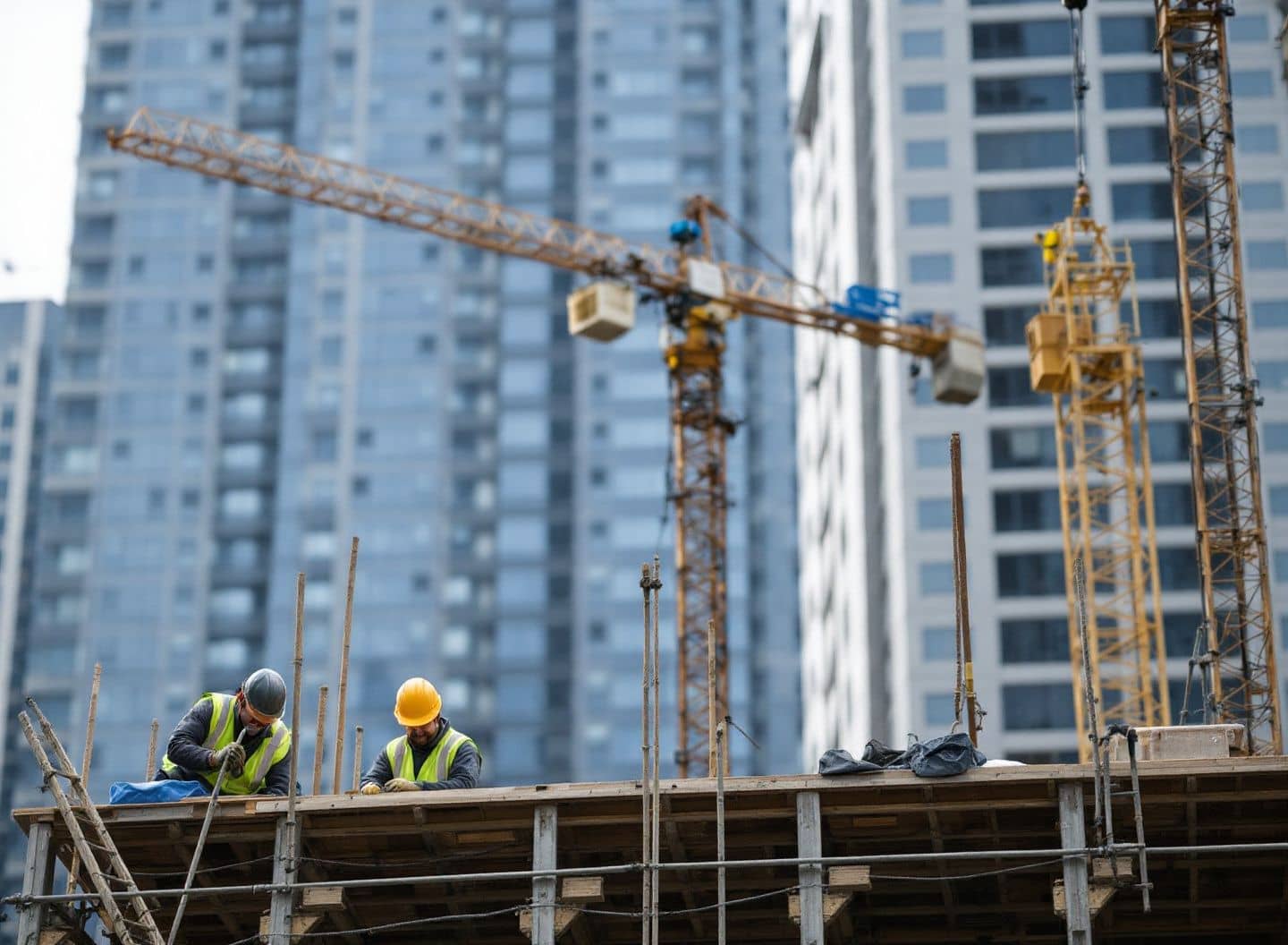
If you were hurt on a New York construction site and you made a mistake that contributed to the accident, your first instinct might be to assume your case is weakened or even worthless. That's a reasonable assumption in most personal injury situations. New York follows a pure comparative fault system, which means a jury can reduce your damages by whatever percentage of blame they assign to you. Trip over your own feet? Maybe you're 20% at fault and your award shrinks by 20%. It's a logical, proportional approach.
But construction accident law in New York doesn't always follow that logic. For a specific category of injuries, particularly falls from height and falling-object accidents, the legislature decided decades ago that worker fault simply doesn't matter. Understanding when that rule applies, and when it doesn't, is one of the most important things an injured construction worker can know.
How Comparative Fault Works in Standard NY Injury Cases
New York's comparative negligence statute, codified at CPLR Article 14-A, allows an injured person to recover damages even if they were partially responsible for the accident. Unlike some states that bar recovery the moment you're more than 50% at fault, New York lets you recover regardless of your share of fault. Your award is simply reduced in proportion to your own negligence.
So if a jury decides your injuries are worth a certain amount and you were 40% responsible, you collect 60% of that figure. Defense lawyers love this system because it gives them a straightforward argument: shift as much blame as possible onto the worker. Was your hard hat on properly? Were you rushing? Did you skip a safety step? Every yes answer is ammunition for reducing the payout.
This comparative fault framework applies to many construction injury claims, including general negligence claims and claims under Labor Law Section 200, which codifies the common-law duty of owners and contractors to maintain a reasonably safe worksite. If your case rests on those theories, your own conduct absolutely matters to the outcome.
What Labor Law § 240 Actually Says, and Why It Changes Everything
New York's Labor Law § 240, often called the Scaffold Law, imposes a different standard entirely. The statute requires owners, general contractors, and their agents to provide proper scaffolding, ladders, hoists, pulleys, braces, irons, ropes, and other devices so that workers are protected from the risks of falling from a height or being struck by a falling object. The duty is non-delegable, which means owners and contractors cannot escape liability by pointing to a subcontractor or by arguing that the worker was better positioned to protect himself.
More importantly, liability under Labor Law § 240 is absolute in the sense that courts have consistently held comparative fault is not a valid defense when the statute applies. If a scaffold collapses because it wasn't properly secured, the owner is liable. If a ladder was defective or placed on an uneven surface with no outriggers or safety feet, the owner is liable. The worker's own carelessness in how they climbed, or whether they looked before they stepped, does not proportionally reduce the award.
This isn't a loophole or an accident of drafting. The legislature built it this way deliberately. The reasoning is that owners and contractors control the site, choose the equipment, hire the subcontractors, and profit from the work. Placing the full financial risk on them creates strong incentives to invest in proper safety measures. A worker earning an hourly wage has comparatively little power to demand better equipment, and almost no ability to compel an owner to replace a worn-out scaffold. The law accounts for that imbalance.
The Mechanism of Height-Related Injuries and Why They're So Severe
Falls from height remain among the most common and most devastating injuries in the construction industry. Under federal safety standards at 29 CFR 1926.501, employers must provide fall protection when the applicable activity-specific requirements are met. Despite that requirement being among the most cited in federal safety enforcement, fall hazards persist across every trade.
Think about the variety of workers who routinely work off the ground: ironworkers erecting structural steel, roofers laying membrane or shingles, carpenters framing upper floors before permanent guardrails exist, painters on scaffolding along the exterior of a building, electricians pulling wire through conduit on elevated platforms. Each trade has its own specific risks. An ironworker walking a beam faces a fall hazard with almost no surrounding structure to grab. A roofer on a sloped surface can slide and be off the edge in seconds if there's no perimeter protection.
The physics of a fall multiply injury severity fast. A fall from even one story can fracture the spine, shatter both heels, rupture internal organs, or cause traumatic brain injury. Falls from greater heights can be fatal. The injuries often require multiple surgeries, extended rehabilitation, and may permanently limit a worker's ability to return to physical labor. The value of a construction injury claim varies with the severity of the injury, the permanence of any disability, and the worker's lost earning capacity over time.
Where 12 NYCRR 23-1.7 Fits Into the Picture
Hurt on a Construction Site?
Tell us what happened. A licensed New York attorney will review your case and call you — free, no obligation.
Beyond Labor Law § 240, injured workers often have claims under Labor Law Section 241(6), which requires that construction work be done in a manner that provides reasonable and adequate protection to workers. Section 241(6) isn't self-executing. It needs a predicate: a specific, concrete safety rule that was violated. New York's industrial code provides those specific rules, and the applicable subsection must be identified; § 23-1.7 as a whole is not a predicate.
The regulation at 12 NYCRR 23-1.7 sets out protection requirements for persons employed in construction, demolition, and excavation work. It addresses hazards like overhead falling objects, underfoot hazards, and areas that require specific protective measures. When a contractor fails to comply with a specific subsection of 12 NYCRR 23-1.7 and that failure contributes to a worker's injury, it can form the basis of a viable Section 241(6) claim.
A critical distinction: unlike a Labor Law § 240 claim, a Section 241(6) claim is subject to comparative fault. So if 12 NYCRR 23-1.7 is the foundation of your claim, a jury can apportion some responsibility to you. This makes the selection and framing of legal theories in a construction case genuinely consequential. In many accidents, multiple theories apply, and a skilled attorney will pursue whichever combination best protects the client's recovery.
The Sole Proximate Cause Defense: The Real Battlefield
Defense attorneys in Labor Law § 240 cases know they can't use comparative fault directly. So they pursue a different argument: that the worker's own conduct was the sole proximate cause of the accident. This is a narrow but real defense. If the employer provided a safe, properly functioning piece of equipment, and the worker chose to ignore it and improvise in a way that caused the fall, a court might find that the equipment failure didn't cause the accident at all. The worker's independent decision did.
The distinction between comparative fault and sole proximate cause sounds technical, but it matters enormously. Comparative fault says 'the worker was partly to blame, so reduce the award.' Sole proximate cause says 'the worker was entirely to blame, so there's no liability at all.' Courts have consistently refused to let defendants dress up a comparative fault argument as a sole proximate cause defense. If the safety device was inadequate in any way, if the ladder slipped, if the scaffold wasn't properly tied off, the sole proximate cause argument typically fails.
Workers should be careful about how they describe the accident in early conversations with employers, supervisors, or insurance representatives. Statements like 'I wasn't paying attention' or 'I should have known better' are often used to build a sole proximate cause defense. That doesn't mean workers should be dishonest. It means they should speak with an attorney before making formal statements about causation.
Practical Implications: What This Means for Your Case
If you were hurt in a fall or struck by a falling object on a New York construction site, the first question worth asking is whether Labor Law § 240 applies to your situation. The statute covers most construction, alteration, repair, demolition, painting, and cleaning work done on buildings and structures. It applies to all owners and contractors except owners of one- and two-family homes who did not direct or control the work.
If § 240 applies and the injury is causally connected to a failure of elevation-related safety equipment, your own mistakes generally don't reduce what you're owed. That's a powerful protection that doesn't exist anywhere else in general tort law. But it requires that the claim be properly identified, pleaded, and argued. Settling for a general negligence theory when a § 240 claim is available, or failing to oppose a sole proximate cause argument with the right evidence, can cost a worker the full protection the law provides.
Document everything you can: the equipment you were using, whether it was provided by the employer or contractor, whether safety harnesses or guardrails were available or required, whether you received any safety training, and what conditions existed at the moment of the accident. Photographs, witness names, and any written safety logs can all be significant later.
The Bigger Picture: Why the Scaffold Law Remains Contested
New York Labor Law § 240(1) provides a claim when a statutory safety-device violation proximately causes a covered elevation-related injury. Business groups have periodically pushed to repeal or amend it, arguing that the one-sided liability drives up insurance costs for construction projects. Advocates for workers counter that the law has measurably improved safety practices on New York sites over many decades, and that weakening it would shift the cost of construction injuries from well-insured owners and contractors onto the workers who can least afford it.
Whatever your view of that debate, the law as it currently stands gives injured construction workers a meaningful avenue to full recovery that exists nowhere else. The interaction between Labor Law § 240, the industrial code requirements in 12 NYCRR 23-1.7, and federal fall protection standards at 29 CFR 1926.501 creates a layered framework. Knowing which layer applies to your injury type can be the difference between a recovery that covers your actual losses and one that falls short.
No article can predict what your specific case is worth or guarantee any result. What it can do is help you ask the right questions when you sit down with a lawyer. Did Labor Law § 240 apply to what I was doing? Was the equipment defective or absent? Is there a viable Section 241(6) predicate under 12 NYCRR 23-1.7? Was the sole proximate cause defense raised, and what evidence supports or defeats it? These are the questions that shape real outcomes in New York construction injury cases.
Attorney Advertising. Prior results do not guarantee a similar outcome. This article is for general informational purposes only and does not constitute legal advice. NY Construction Advocate connects injured workers with experienced New York construction accident attorneys.
Primary sources
Frequently Asked Questions
Can my employer argue I was partly at fault if I was hurt in a scaffold or ladder fall?▼
What is the difference between Labor Law § 240 and Labor Law § 241(6)?▼
Does federal OSHA law at 29 CFR 1926.501 protect me the same way the New York Scaffold Law does?▼
What counts as the 'sole proximate cause' defense and how do I counter it?▼
Which workers are covered by Labor Law § 240?▼
Should I give a recorded statement to the insurance company after a construction accident?▼
Get a Free Case Review
Find out if you have a claim under New York Labor Law. A licensed NY attorney will review your case and call you back.