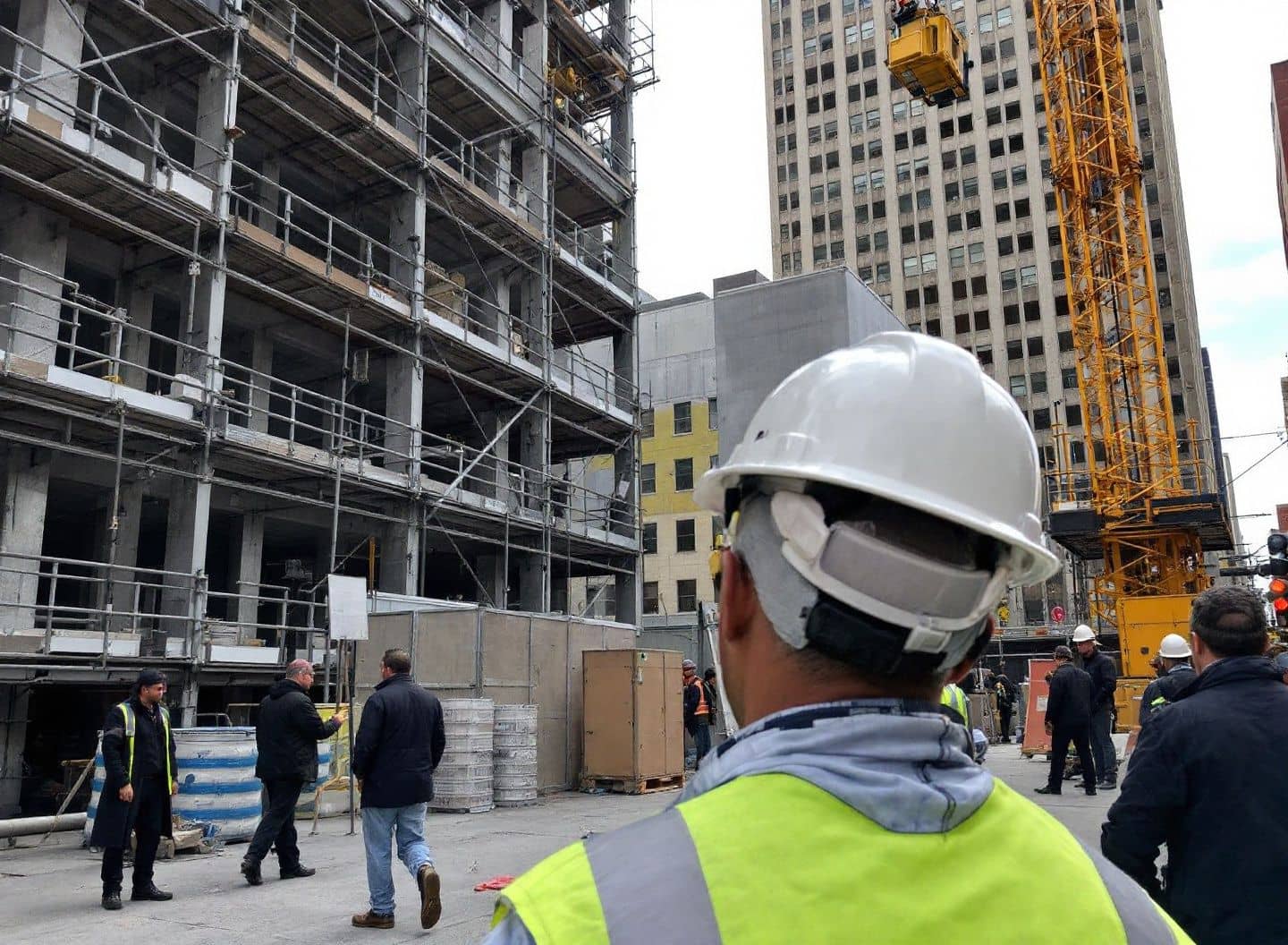
Forklifts move materials that workers simply can't carry by hand: steel beams, concrete blocks, pallets of brick, bundled rebar. On a busy New York construction site, they're everywhere. And because they're everywhere, accidents involving them are disturbingly common. A forklift tip-over can crush the operator in seconds. A forklift traveling through a congested work zone can strike a laborer who had no warning the machine was moving. These aren't freak events. They're predictable consequences of how forklifts are used, how construction sites are organized, and, too often, how safety rules are ignored. If you or a family member was hurt in a forklift accident on a New York construction site, understanding the legal framework behind these injuries is the first step toward knowing your rights.
How Forklift Tip-Overs Actually Happen
A forklift's stability depends on something called the stability triangle, the three-point relationship between its two front drive wheels and a single rear pivot point. Every load the machine carries shifts that triangle. Raise the forks too high, turn too sharply with a heavy load, drive across uneven ground, or hit an unexpected curb, and the machine's center of gravity crosses outside the stability triangle. When that happens, the forklift tips. It doesn't tip slowly. Operators who try to jump clear are often struck by the overhead guard or pinned underneath the counterweight, which can weigh several thousand pounds.
On construction sites, tip-over risks multiply for reasons you don't see in warehouse environments. Ground surfaces are rarely level. Freshly poured concrete, compacted fill, wooden decking, and metal floor plates all have different load-bearing properties. Ramps built for material staging may not be engineered to the forklift's rated capacity. And sites are dynamic: the terrain that was solid yesterday may have been excavated or undermined overnight. Workers and supervisors who don't account for these changing conditions create the conditions for tip-overs to occur.
The Struck-By Hazard: A Different but Equally Serious Risk
Tip-overs get attention because they're dramatic, but struck-by accidents may actually be more frequent. A forklift traveling in reverse has limited rear visibility, especially when the operator is focused on a load that obscures the front. Workers on foot in the same zone may not hear the machine over construction noise. A momentary distraction, a poorly marked travel path, or the absence of a spotter can put a pedestrian worker directly in the forklift's path.
Falling loads are another struck-by mechanism that's easy to overlook. Forklifts carry materials above head height. When a load isn't properly secured, when forks are damaged, or when the operator brakes sharply, materials can slide forward off the forks and fall onto workers below or nearby. On multi-story construction sites, dropped loads from elevated platforms can reach workers on lower floors or at grade. The injuries from a falling load of concrete block or structural steel are severe and often permanent.
Which Trades Face the Greatest Exposure
Almost every trade on an active construction site shares space with forklifts at some point, but certain workers face disproportionate exposure. Ironworkers and concrete laborers often work directly in or adjacent to material staging areas where forklifts are constantly moving loads. Masons depend on forklifts to deliver block, mortar, and scaffolding components to their work area, and they're frequently on foot as deliveries happen. Carpenters receive lumber and form materials by forklift and may be working at low heights when a load passes overhead. And site laborers, whose tasks take them across the entire footprint of a project, are constantly crossing forklift travel paths without the benefit of a fixed work location they can identify as a safe zone.
Supervisors and foremen face their own elevated risk. Site management often involves walking the project to inspect work, which means they're moving through active forklift zones frequently throughout the day. They may also be the ones directing forklift operators, putting them in close proximity to the machines when loads are being positioned.
Federal Standards: 29 CFR 1926.300 and Powered Industrial Trucks
The federal Occupational Safety and Health Administration sets baseline safety requirements for construction sites through Title 29 of the Code of Federal Regulations. 29 CFR 1926.300 addresses general requirements for tools and equipment used on construction sites, including powered industrial trucks like forklifts. Under this framework, equipment must be maintained in safe operating condition, guards and safety devices must be functional, and operators must be trained and authorized. Employers who ignore these requirements aren't just violating a regulation; they're creating the specific mechanical and operational failures that lead to tip-overs and struck-by incidents.
OSHA's standards for powered industrial trucks in the construction context require that equipment be inspected before each shift, that rated load capacities not be exceeded, and that operators understand how to handle their specific machine under the specific site conditions they'll encounter. When an employer skips pre-shift inspections, doesn't train operators on site-specific hazards, or allows a damaged forklift to keep working, it creates a chain of causation that runs directly from the employer's decision to the worker's injury.
Hurt on a Construction Site?
Tell us what happened. A licensed New York attorney will review your case and call you — free, no obligation.
New York State Protections: Labor Law § 241(6) and 12 NYCRR 23-9
New York provides injured construction workers with protections that go beyond federal OSHA requirements, and for forklift accident victims, those protections are significant. Labor Law § 241(6) requires that construction, excavation, and demolition work be performed in a manner that protects workers, and it imposes a non-delegable duty on property owners and general contractors to comply with the safety regulations promulgated under the statute. That non-delegable duty is crucial. It means that even if the property owner had nothing to do with day-to-day forklift operations, it can still be held liable if a specific safety regulation was violated and that violation caused injury.
The specific regulations that give Labor Law § 241(6) claims their teeth in the construction context are found in 12 NYCRR 23-9, the part of the New York Industrial Code that addresses the use of equipment in construction, demolition, and excavation operations. 12 NYCRR 23-9 sets out rules for the safe operation of powered equipment on construction sites, including requirements around load limits, operator competence, and equipment condition. When a forklift tip-over or struck-by accident occurs and a violation of 12 NYCRR 23-9 can be identified, it provides the predicate violation needed to sustain a Labor Law § 241(6) claim against the owner and general contractor.
This matters practically because in many forklift accidents, the operator is employed by a subcontractor. Without Labor Law § 241(6), a worker who was struck by a forklift operated by a co-worker might have limited recovery options due to the workers' compensation bar against suing direct employers. But Labor Law § 241(6) opens the door to claims against the general contractor and property owner, who typically have greater resources and whose insurance coverage tends to be far more substantial than a small subcontractor's policy.
Site Conditions, Flooring, and the Forklift's Operating Environment
New York's construction safety rules touch on something that might seem unrelated to forklifts at first glance: flooring. Labor Law § 241 includes requirements that builders complete fireproof flooring as work progresses. This isn't just about fire safety in the traditional sense. The integrity of floor surfaces directly affects forklift stability. An incomplete or improperly constructed floor can give way under a loaded forklift, or create an uneven surface that shifts the machine's center of gravity unexpectedly. When floor conditions contribute to a forklift tip-over, the owner and contractor's obligations under Labor Law § 241 become directly relevant to the injury analysis.
Beyond flooring, site layout decisions affect forklift safety in ways that are entirely within the control of the general contractor. Designating separate pedestrian and vehicle travel paths, posting clear signage, requiring spotters when forklifts travel in congested areas, and enforcing speed limits for powered equipment are all practical measures that reduce the risk of struck-by accidents. When a general contractor fails to implement these measures and a worker is hurt, that failure becomes part of the legal story.
What Injured Workers Should Do After a Forklift Accident
The immediate priority after any forklift accident is medical treatment. That's true even when injuries don't seem severe at first. Crush injuries, internal trauma, and concussions can have delayed presentations, and gaps in medical care are regularly used to argue against the seriousness of an injury claim. Get evaluated, and be thorough in describing exactly how the accident happened and what part of your body was affected.
After medical care, documentation becomes critical. If you're able to do so safely, photographs of the forklift, the surface it was operating on, the load it was carrying, and the general layout of the work area are valuable. Witness names and contact information matter too, because memories fade and workers sometimes move to other jobs or other states. A coworker who saw the forklift tip or the load fall may be essential to proving what happened.
Report the accident formally through your employer. Workers' compensation requires notice of the injury, and a formal report creates a record that's harder to challenge later. Keep copies of everything. And consult with an attorney who handles construction accident cases in New York before you make any recorded statement to an insurance adjuster. Insurers are not on your side, and statements made without legal guidance can be used to limit your recovery.
The Value of a Forklift Injury Claim
Forklift accidents frequently cause serious, long-term injuries: crush injuries to the lower extremities, traumatic brain injuries, spinal damage, and in the worst cases, amputation or death. The value of any injury claim varies with the severity of the injury, the degree to which it affects the worker's ability to earn a living, the worker's age and occupation, and the strength of the evidence connecting the injury to a specific regulatory violation or act of negligence. Claims that involve clear violations of 12 NYCRR 23-9 or 29 CFR 1926.300 and serious permanent injuries can be substantially more valuable than claims where the violation is ambiguous and the injuries resolve quickly. There's no formula, and no honest attorney can guarantee an outcome, but thorough documentation and early legal involvement consistently produce better results than waiting.
Attorney Advertising. Prior results do not guarantee a similar outcome. This article is for general informational purposes only and does not constitute legal advice. NY Construction Advocate connects injured workers with experienced New York construction accident attorneys.
Primary sources
Frequently Asked Questions
Can I sue someone other than my employer if I was hurt by a forklift on a construction site?▼
What does 12 NYCRR 23-9 actually require for forklifts on construction sites?▼
What is the OSHA standard that applies to forklifts on construction sites?▼
Does it matter if I was partially at fault for the forklift accident?▼
How long do I have to file a forklift injury claim in New York?▼
What if the forklift tip-over happened because the floor gave way or was uneven?▼
Get a Free Case Review
Find out if you have a claim under New York Labor Law. A licensed NY attorney will review your case and call you back.