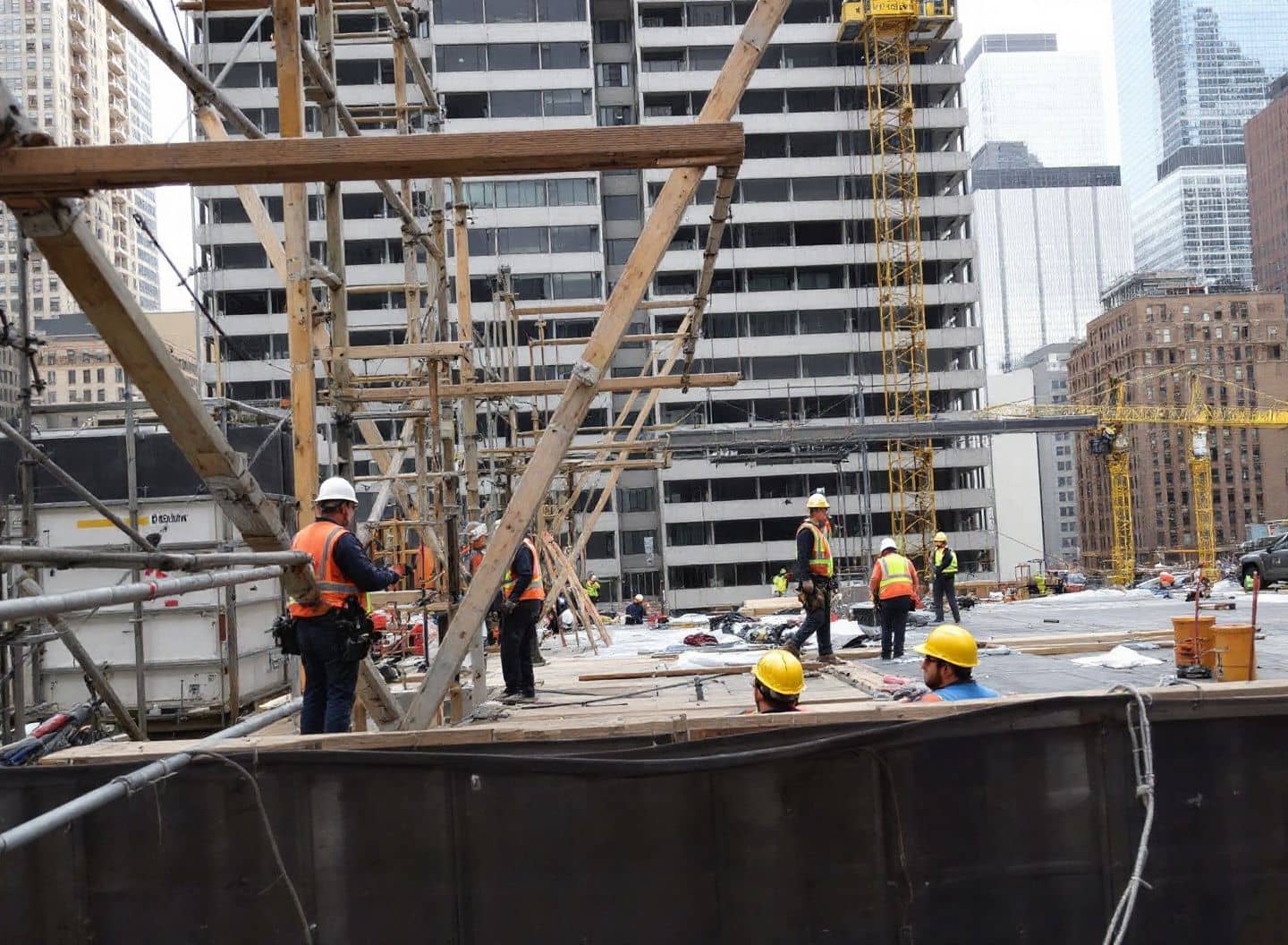
A worker falls from scaffolding. A laborer is struck by falling debris. An electrician is injured when an unguarded machine activates without warning. In each scenario, New York law gives injured workers meaningful legal rights. But behind the scenes, the parties named as defendants are often fighting their own battle: which of them is ultimately responsible for paying, and how much? The answer turns, in large part, on the indemnification clauses buried in construction contracts and on a statute that limits how far those clauses can reach, General Obligations Law § 5-322.1.
The Basic Structure of a New York Construction Project
Most large construction projects in New York involve at least three layers: the property owner, a general contractor, and multiple subcontractors. Each layer hires the one below it through written contracts. Those contracts almost always contain indemnification clauses, provisions that say one party agrees to hold another harmless and to pay for losses, legal fees, and judgments that arise from specified events. On paper, this looks like a clean allocation of risk. In practice, when someone is seriously hurt, these clauses become intensely contested.
Owners and general contractors routinely insist that subcontractors indemnify them for any claim arising out of the subcontractor's work. The logic is straightforward: if your workers or your operations caused the problem, you should bear the cost. That logic is not always wrong, but it becomes legally problematic when the indemnification clause tries to force a subcontractor to cover losses caused entirely by the owner's or general contractor's own negligence.
What General Obligations Law § 5-322.1 Actually Does
New York's General Obligations Law § 5-322.1 draws a hard line. It voids any construction contract provision that purports to indemnify or hold harmless a party from liability for damages arising from that party's own negligence. The statute applies to contracts for construction, excavation, demolition, repair, or improvement of real property. It's a consumer and worker protection measure written into the law specifically because courts recognized that powerful general contractors and owners were requiring smaller subcontractors to sign away all indemnification rights, including coverage for situations the subcontractor had nothing to do with causing.
Here's how it plays out in a real claim. A general contractor fails to maintain a safe walking surface on the job site. A subcontractor's employee is injured. The general contractor points to the indemnification clause in the subcontract and says the subcontractor must defend and indemnify them. Under § 5-322.1, that clause is void to the extent it requires the subcontractor to indemnify the general contractor for the general contractor's own negligence. If the subcontractor was also partly at fault, partial indemnification may still be enforceable. But the statute prevents a complete transfer of liability for someone else's wrongdoing.
Courts interpret § 5-322.1 closely. The key word in most disputes is 'caused by or resulting from the negligence of the indemnitee.' If the clause is drafted to require indemnification regardless of fault, it will typically be struck down. If it's drafted to require indemnification only to the extent of the indemnitor's own negligence, courts generally uphold it. This distinction matters enormously in litigation, and it's one reason why construction attorneys spend considerable time analyzing contract language before trial.
Labor Law § 200 and the Employer's Duty of Care
Before examining how indemnification claims play out between defendants, it helps to understand the underlying liability framework. Labor Law § 200 codifies the general duty to protect workers. Under that statute, every employer and every owner or general contractor who directs or controls work at a construction site must ensure that the site is constructed, equipped, arranged, operated, and conducted to provide reasonable and adequate protection to employees and lawful visitors. Machinery and equipment must be properly positioned, operated, guarded, and illuminated.
Labor Law § 200 claims typically fall into two categories. The first involves dangerous site conditions, where the owner or contractor knew or should have known about a hazard. The second involves the means and methods of work, where a supervisor or contractor directly controlled how the injured worker performed the task that caused the injury. These distinctions matter because they shape who, among the defendants, faces primary liability and who then seeks indemnification.
Federal safety law reinforces these state obligations. Under 29 CFR 1926.20, employers engaged in construction work are required to establish and maintain accident-prevention programs that include frequent and regular inspections of job sites, materials, and equipment. Failure to meet those inspection requirements can support both regulatory liability and civil claims, and it feeds directly into the question of who was negligent, which in turn determines how indemnification clauses are applied.
Trade-Specific Risks and How Indemnity Shifts Accordingly
Different construction trades carry different injury patterns, and those patterns shape how indemnification claims are contested. Consider the following scenarios, each illustrating a distinct mechanism of injury and a distinct indemnification question.
Hurt on a Construction Site?
Tell us what happened. A licensed New York attorney will review your case and call you — free, no obligation.
Ironworkers and structural steel installers face falls from significant heights. If a general contractor controls the fall-protection plan and fails to ensure adequate anchoring points, the general contractor's negligence is a direct contributing cause. A subcontract requiring the ironworker's employer to indemnify the general contractor for that failure would be void under § 5-322.1. But if the ironworker's employer independently chose to skip a step in the fall-protection protocol, that employer may owe partial indemnification to the owner based on its own share of fault.
Electricians work with energized systems and in confined spaces. An injury caused by an unguarded electrical panel, a hazard that 12 NYCRR 23-1.5 requires to be addressed through site-specific safety rules, raises questions about who controlled access to that panel. If the general contractor maintained exclusive control over that area of the site, attempts to shift the entire loss to the electrical subcontractor through indemnification will run into both § 5-322.1 and the factual record showing the general contractor's control.
Laborers and demolition workers face hazards from falling debris, collapsing structures, and equipment malfunctions. Under 12 NYCRR 23-1.5, safety rules governing these conditions are mandatory in all construction, demolition, and excavation work. Violations of those rules, or of the general safety obligations in Labor Law § 200, establish the foundation for negligence claims that then ripple into indemnification disputes.
How Insurance Interacts With Contractual Indemnity
Indemnification clauses rarely operate in isolation. They're almost always paired with additional insured requirements. A typical construction subcontract requires the subcontractor to name the owner and general contractor as additional insureds on the subcontractor's commercial general liability policy. This means the subcontractor's insurer may be required to defend and indemnify the owner or general contractor for claims arising from the subcontractor's work, even before a court determines who was actually at fault.
The interplay between additional insured coverage and § 5-322.1 creates friction. Insurance policies sometimes provide broader coverage than the underlying contract permits. Courts have had to resolve whether an insurer's obligation as an additional insured can exceed what the contract itself allows after § 5-322.1 is applied. Additional-insured coverage depends on the insurance policy and applicable law; General Obligations Law § 5-322.1 does not itself invalidate an insurance contract.
For injured workers, this means the pool of available coverage is often larger and more complex than it appears. Multiple insurers, multiple defendants, and multiple contracts may all bear on who ultimately funds a recovery. The value of any claim varies with the severity of the injury, the extent of lost earning capacity, and the degree of negligence attributable to each party.
What Injured Workers Need to Know About These Disputes
Workers injured on New York construction sites don't typically need to understand every nuance of § 5-322.1 to pursue a claim. But they benefit when their legal team does. Here's why: the indemnification battles between defendants can affect how aggressively each party defends the case. A general contractor that believes it's fully indemnified by a solvent subcontractor may litigate differently than one that knows it's holding significant uninsured exposure. Understanding those dynamics helps a plaintiff's attorney position the case more effectively.
Workers should also know that their employer's workers' compensation coverage doesn't end the story. Workers' compensation bars a direct suit against the employer in most situations, but it doesn't prevent claims against owners, general contractors, and other third parties. Those third parties may then seek indemnification from the employer. The result is a web of claims that runs parallel to the injured worker's own case, and it's resolved by courts looking carefully at the language of the contracts and the facts of the accident.
Documenting what happened matters from day one. Which contractor controlled the area where the injury occurred? Who directed the injured worker's tasks? Who was responsible for inspecting equipment under 29 CFR 1926.20? Who failed to implement the safety protocols required by 12 NYCRR 23-1.5? The answers to those questions determine not just who is liable to the worker, but how indemnification obligations are eventually allocated among the defendants.
Why Courts Take § 5-322.1 Seriously
Courts applying § 5-322.1 aren't doing so reluctantly. The legislature enacted the statute because it recognized a market failure: subcontractors, often smaller and less powerful than the general contractors and owners above them in the chain, were being required to absorb liability that wasn't theirs to bear. Enforcing those clauses would have insulated powerful parties from the consequences of their own unsafe practices, which is precisely the opposite of what Labor Law § 200 and related statutes are designed to achieve.
The practical effect is that safety responsibility can't be contracted away entirely. Even if a subcontract says the subcontractor is responsible for everything, New York law ensures that owners and general contractors who were actually negligent remain on the hook for their share. That accountability is what drives safety investment. When parties know they can't simply pass all risk downstream, they have stronger incentives to maintain safe sites, conduct the inspections required by 29 CFR 1926.20, and comply with the protections mandated by 12 NYCRR 23-1.5 and Labor Law § 200.
Attorney Advertising. Prior results do not guarantee a similar outcome. This article is for general informational purposes only and does not constitute legal advice. NY Construction Advocate connects injured workers with experienced New York construction accident attorneys.
Primary sources
Frequently Asked Questions
What is an indemnification clause in a New York construction contract?▼
Does General Obligations Law § 5-322.1 completely void indemnification clauses in construction contracts?▼
Can a general contractor require a subcontractor to name it as an additional insured even after § 5-322.1 limits indemnification?▼
How does Labor Law § 200 connect to indemnification disputes between contractors?▼
If a worker's employer is protected by workers' compensation, can other defendants still seek indemnification from that employer?▼
What documentation helps resolve indemnification disputes after a construction accident?▼
Get a Free Case Review
Find out if you have a claim under New York Labor Law. A licensed NY attorney will review your case and call you back.