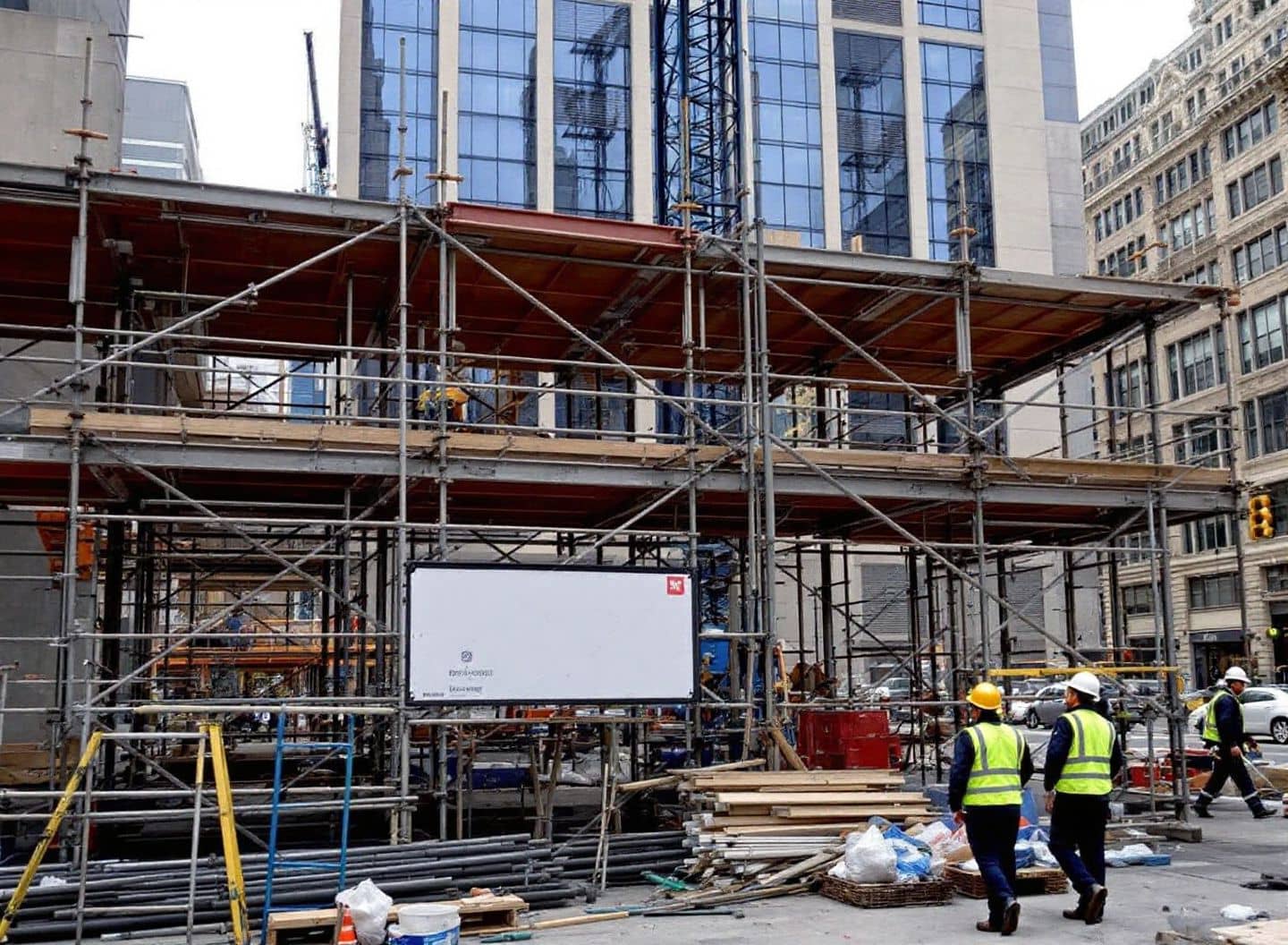
Walk any active construction site in New York City and you'll hear Spanish, Mandarin, Creole, Polish, Bengali, and a dozen other languages before you hear English. That's not an exaggeration. The construction trades in New York are among the most linguistically diverse workplaces in the country, and that diversity is a source of genuine strength. But it also creates a serious, and frequently overlooked, safety problem: when warning signs, safety briefings, toolbox talks, and equipment instructions are delivered only in English, workers who don't read or speak English fluently are left to guess at what those warnings mean. Sometimes they guess wrong. That's when people get hurt.
This article explains how language barriers contribute to construction accidents, what New York law requires of employers and site controllers, and why a failure to communicate safety instructions in a worker's primary language can expose owners, general contractors, and subcontractors to significant legal liability.
How Language Gaps Translate Into Physical Harm
Construction injury is rarely random. There's almost always a breakdown somewhere in the chain of information that should have protected a worker. Language barriers are one of the most direct and underappreciated links in that chain. Think about what a worker actually needs to understand to stay safe on a job site: the load limits of a scaffold they're about to climb, the lockout/tagout procedure for a piece of machinery, the fall protection protocol at an open floor edge, the chemical hazards in a coating they're applying in an enclosed space. All of that information is typically communicated through written safety plans, verbal briefings, posted signage, and equipment warning labels. If those communications are in English only, a worker who primarily speaks Spanish or Punjabi or Russian has no reliable way to absorb them.
The mechanism of injury follows a predictable pattern. A worker doesn't understand that a particular scaffold tier hasn't been fully planked, so they step onto what they believe is a solid work surface and fall through. A worker misses the safety briefing about an overhead crane's swing radius because the foreman gave it only in English, and they're struck by a moving load. A worker applies a chemical product without protective equipment because the hazard label was never translated and no one explained it verbally in their language. In each case, the root cause isn't carelessness on the part of the worker. It's a failure of communication that the employer or site controller had the power and the legal obligation to prevent.
Falls from height are the single most common cause of fatal construction injuries in New York, and they're particularly linked to language-related miscommunication. Scaffolding, ladders, and elevated platforms all involve specific protocols that workers must understand and follow precisely. A worker who doesn't understand the verbal instruction 'don't step beyond the red tape' is at far greater risk than one who hears and understands it. The trade-specific risk is real: ironworkers, carpenters, roofers, and laborers who work at elevation face the most acute danger when safety communication breaks down.
The Federal Baseline: What OSHA Requires
At the federal level, construction safety is governed in part by 29 CFR 1926.20, which sets out general safety and health provisions for construction work. Under that standard, employers are required to initiate and maintain programs for the frequent and regular inspection of job sites, materials, and equipment by competent persons. Critically, OSHA has taken the position that safety training must be conducted in a language workers understand. A training session delivered only in English to a crew that speaks primarily Spanish doesn't satisfy the employer's obligation under OSHA's framework, even if the session is otherwise thorough and well-run. The purpose of training is comprehension, and comprehension requires that workers actually understand what's being communicated.
OSHA's Hazard Communication Standard separately requires that safety data sheets and chemical hazard information be accessible to workers, which in practice means accessible in a language they can read and understand. But the core principle, the one that matters for any kind of hazard on a job site, is that safety information has to actually reach the worker in a meaningful way. Posting a sign or handing out a pamphlet in English to a crew that reads Spanish doesn't meet that bar.
New York's Labor Law Framework and What It Adds
New York has some of the most worker-protective construction safety laws in the country, and they matter enormously in cases where language barriers contribute to injury. Two provisions are especially relevant.
Labor Law § 240, often called the Scaffold Law, places a nondelegable duty on owners and general contractors to provide proper scaffolding, hoists, ladders, and other safety devices for workers engaged in construction, renovation, repair, and related activities. If a required safety device was absent or inadequate in violation of § 240(1) and that violation proximately caused a covered elevation-related injury, a covered owner or contractor may be liable regardless of whether they were personally negligent, and the worker's comparative fault is no defense. There is no recovery if adequate devices were available, the worker knew both that they were available and that he or she was expected to use them, chose for no good reason not to use them, and would not have been injured had they used them. In the language-barrier context, § 240(1) turns on whether the safety devices were constructed, placed, and operated to give proper protection, not on whether a safety briefing was given or understood, so a failure to instruct is not by itself a § 240(1) violation.
The second critical provision is New York's Industrial Code, 12 NYCRR Part 23, which sets safety rules for construction, demolition, and excavation work. Section 23-1.5 states general employer responsibilities and is not itself a § 241(6) predicate. Labor Law § 241(6) places non-delegable duties on owners and general contractors to comply with the Industrial Code, but a claim requires a specific applicable Industrial Code subsection, negligence by a party in the work chain, and proximate cause; comparative fault may reduce recovery. A language-related failure can matter under § 241(6) only when it is tied to the violation of such a specific subsection.
Liability: Who Bears Responsibility When Communication Fails
Hurt on a Construction Site?
Tell us what happened. A licensed New York attorney will review your case and call you — free, no obligation.
One of the most important things an injured worker should understand is that liability in New York construction cases is rarely limited to a single party. General contractors control the day-to-day operations of a job site and typically have the authority to require subcontractors to conduct safety communications in multiple languages. If a general contractor knew, or should have known, that a significant portion of the workforce didn't speak English and failed to require language-appropriate safety training, that's a form of negligence. Property owners who hire contractors for construction work can also be liable under Labor Law § 240 and Labor Law § 241(6), even if they weren't present on the site every day.
Subcontractors who directly employ workers have their own obligations. If a subcontractor runs a toolbox talk in English only and then sends a Spanish-speaking crew to work at elevation without fall protection equipment they didn't understand they needed to use, that subcontractor has failed in a basic duty of care. The fact that the worker was an experienced construction laborer doesn't eliminate the employer's responsibility to communicate the specific hazards of a specific job in a way the worker can understand. Experience doesn't substitute for information about conditions that change from site to site and day to day.
It's worth noting that immigration status does not bar a Labor Law claim, though it may affect proof or calculation of lost wages. The protections of Labor Law § 240 and the industrial code apply to all workers performing covered construction work, regardless of documentation status. Any suggestion that an injured worker's immigration status diminishes their legal rights is incorrect under New York law.
Practical Failures That Show Up in These Cases
When construction injury cases involve language barriers, certain patterns of failure tend to appear. Safety plans are written in English and never translated, even when the workforce is predominantly non-English speaking. Foremen who don't speak the workers' language are assigned to supervise those workers without any interpreter or translation support. Warning signs are posted only in English in areas where non-English-speaking workers regularly operate. Equipment manuals and operating instructions are provided in English only. Pre-shift briefings are conducted in English with no interpreter and no subsequent check to confirm that non-English-speaking workers understood the content.
Each of these failures, standing alone or in combination, can contribute directly to an accident. And each of them is preventable. Translation of key safety documents is not technologically difficult or prohibitively expensive. Bilingual foremen, safety officers, or interpreters can be scheduled for crews where language differences are known. Visual safety communication, like properly designed signage with clear diagrams, can supplement verbal instruction. The failure to take these steps isn't an oversight. It's a choice, and when that choice results in injury, the legal system takes it seriously.
What Injured Workers Should Know About Their Rights
If you were injured on a New York construction site and believe a language barrier contributed to the accident, several things are worth knowing. First, you have the right to report the accident and seek workers' compensation regardless of whether you speak English. Workers' compensation is a no-fault system, meaning you don't need to prove that anyone was negligent to receive benefits for medical treatment and lost wages. Second, workers' compensation is not your only potential source of recovery. If a third party, such as a general contractor, property owner, or another subcontractor, contributed to your injury through negligence or a violation of New York Labor Law, you may have a separate personal injury claim against those parties. The value of such a claim varies with the severity of the injury, the degree of fault, and the specific circumstances of the accident.
Third, the time to act is limited. New York has statutes of limitations that govern how long an injured worker has to file a claim. Claims against certain defendants, like municipal entities, have even shorter notice requirements. Don't wait to get legal advice. The evidence that proves a language barrier contributed to your accident, things like safety briefing records, the languages in which warning signs were posted, and the makeup of the crew, can disappear or become harder to obtain as time passes.
The Bigger Picture: Why This Problem Persists
Language barriers on construction sites aren't a new problem, and the law hasn't been silent about them. Yet the gap between what the law requires and what actually happens on job sites remains wide. Part of the reason is economic pressure: providing translation services costs money, and in an industry with thin margins and aggressive timelines, safety investments are often the first to be cut. Part of it is also a power imbalance. Workers who are non-English speaking are often also newer to the country, less familiar with their legal rights, and more vulnerable to implicit or explicit pressure not to report hazards or complain about working conditions.
New York's Labor Law was designed in part to address exactly this kind of structural imbalance. By making covered owners and contractors liable when a § 240(1) violation proximately causes an elevation-related injury, the Legislature made a deliberate choice to shift the economic risk of inadequate safety from the worker who is most exposed to the harm, to the parties who have the most control over site conditions and the most ability to prevent injury. When language barriers are the root cause of that inadequate safety, the same principle applies.
Understanding your rights is the first step. If you or someone you know was injured on a New York construction site and language played a role in what happened, speaking with an attorney who handles construction accident cases is essential. NY Construction Advocate is here to provide educational resources to help workers and their families understand the legal framework that applies to their situation.
Frequently Asked Questions
Attorney Advertising. Prior results do not guarantee a similar outcome. This article is for general informational purposes only and does not constitute legal advice. NY Construction Advocate connects injured workers with experienced New York construction accident attorneys.
Primary sources
Frequently Asked Questions
Does New York law require construction employers to provide safety training in languages other than English?▼
Can a worker injured because of a language barrier sue the property owner, not just their direct employer?▼
Does it matter that the worker signed a safety acknowledgment form they couldn't fully read?▼
What kinds of evidence help establish that a language barrier contributed to a construction accident?▼
Does a worker's immigration status affect their right to bring a construction injury claim in New York?▼
Are scaffolding accidents particularly common when language barriers are involved, and why?▼
Get a Free Case Review
Find out if you have a claim under New York Labor Law. A licensed NY attorney will review your case and call you back.