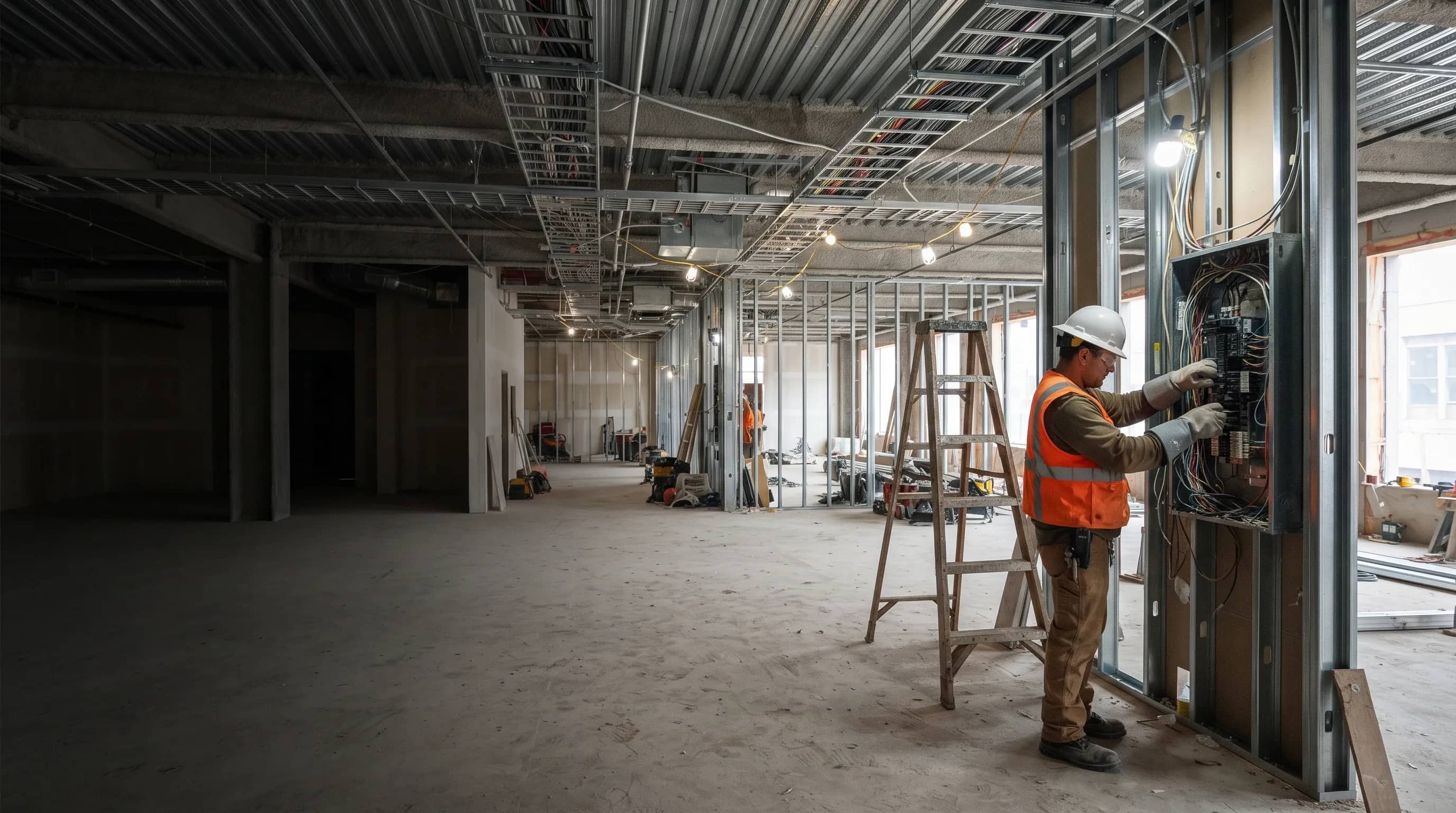
An electrician hurt on a New York construction site usually has a workers' compensation claim against their own employer and may also have a lawsuit against the owner and general contractor. Which law applies depends on how the injury happened: a fall from a ladder or lift points to Labor Law 240(1), while a shock or burn from a live circuit usually points to Labor Law 241(6).
How do electricians usually get hurt on construction sites?
Electrical work puts people close to two hazards at once: energized equipment and height. Most serious injuries come from one of three situations.
The first is a shock from a circuit that should have been dead. An electrician opens a panel or cuts into a wall believing the circuit has been shut off, and it has not, or someone else turns it back on while the work is underway. On renovation jobs, old wiring that does not match any drawing makes this more likely.
The second is a burn. An arc flash at a panel or switchgear can cause serious burns in a fraction of a second, and contact injuries leave burns where current enters and leaves the body. For more on that mechanism, see our guide to arc flash burns on New York construction sites.
The third is a fall. Electricians spend much of the day on stepladders, extension ladders, scissor lifts and scaffolds, pulling wire through ceilings and mounting fixtures. A ladder that shifts, a platform with no guardrail, or a shock that knocks someone off balance can all end in a fall, and the fall is often what causes the worst injury.
Knowing which of these happened matters, because New York law treats them differently.
What does New York's Industrial Code require around live circuits?
The New York Industrial Code has a rule written for electrical hazards: 12 NYCRR 23-1.13. Two parts of it come up most often after an electrician is hurt.
Under subdivision (b)(3), before work begins the employer has to find out, by asking, by looking or by using instruments, whether any electric power circuit, exposed or concealed, is located where the work could bring a person, tool or machine into contact with it. Where such a circuit exists, the employer must post warning signs and tell employees where the lines are, what the hazards are and what protective measures to take.
Subdivision (b)(4) sets the core requirement. An employer may not let an employee work so close to any part of an electric power circuit that the employee could contact it, unless the employee is protected against shock. The rule names how: by de-energizing the circuit and grounding it, or by guarding the circuit with effective insulation or other means.
Other parts of the same rule require that open switches be guarded against being closed while workers are exposed, and that the utility be notified in writing before work within ten feet of a live overhead line.
Federal OSHA has a parallel requirement at 29 CFR 1926.416(a)(1), which uses almost the same words: no work close enough to contact a circuit unless the employee is protected by de-energizing and grounding it or guarding it with insulation. OSHA rules are enforced against employers by OSHA. A lawsuit in a New York court is usually built on the state Industrial Code instead.
How does Labor Law 241(6) apply to a shock or burn?
Labor Law § 241(6) requires owners and contractors to provide reasonable and adequate protection to people working on construction, excavation and demolition sites, and it is enforced through specific Industrial Code rules. To bring a claim, an injured worker has to identify a specific rule that applied, show it was violated, and show the violation was a proximate cause of the injury.
For an electrical injury, 23-1.13(b)(4) is the kind of concrete command these claims rely on, because it states exactly what protection was required: de-energize and ground the circuit, or guard it. If an electrician was sent to work on or next to a live circuit with neither, the rule gives the claim its footing. Whether the rule fits a particular accident still depends on the facts, such as whether the work counted as construction, whether the employee was actually exposed to the circuit, and what the employer knew.
A § 241(6) claim rests on negligence, so New York's comparative fault rule applies. Under CPLR 1411, a worker's own share of fault does not bar the claim, but it reduces the recovery in proportion. If the electrician skipped a lockout step they were responsible for, for example, a jury could assign part of the fault to them. Our article on lockout/tagout failures covers that issue in more detail.
When does Labor Law 240 cover an electrician's fall?
Hurt on a Construction Site?
Tell us what happened. A licensed New York attorney will review your case and call you — free, no obligation.
Labor Law § 240(1) requires owners and contractors to provide ladders, scaffolds, lifts and other devices that give proper protection to workers exposed to elevation-related risks. When a device fails to give that protection and that failure is a proximate cause of a fall, the owner and contractor are responsible, and the worker's own carelessness does not reduce the recovery. If the worker's own conduct was the sole proximate cause, the claim fails.
Electricians often fall after a shock, which raises a harder question: was the fall caused by a ladder that did not protect them, or by the shock alone? In Nazario v. 222 Broadway (2016), a worker received a shock while on an A-frame ladder and fell. The Court of Appeals held that he was not entitled to summary judgment under § 240(1), because there were questions of fact about whether the ladder failed to provide proper protection and whether he should have been given additional safety devices.
The practical lesson is that a fall after a shock is not automatically a § 240(1) case. The facts about the ladder or lift carry the claim: whether it was secured, whether it was the right height for the work, whether it moved, and whether anything like a harness or a lift with a guardrail should have been provided. A worker in this situation will often have both a § 240(1) claim for the fall and a § 241(6) claim for the shock.
Who can an injured electrician sue?
In most cases an electrician cannot sue their own employer, the electrical subcontractor that hired them. Workers' compensation covers medical treatment and part of lost wages instead. Under Workers' Compensation Law § 11, other defendants can bring the employer into the case only in limited situations: when the worker suffered a "grave injury," a short list that includes death, amputation of an arm, leg, hand or foot, total and permanent blindness, and certain brain injuries causing permanent total disability, or when the employer agreed in a written contract before the accident to indemnify that party. Our guide to the grave injury rule explains how that works.
The lawsuit is usually against other parties: the property owner, the general contractor or construction manager, and any other contractor whose crew created the hazard, such as a trade that re-energized a circuit without warning. Labor Law §§ 240 and 241 place their duties on owners and contractors, which is why these parties are the usual defendants even when they did not do the electrical work.
If the job was on property owned by a city, a county, NYCHA or the State, a notice deadline applies. The deadline to give notice of a claim against those public owners is generally 90 days from the injury, far sooner than the ordinary lawsuit deadline. See the 90-day notice of claim trap for details.
What should an electrician do after an injury on the job?
Get medical care first, and tell the provider exactly what happened, including whether you were shocked. Electrical injuries can affect the heart and nerves in ways that are not obvious on the first day.
Then preserve what you can while the site still looks the same:
Circuits get fixed and ladders get moved quickly after an accident. A lawyer who handles New York Labor Law cases can review whether 23-1.13, § 240(1) or both apply, and which parties had the duty to comply. Our page on electricians and construction injuries has more on the trade.
Attorney Advertising. Prior results do not guarantee a similar outcome. This article is for general informational purposes only and does not constitute legal advice. NY Construction Advocate connects injured workers with experienced New York construction accident attorneys.
Primary sources
Frequently Asked Questions
Can an electrician sue after being shocked on a New York construction site?▼
Does Labor Law 240 apply if I was shocked and fell off a ladder?▼
What does 12 NYCRR 23-1.13 require?▼
Does my own mistake reduce what I can recover?▼
Who is responsible if another trade turned the power back on?▼
How soon do I need to act if the job was on public property?▼
Get a Free Case Review
Find out if you have a claim under New York Labor Law. A licensed NY attorney will review your case and call you back.