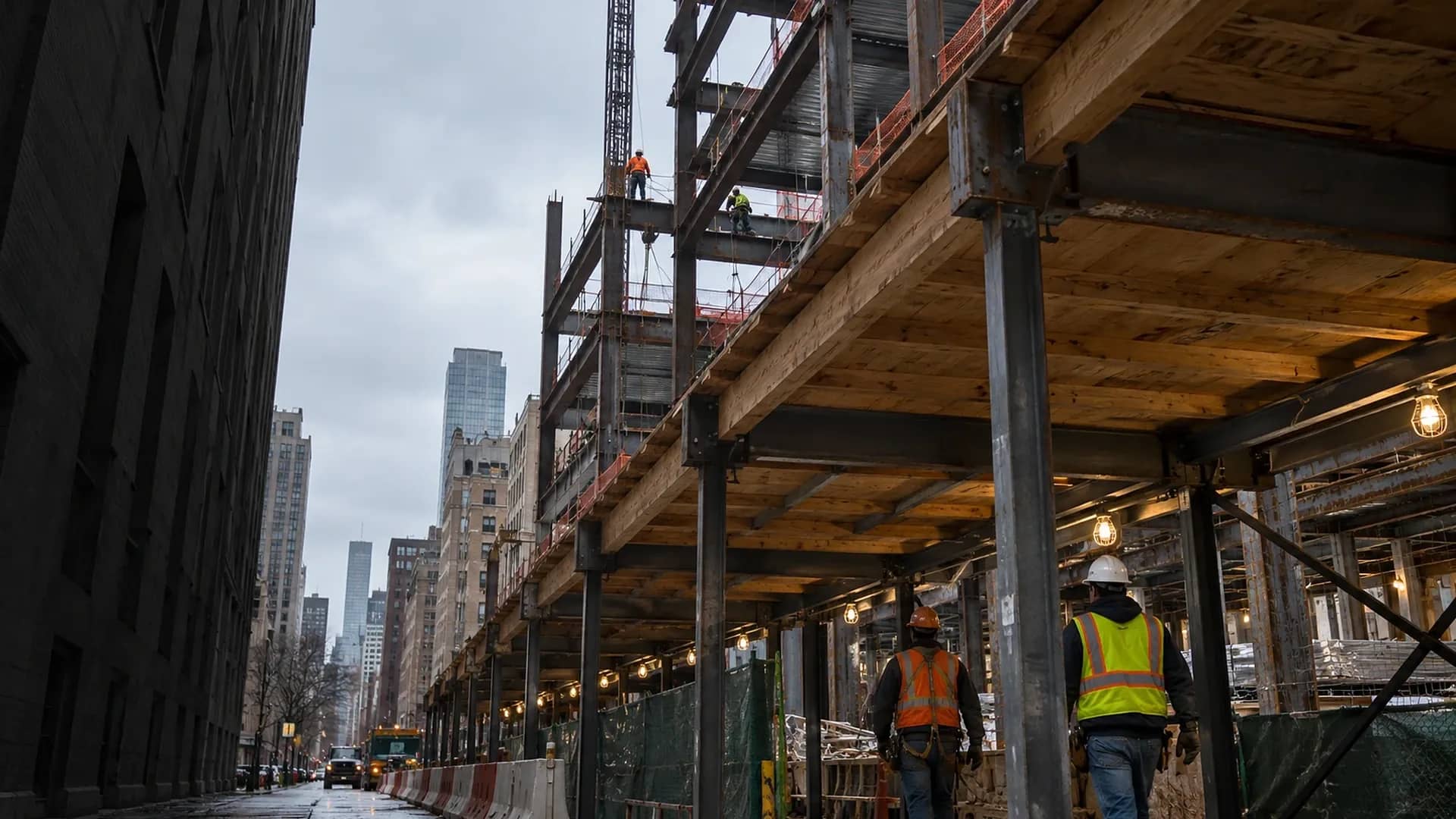
New York requires suitable overhead protection wherever construction workers must work or pass through an area normally exposed to falling material or objects. The requirement comes from Industrial Code rule 12 NYCRR 23-1.7(a). When an owner or contractor ignores it and a worker below is hurt, Labor Law § 241(6) can support a claim, although the worker's own share of fault can reduce what they recover.
What counts as an overhead hazard on a construction site?
An overhead hazard is any spot where something can come down on the people working below. On a busy site that covers a lot of ground: the area under a floor where steel is being bolted up, the path beside a wall that masons are building, the ground below formwork being stripped, the zone under a hoisting route, and the sidewalk edge of a demolition job. Tools slip out of hands, bundles shift on a pick, fasteners roll off an unprotected edge, and debris breaks loose during demolition.
What makes these spots dangerous is that the work is stacked. Different crews work at different levels at the same time, and the people below usually cannot see what is happening above them or hear a warning over the noise of the site. Even a small object gains a great deal of speed over a few floors, and a strike to the head, neck or shoulders can cause brain injury, spinal injury or fractures. A hard hat lowers the risk of a serious head injury. It does nothing to stop the object from falling in the first place. For more on how these strikes happen, see falling object accidents.
What does 12 NYCRR 23-1.7(a) require?
Rule 23-1.7 of the New York Industrial Code covers protection from general hazards, and subdivision (a) deals with overhead hazards. The Industrial Code is issued by the New York State Department of Labor. Subdivision (a) has two parts, and the difference between them matters.
Paragraph (a)(1) applies to every place where people are required to work or pass that is normally exposed to falling material or objects. Those places must have suitable overhead protection. The rule spells out what that means: tightly laid sound planks at least two inches thick full size, tightly laid three-quarter-inch exterior grade plywood, or another material of equivalent strength, carried on a supporting structure capable of holding a load of 100 pounds per square foot.
Paragraph (a)(2) covers a different situation: areas exposed to falling material where people are lawfully present but employees are not required to work or pass. There, the rule calls for barricades, fencing or the equivalent to keep people from wandering in by accident.
Two practical points follow from the text. First, the trigger is about exposure that is a normal feature of the location, so whether a particular spot qualifies depends on the facts of the site, the work going on above it, and how often material could reach it. Second, the protection the rule describes is physical: planking or plywood on a structure that can carry a stated load. The rule's text does not mention hard hats as a way of meeting it.
How does Labor Law § 241(6) turn a code violation into a claim?
Labor Law § 241(6) requires that all areas where construction, excavation or demolition work is being performed be constructed, shored, equipped, guarded, arranged, operated and conducted so as to provide reasonable and adequate protection and safety to the people employed there or lawfully frequenting those places. It lets the Commissioner of Labor make rules to carry that out, and the Industrial Code is where those rules live.
The duty falls on contractors and owners and their agents. The statute's only carve-out for owners is for owners of one- and two-family dwellings who contract for the work but do not direct or control it. For other owners, and for general contractors, the duty does not disappear because a subcontractor's crew was doing the work overhead.
A § 241(6) claim is not built on a general complaint that the site felt unsafe. The injured worker has to point to a specific Industrial Code rule that applied to the situation, show that it was violated, and show that the violation was a proximate cause of the injury. For a worker hit by something falling from above, 23-1.7(a) is usually the rule that does that work, because it sets out concrete requirements a court can measure the site against. Our article on which Industrial Code rules are specific enough to support a 241(6) claim explains that test.
Does the injured worker's own carelessness matter under § 241(6)?
Yes. A § 241(6) claim rests on negligence, so New York's comparative fault rule applies to it. Under CPLR 1411, in any action for personal injury, the injured person's own culpable conduct does not bar recovery, but the damages are reduced in proportion to that person's share of the fault.
In practice, that means the defense can argue that the worker contributed to the accident. Examples include stepping past a barricade, ignoring a posted warning, or cutting through an area the crew had been told to avoid during a pick. If a jury agrees, it assigns the worker a percentage of the fault and the award is reduced by that percentage. The claim does not end simply because the worker made a mistake, but the worker's conduct is part of the case and should be expected to come up. See how your own mistake can reduce a New York construction injury award.
This is one reason the facts around the accident matter so much. Whether the worker was directed to be in that spot, whether there was any reasonable alternative route, and whether a barricade or warning was actually in place are all questions that bear on how fault gets divided.
Hurt on a Construction Site?
Tell us what happened. A licensed New York attorney will review your case and call you — free, no obligation.
What does federal OSHA require for falling-object protection?
Federal rules address the same hazard separately. Under 29 CFR 1926.501(c), when an employee is exposed to falling objects, the employer must have each employee wear a hard hat and must also use one of three measures: erect toeboards, screens or guardrail systems to keep objects from falling from higher levels; erect a canopy structure and keep objects far enough from the edge that they would not go over if displaced; or barricade the area where objects could fall, keep employees out of it, and keep objects back from the edge. For how these protections work on a site, see debris netting and toe boards.
The federal rule is useful for seeing what a protected site is supposed to look like, and like the state rule, it treats physical protection as the main defense: a hard hat is required, but it is never the whole answer. OSHA standards are enforced by OSHA against employers. A § 241(6) claim, by contrast, is built on the New York Industrial Code, which is why the state-court analysis of an overhead injury usually centers on 23-1.7(a).
Can a falling-object injury also be a Labor Law 240 claim?
Sometimes. Labor Law § 240(1) can apply when the object was being hoisted or secured, or needed to be secured for the work, and a device such as a hoist, sling or brace was missing or did not give proper protection, as the Court of Appeals held in Narducci v. Manhasset Bay Associates (2001). The violation still has to be a proximate cause of the injury. An object that simply falls from a surface, without being hoisted or needing to be secured, usually falls outside § 240(1), and that is where 23-1.7(a) and § 241(6) do most of the work. Our explainer on the falling-worker and falling-object branches of Labor Law 240 covers the difference.
Who can be responsible when something falls on a worker below?
Under § 241(6), the owner and the general contractor carry the duty to comply with the Industrial Code, along with their agents. A subcontractor that controlled the overhead work, or that was responsible for the planking, netting or barricades, may also face a claim for its own negligence. A Labor Law claim against these parties is separate from a workers' compensation claim through the injured worker's own employer.
Public owners add a deadline that catches people off guard. When the site is owned by a city, a county, NYCHA or the State, the deadline to give notice of the claim is generally 90 days from the injury, which is far sooner than most people expect. For cities and counties, the rule is General Municipal Law § 50-e. A court has discretion to allow late notice in some cases, but nobody should plan around that.
What should a worker do after being hit by something from above?
Get medical care first, and tell the provider exactly how the injury happened. Head and neck injuries do not always show their full effect on the first day, so follow-up visits matter.
Then make a record while the site still looks the way it did:
Sites change quickly after an accident, and planking or barricades that were missing can appear the next day. A lawyer who handles New York Labor Law cases can review whether 23-1.7(a) applied to the spot where you were hurt and which parties had the duty to comply with it.
Attorney Advertising. Prior results do not guarantee a similar outcome. This article is for general informational purposes only and does not constitute legal advice. NY Construction Advocate connects injured workers with experienced New York construction accident attorneys.
Primary sources
Frequently Asked Questions
Does 23-1.7(a) apply if I was not standing directly under the overhead work?▼
Is a hard hat enough to meet New York's overhead protection rule?▼
Can my own mistake reduce what I recover under Labor Law 241(6)?▼
Who is responsible if a subcontractor's crew dropped the object?▼
What is the difference between 23-1.7(a)(1) and 23-1.7(a)(2)?▼
How soon do I need to act if the site belonged to a city, county, NYCHA or the State?▼
Get a Free Case Review
Find out if you have a claim under New York Labor Law. A licensed NY attorney will review your case and call you back.